Optimize Book Descriptions for SEO + AI Search: Best Hacks
“Your book description isn’t a summary. It’s a sales tool.” —Joanna Penn
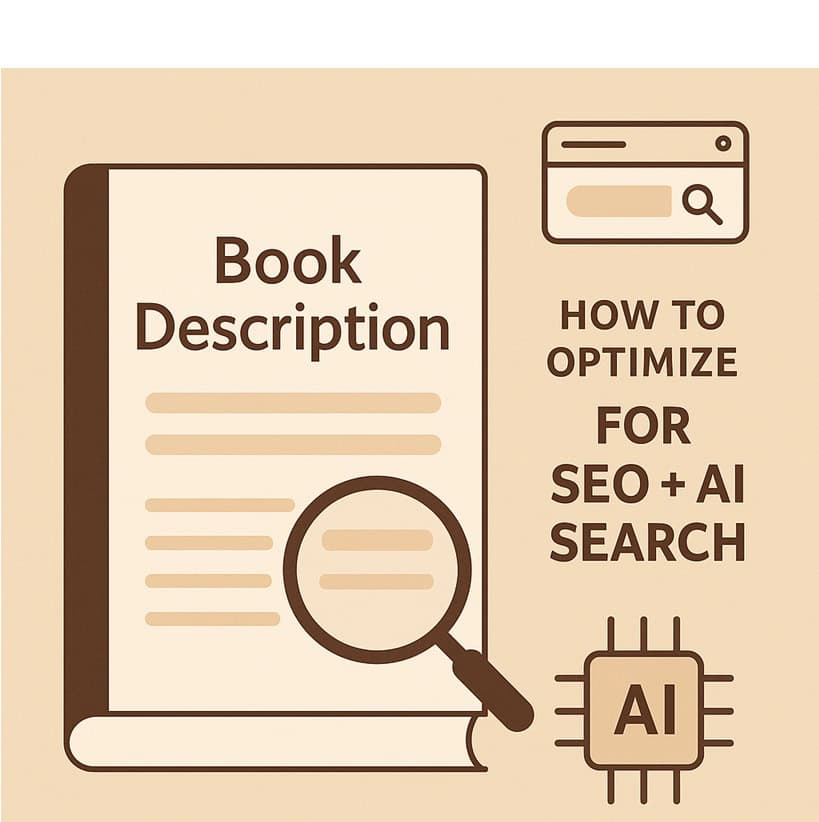
Book descriptions are more than sales copy. They are one of the most critical discovery tools you have, especially as a new indie author. A well-written description helps your book:
- Appear in Amazon search results
- Show up in Google and AI-driven searches
- Get recommended alongside similar books
- Build reader trust quickly
- Convert browsers into buyers
The challenge?
Most authors write book descriptions like mini short stories: beautiful, emotional, and vague. Unfortunately, that’s exactly what search engines and AI struggle to understand.
This part of our series on SEO, GEO, and AEO shows you how to write book descriptions that work for readers and discovery, even if you’re publishing your first book.
How Book Descriptions Affect SEO and AI Discovery
Today’s readers don’t just browse categories. They ask questions like:
- “Best cozy mysteries without graphic violence”
- “Fantasy books for teens who love found family”
- “Beginner guides to self-publishing on Amazon”
Search engines and AI tools scan book descriptions to decide which books match those searches.
They look for signals such as:
- Clear genre and audience cues
- Relevant keywords used naturally
- Emotional tone and stakes
- Structural clarity
- Easy scannability
If your description is overly poetic or vague, AI can’t confidently classify it—and your book is less likely to surface.
What Makes a Book Description Reader-Friendly and AI-Friendly
High-performing book descriptions do two jobs at once:
- They help AI understand exactly what your book is
- They help readers decide quickly if it’s right for them
Strong descriptions usually include:
- A compelling opening hook
- A clear genre signal
- A concise summary or promise
- Emotional stakes or benefits
- Short, scannable paragraphs
- A read-alike comparison
- A clear call to action
This structure is especially powerful for new indie authors because it removes guesswork for both humans and algorithms.
A Simple Book Description Formula for New Indie Authors
You don’t need to reinvent anything. Use this proven framework consistently.
1. The Hook (1–2 sentences)
Open with a problem, question, or moment of tension.
Examples:
- What if telling the truth could cost you everything?
- Writing a book is hard—but publishing it shouldn’t feel impossible.
2. The Genre Signal (One clear line)
Tell readers and AI exactly what this book is.
Examples:
- A cozy mystery with humor, heart, and zero graphic violence.
- A practical guide for new indie authors navigating self-publishing.
This line alone can dramatically improve discoverability.
3. The Core Summary (3–5 sentences)
Focus on clarity, not cleverness.
- Introduce the main character or reader problem
- Present the central conflict or promise
- Hint at stakes or outcomes
- Avoid spoilers
- Use keywords naturally
4. The Emotional Pull (1–2 sentences)
AI tracks emotional language—and readers respond to it.
Examples:
- A story about trust, resilience, and finding your voice.
- Designed to replace overwhelm with confidence and momentum.
5. The Read-Alike Line (Optional but Powerful)
This helps platforms connect your book to similar titles.
Example:
Perfect for readers who enjoy character-driven mysteries and slow-burn suspense.
6. The Call to Action (1 sentence)
Invite the reader forward.
Examples:
- Start reading today.
- Begin your publishing journey with confidence.
Keywords New Indie Authors Can Use Naturally
You don’t need keyword stuffing. You need relevance.
Fiction Keywords (Examples)
- cozy mystery
- middle-grade adventure
- YA fantasy
- found family
- coming-of-age
Non-fiction Keywords (Examples)
- self-publishing guide
- indie author advice
- writing craft
- book marketing basics
- productivity for writers
Use keywords where they fit naturally, especially in your genre signal and summary.
Formatting Choices That Improve Visibility
Small formatting decisions make a big difference:
- Short paragraphs (2–3 lines max)
- Active voice
- Clear stakes or benefits
- Emotional language
- Plenty of white space
AI prefers a clean structure.
Readers prefer momentum.
This approach delivers both.
Sample Book Descriptions (Using Neutral Examples)
Fiction Example
What if solving the mystery meant uncovering secrets no one wanted revealed?
A character-driven cozy mystery with heart, humor, and unexpected twists.
When a small-town librarian stumbles into a decades-old disappearance, she quickly realizes the truth is far closer, and more dangerous, than she imagined. As clues surface, she must decide how much she’s willing to risk to uncover the past.
Perfect for readers who enjoy gentle suspense and clever mysteries.
Non-fiction Example
Publishing your first book doesn’t have to feel overwhelming.
This practical guide helps new indie authors move from idea to publication with clarity and confidence. You’ll learn how to plan, write, publish, and promote your book, without burnout or confusion.
Ideal for writers who want a clear, manageable path forward.
Common Book Description Mistakes to Avoid
Many new indie authors fall into these traps:
- Long blocks of text
- No clear genre signal
- Overly poetic summaries
- Starting with backstory
- Missing stakes or benefits
- No call to action
If your description sounds like jacket copy from decades ago, it’s probably not optimized for today’s search environment.
Final Takeaway
Your book description isn’t just about persuasion anymore. It’s about clarity, structure, and discoverability for readers and AI.
Once you understand that, writing effective descriptions becomes far less mysterious—and far more powerful.
TIP: If you’d like to have all of the AI powered search strategies in one place, read SEO, GEO, and AEO for Indie Authors: Strategic Optimization for AI Search (paperback or eBook).
Quick Book Description Checklist
This checklist alone can dramatically improve your book’s discoverability. Before you publish, confirm you have the following.
- A strong opening hook
- A clear genre line
- Short, scannable paragraphs
- Emotional language
- A concise summary
- A read-alike comparison
- A clear CTA
Think of optimizing your book’s description this way:
- AI Search decides whether your book is recommended (intent matching)
- Amazon Search decides where your book competes
After optimizing for AI search, check out our writer’s guide on how to fine-tune your description for Amazon KDP categories and rankings.
FAQs:
Q: Can blog content really help sell books?
A: Yes. Blog content builds trust, visibility, and authority, which makes readers more likely to subscribe, follow, and eventually buy books.
Q: How can authors make content AI-friendly?
A: Authors can make content AI-friendly by using clear headings, concise paragraphs, definitions, examples, FAQs, and structured formatting that makes answers easy to identify.
Q: Do keywords still matter in AI-driven search?
A: Yes, but differently. Keywords help establish topic relevance, while intent matching and clarity determine whether content is reused by AI systems. Keywords open the door; helpful answers keep it open.
Q: What matters more: keywords or reader intent?
A: Reader intent matters more. Keywords help identify topics, but content succeeds when it clearly solves the problem the reader or AI system is trying to address.
We trust you’ve found this writer’s guide both enlightening and inspirational. It’s designed to equip you with the tools and insights to bolster your success as a burgeoning author.
The path of writing is one of ceaseless learning and growth. You are not expected to tread this path solo. We’re thrilled to accompany you on this journey, offering support and motivation at every turn. Our objective is to deliver foundational knowledge and pragmatic guidance, enabling you to traverse the literary landscape with amplified confidence.
For more guidance, see other writer’s guides in this series. I suggest starting with the first one: Is SEO Dead? What to Know About GEO and AI Search. You might also like Engaging AI-Generated Content: 6 Secrets.
If you have a draft you want to publish with the help of AI, read, Is Your Book Ready to Self-Publish? Lastly, for help writing a non-fiction book, read Write Your First Non-Fiction eBook: a 30-Day Workbook for Getting It Done.
How can we help? To let us know, please fill out our Contact form.
Happy writing!