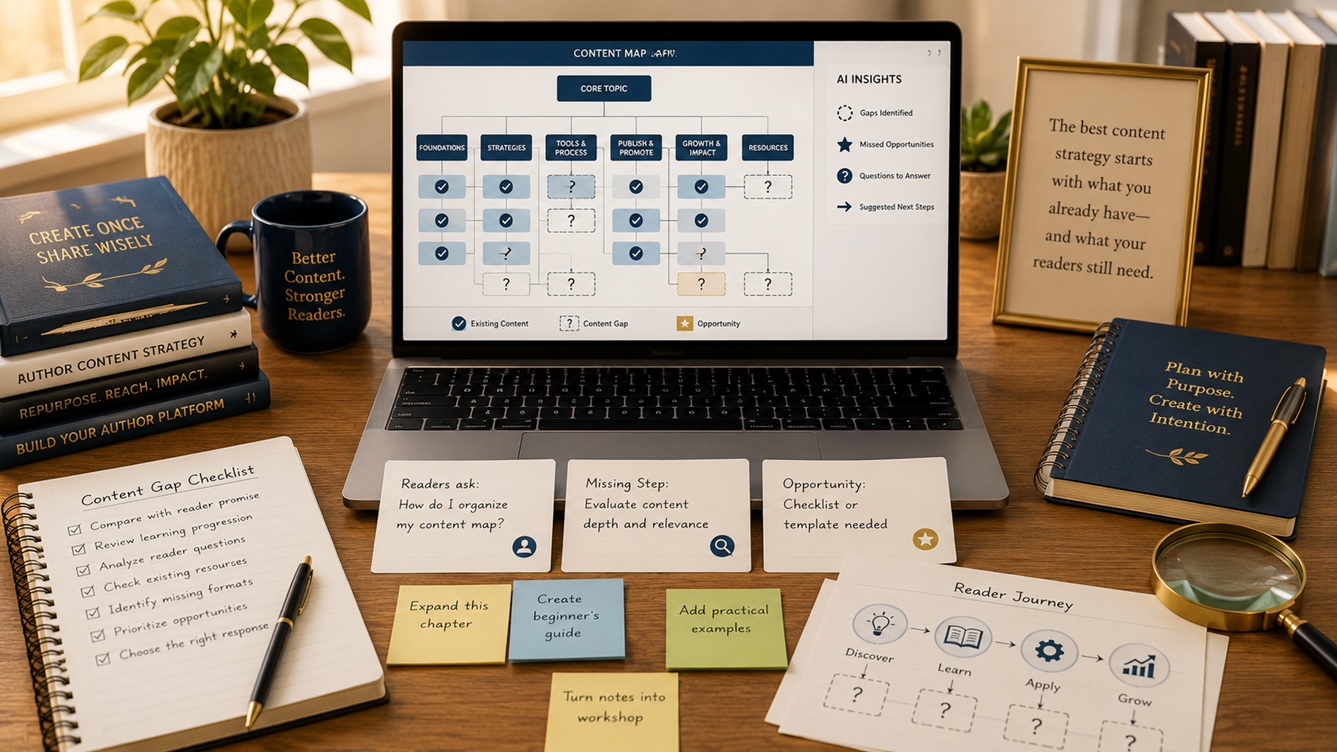
Use AI to Find Content Gaps and Missed Opportunities—7 Best Hacks
“Every good communication starts not with the message you want to send, but with a deep-rooted understanding of what your audience already thinks, feels, needs, and wants.” – Mark McShane, co-founder of Cupid PR
You may already have more content than you realize.
Your books, articles, newsletters, checklists, presentations, videos, and notes contain ideas that can continue helping readers. After creating a content inventory and repurposing map, you may see dozens of pieces connected across several projects.
However, seeing what you have raises another question: What is still missing?
Perhaps you have explained the beginning and end of a process but skipped an important step in the middle. You may have introduced a useful idea without showing readers how to apply it. One book chapter may contain several subjects that have never become website articles. Your audience may also be asking questions that your current content does not answer.
AI can help you recognize those content gaps.
It can compare outlines, summaries, reader questions, website articles, and book promises. It can group similar subjects, identify thin coverage, and suggest possible opportunities.
But AI can also produce an endless list of generic topics.
The goal is to identify content gaps that matter to your readers and support your work as an author.
As Mark McShane explains, “Every good communication starts not with the message you want to send, but with a deep-rooted understanding of what your audience already thinks, feels, needs, and wants.” A useful gap analysis begins with the audience—not the publishing calendar.
The following seven steps will help you use AI to find meaningful content gaps and decide which missed opportunities deserve your attention.
What Is a Content Gap?
A content gap is useful information, guidance, or support that your intended reader needs but cannot currently find within your body of content.
The gap may be an entirely missing topic.
It may also be a weakness within material you have already created.
For example, you may have published an article explaining why authors should build an email list but never created a practical beginner’s guide for setting one up. You may have written several articles about AI prompts but omitted instructions for organizing and saving successful prompts.
A gap can also appear between pieces of content.
Suppose one article helps readers audit their existing material, while another teaches them to turn blog posts into a book. Readers may still need help deciding which audited material belongs in that book.
That missing decision process is a reader-progression gap.
7 Types of Content Gaps
Understanding the type of gap will help you decide how to address it.
1. Topic Gaps
A topic gap exists when an important subject has not been covered.
For example, an author website may contain articles about:
- Writing a manuscript
- Editing a book
- Designing a cover
- Publishing through Amazon KDP
But it may contain nothing about preparing the book description or selecting keywords. The missing topic may represent a useful opportunity.
However, relevance matters. A subject is not a meaningful gap merely because it is absent. It must support your readers, expertise, author brand, or current projects.
2. Depth Gaps
A depth gap occurs when you mention a useful subject but do not explain it sufficiently.
An article might tell authors to create a style guide without explaining:
- What the guide should contain
- How to develop one
- When to use it
- How AI should apply it
- How to update it
The topic technically exists in your content library, but the reader still lacks enough information to act.
A depth gap may be solved by:
- Expanding the existing article
- Creating a companion article
- Adding an example
- Providing a checklist or template
- Developing the subject into a book chapter
3. Reader-Progression Gaps
Practical nonfiction usually leads readers from one stage to another.
A progression might be:
- Understand the problem.
- Evaluate the current situation.
- Choose a strategy.
- Follow a process.
- Review the result.
- Maintain the system.
If your content covers Steps 1, 2, 4, and 6, the reader may not know how to choose a strategy or evaluate the finished work.
A reader-progression gap is often more important than a missing keyword topic because it prevents readers from completing the result you promised.
4. Audience Gaps
The same general topic may require different guidance for different readers.
For example:
- A new author needs a simple introduction to AI prompting.
- An experienced author may need a reusable prompt system.
- A fiction author may need character and story examples.
- A nonfiction author may need research, teaching, and organizational examples.
You do not need to create a separate version for every possible audience. However, an audience gap may deserve attention when an important group cannot apply your existing material.
5. Format Gaps
Sometimes the information exists, but not in the format the reader needs.
A detailed article might be useful for learning, while the reader still needs:
- A printable checklist
- A worksheet
- A short demonstration
- A template
- A quick-reference guide
- An audio explanation
- A step-by-step video
A format gap does not always require a new subject. It may call for adapting existing material into a more practical resource.
6. Evidence and Example Gaps
Advice becomes more useful when readers can see how it works.
An evidence or example gap may appear when content:
- Makes claims without support
- Gives instructions without demonstrations
- Recommends a process without showing the result
- Describes a mistake without an example
- Introduces a framework without applying it
You might fill this gap with:
- A case study
- A before-and-after comparison
- A sample prompt
- A completed worksheet
- A personal lesson
- A documented experiment
7. Connection Gaps
Your content may exist but remain difficult to discover.
For example:
- An article does not link to the checklist that supports it.
- A book page does not connect to related website articles.
- A beginner article does not point readers toward the next step.
- Several articles belong to a series but are not labeled or linked as one.
In that case, the solution may not be new content.
You may need:
- Internal links
- A series page
- A resource library
- A revised call to action
- A pillar article
- Better categories or tags
Fixing a connection gap can increase the usefulness of content you already have without creating anything new.
Step 1: Begin with the Reader Promise
Before asking AI to identify gaps, define what your content is supposed to help readers accomplish.
A book, article series, or website should have a clear promise.
For example: KickAssWritersGuide.com helps new indie authors use practical knowledge and AI tools to write, publish, and grow their author businesses with greater confidence.
You might use a more specific promise for one article series: This series will help indie authors audit, organize, evaluate, and strategically repurpose their existing content with AI.
Once you define the promise, ask:
- What must readers understand?
- What must they decide?
- What must they do?
- What could prevent them from succeeding?
- What support will they need afterward?
These questions create a standard against which you can compare your existing content.
Example AI Prompt
Act as a developmental content strategist. Review the following reader description and content promise. Identify the knowledge, decisions, actions, examples, and resources readers would reasonably need to achieve the promised result. Do not compare these needs with my existing content yet. First, create an ideal reader-needs framework.
This prompt asks AI to define the destination before examining what already exists.
Step 2: Compare the Reader’s Needs with Your Content Map
Next, compare the ideal reader-needs framework with your content inventory or repurposing map.
For each reader need, determine whether your current content provides:
- Complete coverage
- Partial coverage
- Repeated coverage
- Outdated coverage
- No coverage
- Coverage that needs verification
A simple comparison table might look like this.
| Reader Need | Existing Content | Coverage | Action |
| Understand content auditing | Audit article | Complete | Maintain |
| Create an inventory | Audit article and checklist | Complete | Maintain |
| Select a source of truth | Repurposing-map article | Partial | Expand |
| Prioritize content gaps | No dedicated article | Missing | Create |
| Maintain the system | Workflow article planned | Planned | Draft later |
This comparison helps distinguish a genuine gap from a topic that merely uses different terminology.
Example AI Prompt
Compare the following reader-needs framework with my content inventory. Classify each need as complete, partial, repeated, outdated, missing, or uncertain. Identify the content supporting each classification and explain your reasoning. Do not recommend new articles yet.
Separating diagnosis from recommendations prevents AI from jumping immediately into idea generation.
Step 3: Examine the Reader’s Progression
Readers do not experience content as a pile of independent topics. They move through questions and decisions.
For example, an author interested in content repurposing may need to:
- Understand what repurposing is.
- Inventory existing material.
- Identify related pieces.
- Evaluate quality and relevance.
- Find gaps.
- Choose a new format.
- Adapt the material.
- Review voice and accuracy.
- Publish and connect the new content.
- Update the repurposing record.
If one of these stages is missing, readers may become stuck. Ask AI to arrange your existing content in the order a beginner would need it. Then ask it to identify where the progression breaks.
Example AI Prompt
Arrange the following articles and resources into the most logical learning sequence for a new indie author. Identify any missing steps between them. Explain what readers would need at each missing stage. Do not assume every gap requires a full article.
That final instruction encourages AI to consider smaller solutions, such as a transition, checklist, example, or internal link.
Step 4: Review Questions from Real Readers
Your readers can reveal gaps that an outline comparison misses.
Review:
- Website comments
- Email replies
- Client questions
- Social media responses
- Workshop discussions
- Podcast comments
- Search terms that led visitors to your site
- Questions you repeatedly explain in conversations
- Questions you had while completing the process yourself
Look for patterns.
One unusual question may not justify new content. The same question appearing repeatedly may reveal confusion, missing guidance, or an opportunity for a useful article.
Reader questions can also reveal that your existing title does not make an answer easy to find.
Perhaps you have already covered the subject, but readers do not recognize that the article solves their problem. In that case, you may need to improve:
- The title
- Introduction
- Headings
- Meta description
- Internal links
- Article category
- Call to action
Not every apparent gap requires new writing.
Example AI Prompt
Group the following reader questions by underlying need. Identify which questions appear to ask for the same information using different words. Compare the groups with my current article list and classify them as answered, partially answered, unanswered, or difficult to locate.
Do not provide private reader information to an AI tool. Remove names, email addresses, account details, and other identifying information before analyzing questions.
Step 5: Search Existing Material for Overlooked Opportunities
A gap in your published content may already be filled in your unpublished material.
Review:
- Book chapters
- Deleted book sections
- Article drafts
- Research notes
- Workshop materials
- Presentation slides
- Email drafts
- Podcast outlines
- Video transcripts
- AI conversation exports
- Reader downloads
- Personal process documents
You may discover that the missing topic does not need to be created from the beginning.
For example:
- A book chapter may contain the foundation for a pillar article.
- A newsletter may contain a useful personal example.
- A checklist may reveal the outline for a tutorial.
- Research notes may support a comparison article.
- A frequently used AI prompt may become a practical template.
Use your content repurposing map to connect these materials with the identified gaps.
Example AI Prompt
Compare these unpublished notes, chapter summaries, and draft materials with the verified content gaps below. Identify source material that could help address each gap. Distinguish between material that provides complete support, partial support, a useful example, or no meaningful support.
Ask AI not to force a connection merely because two pieces contain the same keyword.
Step 6: Ask AI to Create a Gap Report
Once you have gathered the evidence, AI can organize it into a content-gap report.
The report might include:
- Gap description
- Gap type
- Reader affected
- Existing related content
- Evidence of need
- Recommended response
- Best format
- Estimated level of effort
- Strategic value
- Risk of duplication
- Verification required
Example AI Prompt
Create a content-gap report using the reader-needs framework, content inventory, learning sequence, reader-question groups, and unpublished-material review below.
For each gap, include:
- Gap description
- Gap type
- Reader need
- Existing related content
- Evidence supporting the gap
- Possible response
- Best format
- Risk of overlap
- Information requiring verification
Separate confirmed gaps from possible gaps. Do not recommend creating content merely because a keyword or topic is absent.
The distinction between confirmed and possible gaps is essential. AI may notice a logical possibility, but you may not have enough evidence that readers actually need it.
Step 7: Prioritize Opportunities by Reader Value
A content-gap report may contain more ideas than you can reasonably develop. Do not treat it as a publishing schedule. Prioritize each opportunity based on factors such as:
Reader Need
Does the gap prevent readers from understanding or completing an important process?
Strategic Fit
Does the subject support your website, books, expertise, and author brand?
Distinct Value
Would the new piece offer something meaningfully different from your existing content?
Evidence
Do reader questions, content reviews, or personal experience support the need?
Reuse Potential
Could the material support a future book, course, download, newsletter, or article series?
Effort
Can you address the gap with a revised section, or does it require substantial research and development?
Urgency
Is the missing information preventing a current project, publication, or reader path from working?
You can score each factor from one to five, but the numbers should support your judgment rather than replace it.
A high-value gap usually:
- Serves a clear reader need
- Fits your expertise
- Supports an existing project
- Offers distinct value
- Can be developed accurately
- Connects naturally with other content
Choose the Right Response to Content Gap
A gap does not always require a new article.
You might address it by:
Updating Existing Content
Use this when the answer already exists but needs clarification, current information, or a stronger title.
Expanding Existing Content
Use this when a valuable subject lacks sufficient detail.
Creating a Companion Article
Use this when the new topic deserves focused treatment but should remain connected to existing content.
Adding a Resource
A checklist, worksheet, template, example, or FAQ may solve the problem more effectively than another long article.
Improving Connections
Use internal links, series navigation, category pages, or calls to action when readers simply cannot find the next step.
Creating a New Book or Series
A large cluster of related gaps may reveal a subject substantial enough for a new book or article series.
That is how a content-gap analysis can uncover more than isolated article ideas. It can reveal an entire reader need that your current books and website do not yet address.
Avoid Filling Gaps with Unnecessary Content
AI can generate hundreds of plausible ideas within seconds.
That does not mean you should create them.
An absent topic may not belong on your website. A possible keyword may not matter to your readers. An idea may also be too far outside your experience to address responsibly.
Before approving a new piece, ask:
- Does this solve a real reader problem?
- Does it support my author brand?
- Do I have the knowledge or sources to address it?
- Is the subject already covered under another title?
- Would an update or internal link solve the problem?
- Can I offer a distinct perspective or practical method?
- Does this opportunity support a larger content or book strategy?
Creating less content with greater purpose is usually more valuable than filling every apparent gap.
Use AI to Reveal Possibilities, Not Invent Demand
AI can help you:
- Compare reader needs with existing material
- Organize questions
- Detect incomplete coverage
- Find missing steps
- Match unpublished material with opportunities
- Create a gap report
- Rank ideas using your criteria
- Suggest useful formats
However, AI cannot know that readers need a piece merely because it can imagine the topic.
Ask it to distinguish among:
- Evidence from your materials
- Logical inference
- General suggestion
- Missing information
The final decision belongs to you.
You know which questions your readers ask, which subjects fit your experience, and which opportunities support the work you are building.
Final Thoughts
A content gap is not simply a subject you have not covered.
It is useful information, guidance, evidence, or support that your intended reader needs but cannot currently find within your body of work.
Begin with the reader promise. Define what readers need to understand and accomplish. Compare those needs with your content map. Examine the reader’s progression, review real questions, and search your unpublished material for overlooked resources.
Then ask AI to organize the findings into a gap report.
Finally, prioritize opportunities according to reader value, strategic fit, evidence, distinctiveness, and effort.
You do not need to fill every gap. You need to recognize the gaps that matter, and create the content that helps your readers move forward.
AI-Assisted Content Gap Checklist
Define the Reader Need
- Identify the intended reader.
- Write the central content or book promise.
- List what readers must understand.
- Identify the decisions they must make.
- List the actions they must complete.
- Note obstacles that may prevent success.
Review Existing Content
- Compare reader needs with the content inventory.
- Mark complete coverage.
- Mark partial or shallow coverage.
- Identify repeated coverage.
- Flag outdated information.
- Mark missing and uncertain topics.
- Check whether the answer exists under another title.
Examine the Reader’s Progression
- Arrange existing content in learning order.
- Identify missing steps.
- Check whether readers can move from understanding to action.
- Confirm that every major process includes evaluation and follow-up.
- Look for weak transitions between related resources.
Review Reader Evidence
- Group recurring reader questions.
- Review website comments and email responses.
- Examine relevant search terms and site data.
- Record questions you answer repeatedly.
- Remove personal information before using AI.
- Distinguish one-time questions from repeated needs.
Search Unpublished Material
- Review book chapters and unused sections.
- Search article and newsletter drafts.
- Examine notes, presentations, and scripts.
- Check existing checklists and templates.
- Review relevant research files.
- Match useful source material with verified gaps.
Evaluate Each Opportunity
- Identify the type of gap.
- State the reader benefit.
- Confirm evidence of need.
- Compare it with existing content.
- Assess the risk of duplication.
- Identify the best format.
- Estimate the research and development required.
- Confirm alignment with the author brand.
Choose the Best Response
- Update existing content when possible.
- Expand material that lacks depth.
- Add a companion article when focused treatment is needed.
- Create a checklist, worksheet, example, or template.
- Improve internal links when the content is difficult to find.
- Develop new content only when it offers distinct value.
Record the decision in the content repurposing map.
For more guidance, see our other writer’s guides in this series. We suggest starting with the first one, Turn Blog Posts into a Book with AI: 8 Best Hacks.
Or for all the writer’s guides in one place, grab our book: Repurpose Your Author Content with AI (available on Amazon).
We trust you’ve found this writer’s guide both enlightening and inspirational. It’s designed to equip you with the tools and insights to bolster your success as a burgeoning author.
You might also enjoy our books: Book Description Optimization: A Step-by-Step System to Clarity, Discoverability, and Reader Trust OR Write Smarter, Stay Human: Use AI Without Losing Your Voice, Values, or Vision.
The path of writing is one filled with ceaseless learning and enhancement. You are not expected to tread this path solo. We’re thrilled to accompany you on this journey, offering support and motivation at every turn.
Our objective is to deliver foundational knowledge and pragmatic guidance, enabling you to traverse the literary landscape with amplified confidence.
If you have a draft you want to publish with the help of AI, read Is Your Book Ready to Self-Publish?
How can we help? To let us know, please fill out our Contact form.
Happy writing!