Use AI Without Losing Your Author Voice: 6 Best Hacks
“You do not rise to the level of your goals. You fall to the level of your systems.” — James Clear, Atomic Habits
Are you an indie author trying to figure out where AI fits into your writing life? If so, you’re not alone. Many writers feel pulled in two directions at once. They see the potential if they use AI. They also feel uneasy. They want help, but they do not want shortcuts that weaken their work or make them sound like everyone else.
That tension is healthy.
The question is whether you can use AI in a way that strengthens your writing, supports your indie author business, saves time where it matters, and keeps you firmly in charge. You can, but the answer is not found in chasing every new tool. It is found in building better AI author systems.
This first part of our series on using an AI Author System offers a big-picture framework for applying AI as a practical support tool in a human-led indie author business. For all the writer’s guides in this series, along with several bonuses, grab our ebook: Write Smarter, Stay Human: Use AI Without Losing Your Voice, Values, or Vision (available on Amazon).
Many of the principles apply to both fiction and nonfiction. In this series, we’re focusing on nonfiction. (We’ll cover fiction in a separate series). This series is especially for indie authors who want to write better nonfiction books, publish with more confidence, and grow without losing the human center of their work.
2 Extremes That Trap Indie Authors
When authors first start exploring AI, they often fall toward one of two extremes.
The first is fear. You may worry about sounding robotic, making ethical mistakes, losing your voice, or damaging reader trust. You may wonder whether using AI at all somehow makes your work less real. You may also fear falling behind while other authors seem to move faster.
The second is hype. This is the idea that AI can do everything better, faster, and easier. It is the promise that you can automate your way past hard thinking, strong structure, careful revision, or meaningful strategy. That promise sounds tempting, especially when you are busy, tired, or overwhelmed.
Neither extreme helps.
Fear keeps you stuck. Hype makes you careless. What helps is a third path: using AI with clear boundaries, smart judgment, and practical systems that support your goals instead of distracting you from them.
Why Systems Matter More Than Tools
Many indie authors assume the key to success is finding the perfect tool. In reality, tools come and go (nearly every week). Interfaces change. Features disappear. New apps show up every week. If your process depends too heavily on any one tool, you end up rebuilding your workflow over and over.
Systems last longer.
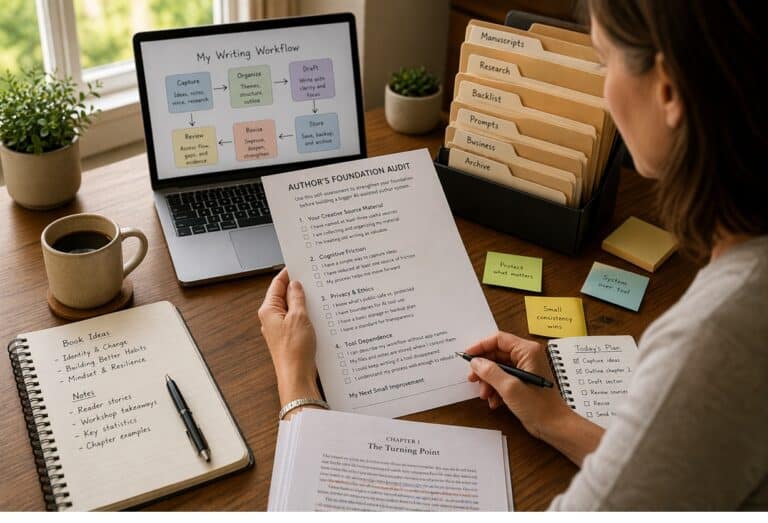
A system is the repeatable way you think, decide, organize, draft, revise, protect, and publish. It helps you know when to use AI, how to use it, and when not to use it. It gives you a filter for separating useful help from empty novelty.
For nonfiction indie authors, this matters even more. You are trying to communicate ideas clearly, serve readers well, build trust, and create genuinely helpful books. That requires more than speed. It requires clarity, usefulness, durability, and judgment.
If you build strong systems, AI becomes a helpful assistant. If you skip the system part, AI can become noise.
What a Healthy AI Framework Looks Like
A healthy AI framework does not start with prompts. It starts with principles.
You are still the author. You are still responsible for the quality, truthfulness, clarity, and usefulness of your book. AI can support your thinking, but it cannot replace your lived experience, your values, your discernment, or your understanding of your readers.
A strong framework usually includes questions that move you away from random experimentation and toward intentional use. Questions like these:
- What parts of my process need support?
- Where am I losing time or clarity?
- Which tasks require human judgment the most?
- How will I protect my voice and ideas?
- What kind of help would improve quality instead of just increasing output?
Start With Your Author Foundation
Before using AI heavily in drafting or marketing, it helps to strengthen your foundation as an author. That includes your source material, your judgment, and your operating habits.
Your existing work has value. Your notes, drafts, outlines, frameworks, examples, lessons learned, and backlist all contain useful patterns. They reflect how you think, what you care about, and how you explain things. In many ways, this is your most valuable raw material. It gives AI something meaningful to work with instead of forcing it to rely on generic output.
It also helps to think of AI as an external brain, not a replacement brain. It can help you brainstorm, organize, compare, summarize, or generate options. But the final direction still needs to come from you.
This is also the stage where privacy and ethics matter. Not every idea, draft, client detail, or personal story belongs in a tool. The more intentional you are early on, the easier it becomes to build a workflow you can trust.
Use AI to Support the Book, Not Replace the Author
Once your foundation is stronger, AI can become useful inside the writing process itself. But the best use is usually collaborative, not automatic.
For nonfiction indie authors, AI can help with things like organizing rough ideas, surfacing gaps in logic, suggesting structures, generating revision questions, summarizing dense material, or helping you create production briefs and content plans. It can also help you see your own material more clearly.
What it should not do is quietly flatten your voice.
Your readers want clarity, personality, lived understanding, and useful guidance. They want to feel that a real person thought carefully about what would help them most. If AI output starts sounding slick, vague, repetitive, or strangely lifeless, that is a signal to pull back and re-center the work in your own thinking.
Common Mistake: Using AI Too Early
One common mistake is turning to AI before you have done enough thinking yourself.
If you ask a tool to define your topic, message, and structure before you have wrestled with your own ideas, you may end up building your book around average language and borrowed logic. The result often sounds tidy but thin.
A better approach is to do some of the messy human work first. Gather notes. Clarify your angle. Identify what your readers really need. Then use AI to help you shape, assess, refine, or expand.
Build an Author Business System
A good nonfiction book is positioned, packaged, launched, and supported.
This is another place where AI can help, but only if you keep strategy in human hands. AI can aid audience research, metadata drafts, brainstorming, sales page options, email ideas, content repurposing, and pattern spotting. It can help you work faster. It can even help you see missed opportunities.
But it cannot decide what your book truly is. It cannot determine what promise you should make to readers. It cannot tell you what is honest, sustainable, or aligned with your long-term goals unless you have already thought that through.
The strongest indie author business is not built by reacting faster than everyone else. It’s built by making better decisions. AI can support those decisions, but it should not replace them.
Quick Win: Create One Repeatable AI Workflow
You do not need a giant tech stack to benefit from AI. One good workflow used consistently is more valuable than ten random tricks you never fully trust. Start with one small, repeatable workflow.
For example, after drafting a section yourself, ask AI to help you do one of the following:
- Identify unclear spots
- Flag repetition
- Suggest questions a reader might still have
- Summarize your main points to test clarity
- Turn your rough ideas into an organized revision checklist
Think Long Term, Not Just Speed
One of the biggest mistakes indie authors make is using AI only for short-term speed. Speed can help, but it is not the highest goal.
A stronger long-term goal is resilience.
That means creating workflows you can adapt, documenting what works, protecting your intellectual assets, and building a catalog that grows more useful over time. It means treating your books, ideas, and systems as part of a larger body of work rather than as isolated one-off projects.
When you think this way, AI becomes less of a novelty and more of a support layer inside a durable author business.
What This Means for You Right Now
You do not need to master everything at once. You do not need to assess every app, learn every term, or redesign your entire writing life this week.
You need a better way to think.
You need a framework that helps you sort signal from noise, support from distraction, and real progress from the illusion of productivity. You need permission to move one layer at a time.
That might mean making a better privacy decision. It might mean building a cleaner drafting workflow. It might mean creating one process for protecting voice during revision. It might mean using AI to support your publishing tasks without letting it take over your judgment.
Small, intelligent improvements compound.
That is how stronger authorship develops. That is how confidence grows. And that is how AI becomes something genuinely useful rather than something you either fear or over trust.
If you are a nonfiction indie author who wants practical help without hype, you are in the right place. You do not need to become a tech expert. You especially do not need to lose your voice to gain efficiency. You do need systems that strengthen your work, clarify your process, and make your author business more durable.
That is the path worth building.
FAQs
These FAQs build on the writer’s guide’s core ideas about systems, judgment, voice, and long-term resilience. They go a little deeper into common questions you may still.
How do I know whether AI is actually helping my writing instead of quietly weakening it?
Answer: A useful test is to compare the final result to your usual work. If the writing feels clearer, more focused, and easier for readers to follow while still sounding like you, AI is probably helping. If the draft feels flatter, more generic, oddly polished, or less emotionally true, the tool may be pulling you away from your real voice rather than supporting it.
What should I include in a simple AI system for my writing process?
Answer: Start with a very small framework you can repeat. That might include one clear purpose for using AI, one or two tasks you trust it with, a way to review the output critically, and a final step where you revise in your own voice. A good system does not need to be complicated. It needs to be clear enough that you know why you are using AI and how you will stay in charge.
How can I tell which part of my author process needs AI support first?
Answer: Look for the point where you lose the most time, clarity, or momentum. For one author, that may be organizing scattered notes. For another, it may be identifying repetition during revision or turning rough ideas into a workable outline. Start where the friction is highest, because that is usually where one small improvement can create the most immediate relief.
How often should I review or adjust my AI workflow?
Answer: Review it whenever it starts feeling noisy, confusing, or less useful than it did at first. You do not need to rethink your process every week, but you should check in often enough to notice whether the workflow still supports your goals. A simple system that works well for three months is more valuable than a constantly changing setup you never fully trust.
How can I keep AI from shaping my book in ways that do not fit my readers?
Answer: Before you use AI, get clear about your reader, your promise, and the purpose of the piece you are writing. The more specific you are about who the book is for and what it should do for them, the easier it becomes to judge whether AI’s suggestions are actually useful. That clarity helps you reject ideas that sound impressive but do not belong in the book you are trying to write.
We hope you’ve found the writer’s guide strategies useful and motivating. We hope they’ll equip you with the insights and tools needed to help you succeed as a new author.
For all the writer’s guides in this series, along with several bonuses, grab our ebook: Write Smarter, Stay Human: Use AI Without Losing Your Voice, Values, or Vision (available on Amazon).
Writing is a journey of continuous learning and improvement. You don’t have to go it alone. We’re excited to continue the journey with you, providing guidance and encouragement every step of the way. Our goal is to provide essential insights and practical advice to help you navigate the writing world with increased confidence.
If you have a draft you want to publish and are wondering how AI can help, read: Is Your Book Ready to Self-Publish?
For help writing a nonfiction book, read Write Your First Nonfiction eBook: a 30-Day Workbook for Getting It Done.
Don’t wait. Start today!
How can we help? To let us know, please fill out our Contact form.
Happy writing!