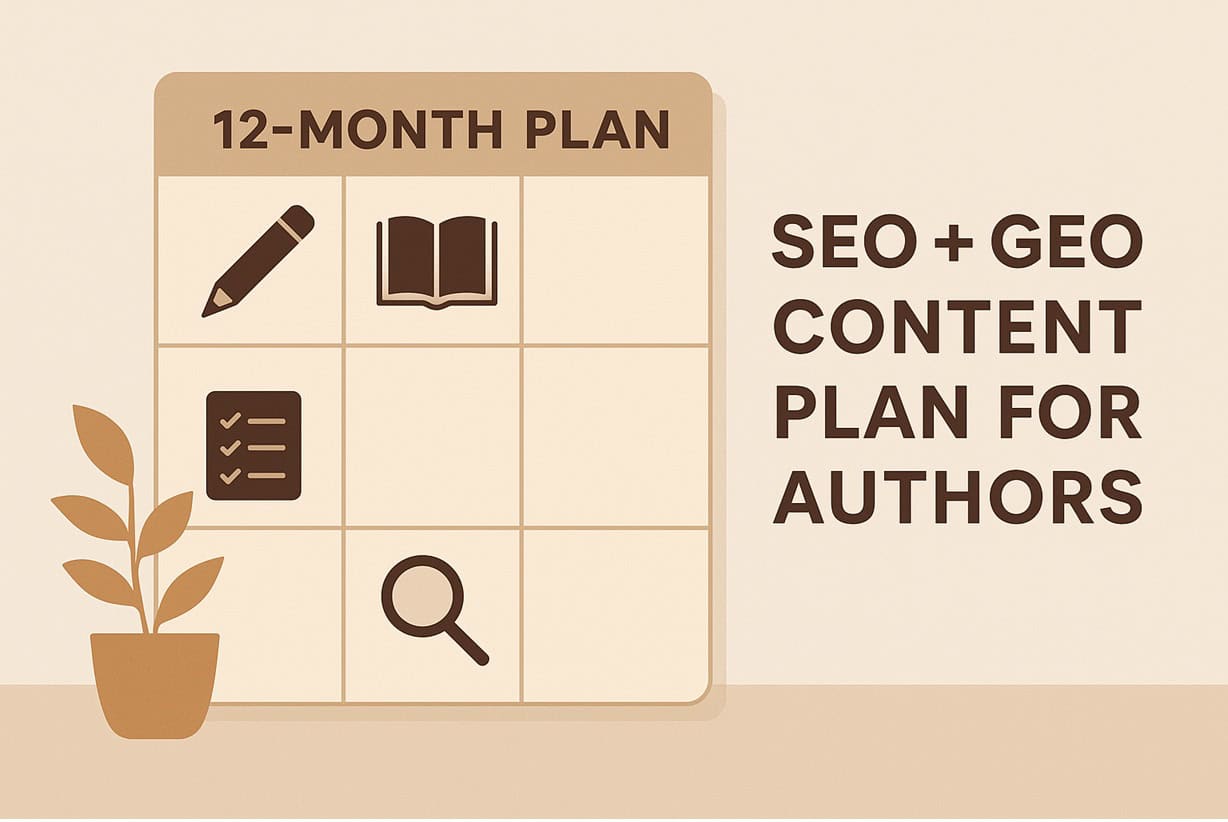
A 12-Month SEO + GEO Content Plan for New Indie Authors
“Consistency is what turns information into authority.” —Brian Clark, Founder of Copyblogger
Most new indie authors want more visibility but feel overwhelmed by the pressure to “create content all the time.” Writing books already takes enough energy. Adding marketing on top of that can feel exhausting.
The solution isn’t more content. The solution is structure.
A clear, realistic 12-month content plan helps new indie authors stay visible without burning out. Instead of guessing what to publish next, you follow a simple roadmap that builds traffic, trust, and authority over time.
In today’s search environment, where readers use Google and AI tools like ChatGPT, Gemini, Perplexity, and Bing Copilot, your content needs to do three things:
- SEO: Bring readers to your website through traditional search
- GEO: Help AI tools understand, summarize, and quote your content
- AEO: Position your content as the preferred answer to common questions
This 12-month content plan helps new indie authors who want to build steady growth, not manage marketing chaos.
Why New Indie Authors Need a 12-Month Content Plan
Without a plan, content creation feels random and stressful.
With a plan, everything becomes calmer and more intentional.
A structured content approach helps new indie authors:
- Always know what to publish next
- Build an AI-friendly website over time
- Grow visibility steadily instead of in bursts
- Set reader expectations
- Earn trust from AI search systems
- Avoid creative burnout
Consistency matters more than volume. One strong, well-planned post each month often outperforms dozens of rushed articles.
How New Indie Authors Can Use This Plan
This plan works if you want to:
- Increase website traffic
- Build long-term authority
- Improve AI discoverability
- Support your book marketing
- Create a reusable content ecosystem
Each month focuses on one clear type of content, including:
- A piece that supports SEO
- Structure that supports GEO
- Optional AEO-friendly formatting
By the end of the year, new indie authors will have a content library that feeds both traditional search engines and AI systems.
The 12-Month Content Plan
Months 1–3: Build Your Foundation
Month 1 — Pillar Content (High-Authority SEO + GEO)
Goal: Publish one comprehensive, evergreen guide.
Examples:
- How to Outline a Novel: A Complete Guide
- Self-Publishing for Beginners
- Writing YA Sci-Fi: Essential Elements
Include:
- Clear headings
- Definitions
- Lists
- A strong introduction
- A summary section
- An FAQ block
This becomes your website’s AI-friendly anchor page.
Month 2 — Supporting Articles (Topic Cluster)
Goal: Publish 2–3 articles that support and link to your pillar.
Examples:
- How to Write a Compelling Sci-Fi Hero
- Common Mistakes First-Time Indie Authors Make
- How to Format Your First Book
Internal links help search engines and AI understand your expertise.
Month 3 — Experience-Based Articles (E-E-A-T)
Goal: Share what you’ve learned personally.
Examples:
- What I Learned Publishing My First Book
- What I’d Do Differently as a New Indie Author
- My First Book Launch: What Worked and What Didn’t
Real experience builds trust, especially with AI systems.
Months 4–6: Match Search Intent
Month 4 — Answer Posts (AEO-Focused)
Short posts that answer one clear question.
Examples:
- How Long Should a Novel Be?
- What Is a Beta Reader?
- Should New Indie Authors Hire a Book Coach?
Use:
- A one-sentence definition
- A short explanation
- Steps or examples
- An FAQ section
Perfect for AEO.
Month 5 — List Posts (SEO + GEO)
Examples:
- 10 Tools Every Indie Author Should Know
- 7 Plot Structures That Work in Any Genre
- 12 Ways to Market a Book on a Budget
Lists are easy to rank and easy for AI to summarize.
Month 6 — Comparison Posts
Examples:
- Vellum vs Atticus
- Ebook vs Print: What Sells Better?
- KDP vs IngramSpark: What Indie Authors Should Know
These attract readers who are ready to make decisions.
Months 7–9: Build Engagement
Month 7 — Reader-Focused Content
Examples:
- Books Like [Your Book]
- YA Sci-Fi Books for Adventure-Loving Teens
Especially useful for fiction authors.
Month 8 — Email List Support
Tie content to a free resource.
Examples:
- A Simple Book Launch Checklist
- Free World-Building Guide for Sci-Fi Writers
- Character Creation Tips + Free Template
Month 9 — Behind-the-Scenes Content
Examples:
- How I Develop Characters
- My Writing Rituals
- How I World-Build My Novels
This strengthens your author brand and trust signals.
Months 10–12: Optimize and Expand
Month 10 — Update Existing Content
Refresh your best-performing posts with:
- New examples
- Updated tools
- Clearer summaries
- Improved structure
Updates signal freshness to search engines and AI.
Month 11 — Start a Second Content Cluster
Choose a new focus area:
- Writing craft
- Book marketing
- Genre expertise
- Publishing strategy
Clusters build authority faster than isolated posts.
Month 12 — Repurpose Everything
Turn your best content into:
- Email sequences
- YouTube scripts
- Short-form videos
- PDFs or guides
- Social posts
- Even future book chapters
Maximum reach, minimal effort.
A Simple Weekly Routine for New Indie Authors
- Monday: Outline one section
- Tuesday: Draft
- Wednesday: Format (headings, lists)
- Thursday: Add FAQs and summary
- Friday: Publish or schedule
Small steps. No overwhelm.
How AI Tools Support This Plan
AI tools can help with:
- Brainstorming topics
- Researching questions
- Creating outlines
- Improving clarity
- Repurposing content
- Structuring summaries
Your role as the author:
- Provide real examples
- Share lived experience
- Add insight and opinion
- Maintain your voice
That blend is what AI systems trust most.
12-Month Checklist for New Indie Authors
- Create one pillar page
- Build a topic cluster
- Add experience-based content
- Publish answer posts
- Write comparison posts
- Publish list posts
- Focus on reader-centered content
- Support email growth
- Share behind-the-scenes insights
- Update existing articles
- Build a second cluster
- Repurpose everything
Final Thought for New Indie Authors
This plan isn’t about chasing algorithms. It’s about building a sustainable visibility system that works quietly in the background while you write your books. One thoughtful post at a time is enough.
TIP: If you’d like to have all of the AI powered search strategies in one place, read SEO, GEO, and AEO for Indie Authors: Strategic Optimization for AI Search (paperback or eBook).
FAQs
Q: How often should authors publish content?
A: Consistency matters more than frequency. Publishing high-quality content on a sustainable schedule builds more trust than frequent but rushed posts.
Q: How long does SEO and GEO take to work?
A: Consistency matters more than frequency. Publishing high-quality content on a sustainable schedule builds more trust than frequent but rushed posts.
Q: Do tools matter more than strategy?
A: No. Tools support strategy, but they don’t replace it. Clear goals, reader-focused content, and consistency matter more than any specific tool.
Q: Can blog content really help sell books?
A: Yes. Blog content builds trust, visibility, and authority, which makes readers more likely to subscribe, follow, and eventually buy books.
We hope you found these writer’s guide strategies helpful and inspiring. They’re intended to provide you with the necessary tools and insights to succeed as an indie author.
For more guidance, see other writer’s guides. I suggest starting with the first one: I SEO Dead? What to Know About GEO and AI Search. Or see AI Empowers New Indie Authors: 5 Best Hacks.
If you have a draft and want to explore how AI can help you self-publish it, read, Is Your Book Ready to Self-Publish? Lastly, for help writing a non-fiction book, read Write Your First Non-Fiction eBook: a 30-Day Workbook for Getting It Done.
Writing is an ongoing adventure that involves continuous learning and improvement. You don’t have to go through this alone. We are excited to accompany you every step of the way, providing you with support and motivation. Our goal is to give you the necessary knowledge and practical advice to navigate the world of writing with confidence.
Don’t wait. Start today! How can we help? To let us know, please fill out our Contact form.
Happy writing!