Reader Search Intent: The Key to Content That Gets Found
“If your content doesn’t satisfy search intent, nothing else you do will matter.” —Neil Patel
If keyword research tells you what readers are searching for, search intent tells you why they’re searching in the first place.
For new indie authors, understanding intent is one of the most potent ways to create high-performing blog posts, book descriptions, landing pages, and author content.
Search engines and AI tools (ChatGPT, Gemini, Claude, Perplexity) now prioritize intent-matched content over keyword-heavy pages. This means:
- Clear answers beat clever wording
- Reader needs beat volume or length
- Intent-focused pages get surfaced more often
- AI is more likely to quote and recommend content that fully satisfies a user’s purpose
This part of our SEO, GEO, and AI Search for Indie Authors Series breaks down reader search intent in a simple, author-friendly way. It shows you how to use it to write content that both readers and AI search engines love. If you’d like to have all of the AI powered search strategies in one place, read SEO, GEO, and AEO for Indie Authors: Strategic Optimization for AI Search (paperback or eBook).
1. What Is Search Intent? (Plain English)
Search intent describes why someone types (or speaks) a search query. Search intent is the beating heart of modern discoverability. It answers questions like:
- What problem does the reader want solved?
- What action do they hope to take?
- Are they researching… comparing… buying… or navigating somewhere?
When your content matches the reader’s intent, you create:
- Engagement
- Trust
- Better SEO
- Stronger GEO and AEO signals
- Higher visibility in AI-generated answers
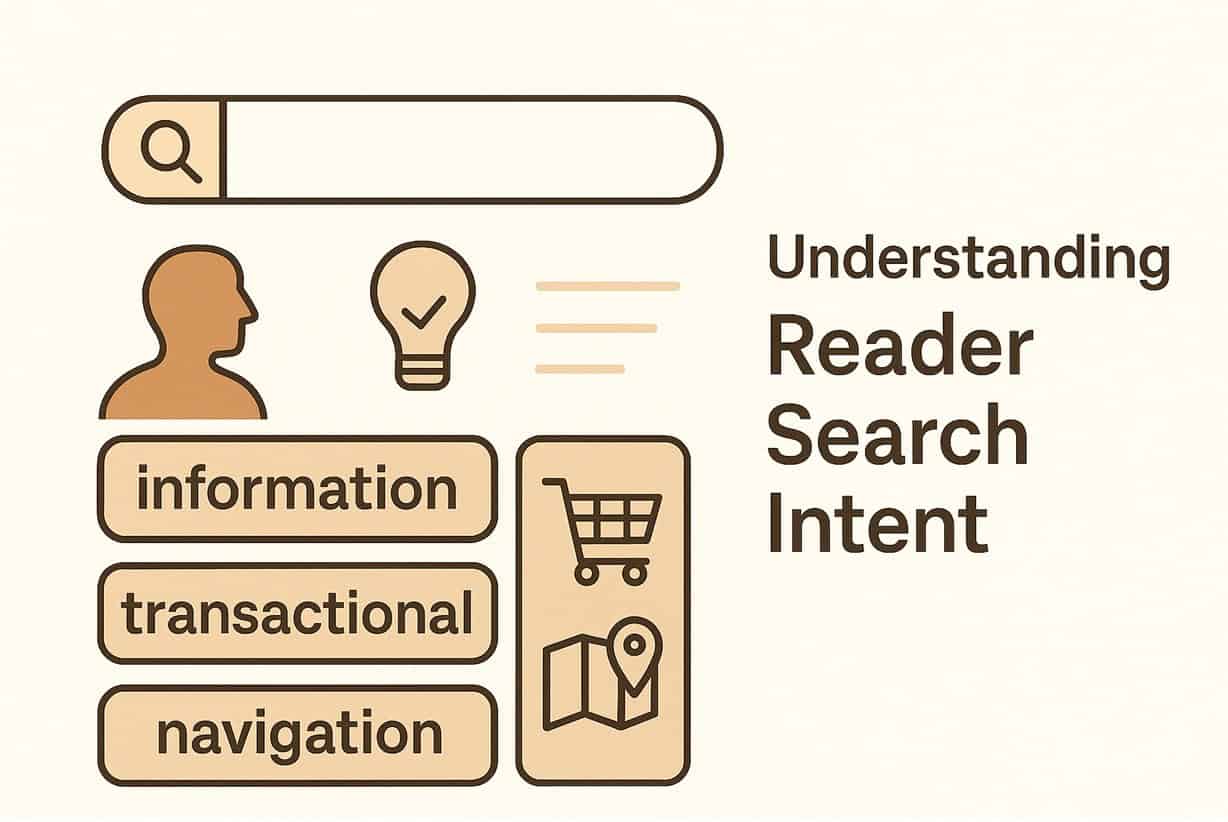
2. The Four Types of Reader Intent (Every Author Must Know)
These four categories apply across Google, Amazon, ChatGPT, Gemini, Bing Copilot, and Perplexity.
Informational Intent
Readers want to learn something.
Examples:
- “How to write a mystery novel”
- “What is AEO search?”
- “Parts of a sci-fi story structure”
Best content types:
- Blog posts
- Educational guides
- Tutorials
- Pillar articles (like this series)
Commercial Intent
Readers want to compare options before choosing.
Examples:
- “Best AI tools for authors”
- “Atticus vs Vellum”
- “Top YA sci-fi books for teens”
Best content types:
- Comparison posts
- Review posts
- Best-of lists
- Buyer’s guides
Transactional Intent
Readers want to take action (buy, hire, download).
Examples:
- “Hire a book editor”
- “Buy YA sci-fi novel paperback”
- “Author coaching for beginners”
Best content types:
- Sales pages
- Book product pages
- Service pages
- Lead magnets
Navigational Intent
Readers want a specific place or brand.
Examples:
- “Kickass Writers Guide articles”
- “Scrivener support site”
- “KDP login”
Best content types:
- Your homepage
- About page
- Category pages
- Author bio
- Book pages
Each intent type requires a different writing approach, which can help you feel more in control and successful in your SEO and AI search efforts.
3. How to Write Content That Matches Reader Intent
Matching intent is both art and strategy. Here’s how to do it:
A. Start by answering the core question immediately
Example for informational intent:
“User intent is the reason behind a reader’s search—whether they want to learn, compare, buy, or find something specific.”
This direct clarity is EXTREMELY geo- and aeo-friendly.
B. Use headers that mirror the reader’s intent
Informational header: How to Outline a Mystery Novel in Five Steps
Commercial header: Atticus vs Vellum: Which One Should You Choose?
Transactional header: Hire a Professional Book Editor: What to Expect
AI engines rely on these signals to identify your article type.
C. Use lists and bullet points
Lists help both humans and AI:
- Parse meaning
- Identify steps
- Surface answers
This increases your chances of being included in AI responses.
D. Add an FAQ section
Answer engines LOVE FAQ blocks because they:
- Mirror how people ask questions
- Provide direct responses
- Clarify context
E. Match the depth of intent
Match the depth of your content to the reader’s intent by providing more detailed information for informational searches and clear pathways for navigational queries. Different intents require different levels of explanation to ensure your content resonates with and satisfies the reader’s needs.
Informational = more detail
Commercial = comparisons
Transactional = reassurance + clarity
Navigational = clear pathway to what the user wants
4. Examples Authors Can Use Immediately
Here are practical, real-world examples across different author contexts.
Example 1: Nonfiction Author (Informational Intent)
Keyword: “how to market a self-published book”
Intent: informational
Opening sentence: “To market a self-published book, begin with three key pillars: audience clarity, platform presence, and consistent outreach.”
Example 2: Fiction Author (Commercial Intent)
Keyword: “YA sci-fi books for teens”
Intent: commercial
Suggested list content:
- Fast-paced sci-fi adventure
- High-stakes mysteries
- Heroic teens
- Futuristic tech
Your description becomes an “answer” to the comparison-based query.
Example 3: Writing-Advice Blogger (Transactional Intent)
Keyword: “hire a book coach”
Intent: transactional
Sentence: “If you’re looking to hire a book coach, here’s exactly what to expect, what it costs, and how to choose the right coach for your project.”
Example 4: Author Brand (Navigational Intent)
Keyword: “Kickass Writers Guide logo”
Intent: navigational
Make sure your branding + pages are easy to find.
5. Why Search Intent Is Critical for GEO and AEO
If you get search intent right, you dramatically increase your chance of visibility everywhere. AI systems match meaning, not just keywords. When your content matches intent:
- AI can identify your article’s purpose
- Your content becomes easier to summarize
- Your definitions become preferred answers
- Your article fits Q&A structures
- You’re more likely to appear in generative search experiences
Search intent is a top-tier ranking and retrieval factor across:
- ChatGPT Search
- Gemini AI
- Perplexity
- Bing Copilot
- You.com
6. Reader Intent Checklist
✔Informational: Use definitions, steps, tutorials, clarity.
✔Commercial: Use comparisons, lists, pros/cons.
✔Transactional: Use call-to-action elements + clear expectations.
✔Navigational: Use clear page structure + easy navigation.
We hope you’ve found the writer’s guide strategies helpful and motivating. We hope they’ll equip you with the insights and tools needed to help you succeed as a new author.
For more guidance, see other writer’s guides in this series, starting with the first one: Is SEO Dead? What to Know About GEO and AI Search
Writing is a journey of continuous learning and improvement. You don’t have to go it alone. We’re excited to continue the journey with you, providing guidance and encouragement every step of the way. Our goal is to provide essential insights and practical advice to help you navigate the writing world with increased confidence.
If you have a draft you want to publish and are wondering how AI can help, read Is Your Book Ready to Self-Publish?
Lastly, for help writing a non-fiction book, read Write Your First Non-Fiction eBook: a 30-Day Workbook for Getting It Done.
Don’t wait. Start today!
How can we help? To let us know, please fill out our Contact form.
Happy writing!