GEO + AEO Formatting Techniques To Use Every Time You Write
“Structure is meaning. The way you format content determines whether it gets seen.” —Barry Adams, Search Engine Consultant
Most indie authors focus on what to write. But in today’s search landscape, how you format your writing is just as critical. Formatting shapes meaning. It tells AI systems where your definitions are, which sentences contain answers, the structure of your article, and which sections provide the most value.
GEO (Generative Engine Optimization) and AEO (Answer Engine Optimization) rely on clean formatting more than any other element of your writing. A perfectly formatted piece helps AI instantly understand your content. It also increases the chances that your writing becomes the preferred answer in ChatGPT, Gemini, Perplexity, and Bing Copilot.
This part of our SEO, GEO, and AI Search for Indie Authors Series gives you the exact formatting techniques to use in every blog post, article, guide, or resource you publish.
1. Why Formatting Matters in Search + AI
AI systems don’t read like humans. They scan for:
- meaning
- structure
- definitions
- steps
- intent
- clarity
Your formatting communicates all of this.
When formatting is clear:
✔ AI can summarize your content
✔ Your answers appear in AI search results
✔ Readers stay on your page longer
✔ Your content looks more professional
✔ SEO improves naturally
When formatting is weak:
✘ AI misinterprets the content
✘ Your page is ignored in generative answers
✘ Your explanations get lost
✘ Readers bounce quickly
✘ SEO performance suffers
Formatting is not decoration.
It’s a visibility tool.
2. The GEO + AEO Formatting Framework (Use This Every Time)
Below are the eleven formatting elements that AI relies on most.
1. Start With a Clear, Beneficial Title
Your title should tell both readers and AI:
- the topic
- the purpose
- the benefit
Examples:
- “How to Write a Compelling Book Description”
- “Keyword Research for Indie Authors”
- “How to Build an Author Platform in 30 Minutes a Day”
Avoid poetic or vague titles.
Save those for your book, not your blog.
2. Use a 2–4 Sentence Introduction
Short. Simple. Outcome-focused.
Great introductions answer three questions:
- What is the topic?
- Why does it matter?
- What will the reader learn?
This is extremely AI-friendly.
3. Add a Clear, One-Sentence Definition Early
AI engines love definitions because they anchor meaning.
Examples:
AEO Definition:
AEO (Answer Engine Optimization) is the practice of structuring content so AI tools can use it as a preferred answer.
GEO Definition:
GEO (Generative Engine Optimization) helps your content become understandable, extractable, and quotable by AI search tools.
Definitions = clarity
Clarity = AI trust
4. Break Content Into H2 + H3 Headings
AI reads headings first.
Headings act as:
- signposts
- meaning markers
- topic organizers
Every section should have a heading. No giant, unbroken text blocks ever.
5. Use Short Paragraphs (2–4 Sentences)
AI tools struggle with long paragraphs. Readers do too. The ideal format for indie authors is short, crisp, and helpful.
Short paragraphs:
- increase comprehension
- reduce bounce rate
- improve GEO clarity
- make scanning easier
6. Use Bulleted Lists and Numbered Steps
Lists are AI magnets.
Use numbered steps when teaching:
- Step one
- Step two
- Step three
Use bullets when listing:
- concepts
- examples
- benefits
- problems
This dramatically increases AEO extraction.
7. Include Clear Examples
AI loves examples because they help interpret meaning.
Examples can be:
- short sentences
- mini case studies
- before/after comparisons
- rewritten samples
Examples make your content sticky.
8. Add an FAQ Section at the End
FAQs mimic exactly how users ask questions. This makes them ideal for AEO. AI often pulls FAQ answers verbatim.
Each FAQ should be:
- a question in plain language
- a short, direct answer
9. Use Subtle Emphasis (Bold, Italics, Callouts)
Use bold sparingly for:
- key terms
- definitions
- important steps
- high-value takeaways
Avoid over-formatting.
AEO engines may treat excessive bold text as noise.
10. Add a Summary or TL;DR Block
AI systems rely on summaries to:
- confirm meaning
- extract concise answers
- determine relevance
A 3–5 bullet TL;DR is perfect.
11. Keep Your Paragraphs and Sentences Simple
This isn’t dumbing down your writing.
It’s removing friction.
Simple formatting helps both:
- readers
- AI engines
Aim for a 9th–10th grade reading level for clarity.
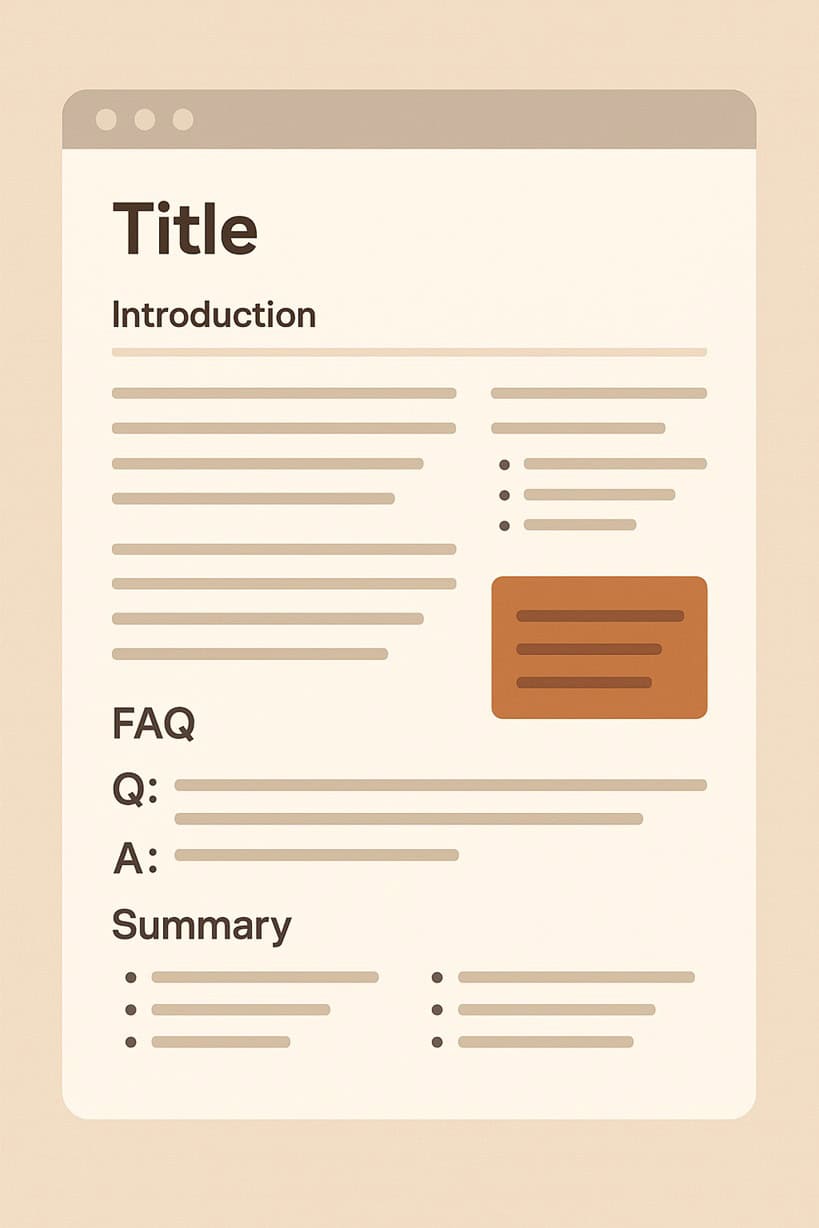
3. The GEO + AEO Formatting Template (Copy + Paste)
Use this for every article to guarantee clarity and AI readability.
AEO/GEO-Optimized Template
Title:
[Clear benefit-focused title]
Introduction (2–4 sentences):
State what this guide covers, why it matters, and what the reader will learn.
Definition:
[Topic] is defined as…
Section 1 — Key Concept
Short paragraph
List or steps
Example
Section 2 — Supporting Idea
Short paragraph
List or steps
Example
Section 3 — How to Apply It
Short paragraph
Steps
Example
Examples Section
Example 1
Example 2
FAQ Section
Q:
A:
Q:
A:
Summary / TL;DR
- Bullet summary
- Bullet summary
- Bullet summary
4. Mistakes to Avoid (Formatting Edition)
❌ Walls of text
AI can’t extract meaning.
❌ Vague headings
AI misinterprets sections.
❌ Starting with a story instead of an answer
Humans like it. AI ignores it.
❌ Overuse of bold and italics
Looks spammy and dilutes meaning.
❌ No FAQ or summary
Huge missed AEO opportunity.
5. Formatting Checklist (Printable)
✔ Clear title
✔ Short intro
✔ Early definition
✔ H2/H3 headings
✔ Short paragraphs
✔ Lists + steps
✔ Examples
✔ FAQ section
✔ Summary
✔ Clean, simple formatting
TIP: If you’d like to have all of the AI powered search strategies in one place, read SEO, GEO, and AEO for Indie Authors: Strategic Optimization for AI Search (paperback or eBook).
FAQs
Q: Do tools matter more than strategy?
A: No. Tools support strategy. They don’t replace it. Clear goals, reader-focused content, and consistency matter much more than any specific tool.
Q: Can new indie authors compete with big websites?
A: Yes. New indie authors often have an advantage because AI systems value firsthand experience, clarity, and relevance. Well-structured content written from real experience can outperform larger sites that publish generic information.
Q: Do authors need credentials to build authority?
A: No. Authority can be built through lived experience, clear explanations, consistency, and helpful content. Credentials help, but they are not required.
We hope you’ve found the writer’s guide strategies helpful and motivating. We hope they’ll equip you with the insights and tools needed to help you succeed as a new author.
For more guidance, see other writer’s guides in this series. I suggest starting with the first one: Is SEO Dead? What to Know About GEO and AI Search. Or read AI Empowers New Indie Authors: 5 Best Hacks.
Writing is a journey of continuous learning and improvement. You don’t have to go it alone. We’re excited to continue the journey with you, providing guidance and encouragement every step of the way. Our goal is to provide essential insights and practical advice to help you navigate the writing world with increased confidence.
If you have a draft you want to publish and are wondering how AI can help, read Is Your Book Ready to Self-Publish? Lastly, for help writing a non-fiction book, read Write Your First Non-Fiction eBook: a 30-Day Workbook for Getting It Done.
Don’t wait. Start today!
How can we help? To let us know, please fill out our Contact form.
Happy writing!