AI for Collaborative Drafting Without Losing Voice: 6 Hacks
“Working with AI is more than just pushing buttons. It’s about asking the right questions.” — Dr. Jaime Teevan, Chief Scientist and Technical Fellow at Microsoft
When indie authors reach the drafting stage, the pressure often increases. By that point, you may already have a strong idea, a rough outline, scattered notes, and a real need to make progress. If you are balancing writing with work, family, caregiving, or other responsibilities, it can feel tempting to ask AI to draft the whole chapter and call it momentum.
That shortcut usually creates a different problem. The draft may come back looking polished, organized, and readable. Yet something essential often goes missing. The voice feels flatter. The insights sound more generic. The examples seem interchangeable. The section may say the right kinds of things, but not in a way that sounds distinctly like you.
This part of our writer’s guide series on AI Systems will show you how to use AI for collaborative drafting in a more effective way, one that helps you move faster while keeping the substance, judgment, and voice in your hands.
For all the writer’s guides in this series, along with several bonuses, grab our ebook: Write Smarter, Stay Human: Use AI Without Losing Your Voice, Values, or Vision (available on Amazon).
What Collaborative Drafting Means
Collaborative drafting is not handing your chapter to AI and hoping for the best. It is a human-led process where AI helps you build momentum, deepen ideas, and strengthen weak spots more quickly.
That distinction matters. In nonfiction, readers are not just looking for clean sentences. They are looking for clarity, usefulness, and trust. They want guidance that feels grounded in real thought and real understanding. If your chapter sounds like generic internet advice, the value drops fast.
Collaborative drafting works best when you begin with material that already belongs to you. That might be a rough outline, a voice memo, a freewrite, a list of teaching points, journal notes, workshop material, or a paragraph that captures the heart of the section. Once your own thinking is on the page, AI has something real to respond to.
That is the difference between support and substitution. Support strengthens your work. Substitution weakens authorship.
Why “Draft the Chapter” Is Often the Wrong Prompt
Many nonfiction authors lose control of a project the moment they start with a blank request.
If you ask AI to “write a chapter on changing habits” or “draft a chapter on healing after burnout,” the result may sound competent, but it usually stays broad and predictable. That is because the tool is filling in missing direction with general patterns. It is producing something plausible, not something deeply yours.
A better approach is to begin with section goals. Instead of requesting a finished chapter, clarify what that section actually needs to accomplish.
For example, you might decide that a section should:
- open with the reader’s frustration
- explain why a common piece of advice fails
- introduce a more realistic model
- offer one quick action step
- end with a short checklist or reflection
That kind of structure gives AI a job to support instead of a topic to fill. It also keeps you focused on the reader’s benefit, which is especially important for nonfiction.
Start with Section Anchors
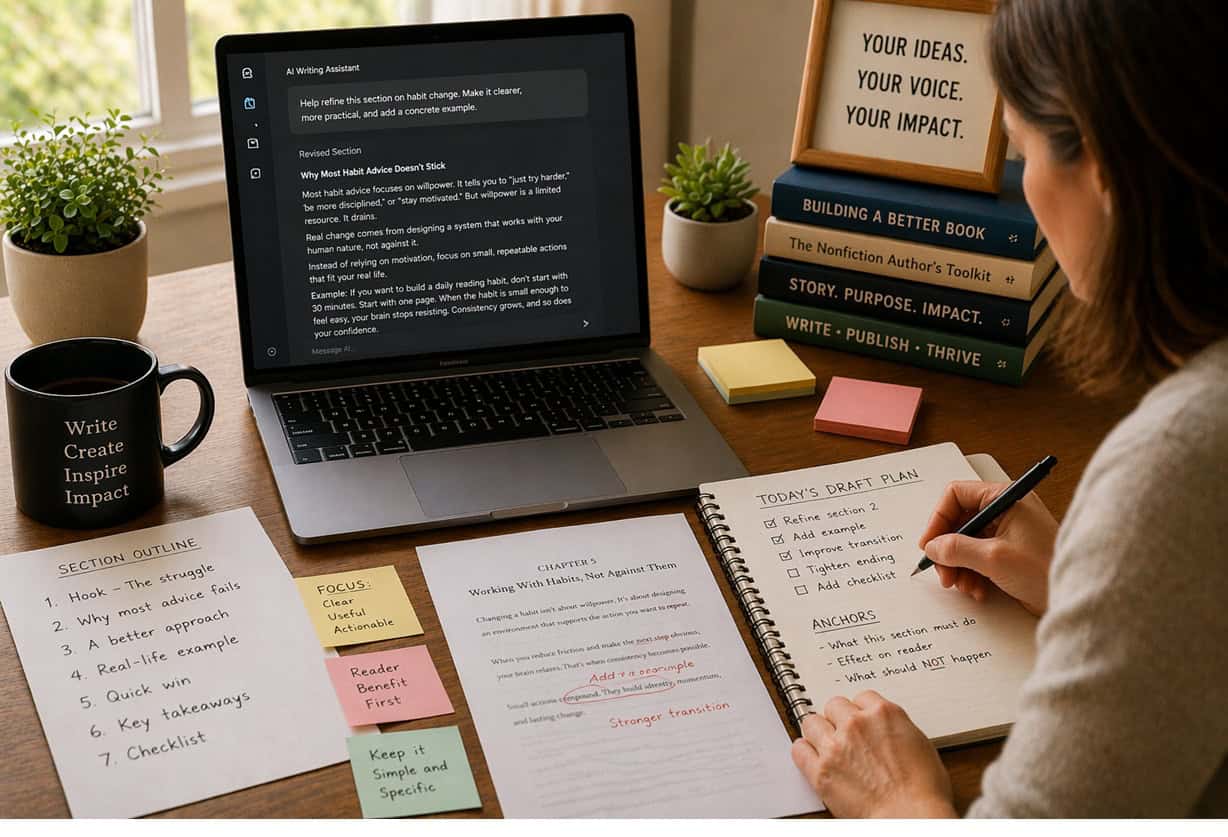
One of the smartest habits you can build is to define a few anchors before involving AI in the draft.
These anchors can be very simple:
- What must this section do?
- What effect should it have on the reader?
- What should not happen in this section?
Those three questions create useful boundaries. They help you protect the section’s purpose before the language expands. They also reduce drift, which is one of the biggest risks in AI-assisted drafting. A section can grow quickly while quietly wandering away from the point you meant to make.
For example, an indie author writing a self-help book might decide a section needs to help readers stop mistaking busyness for meaning. The desired effect may be relief, clarity, and a sense of permission to rethink their habits. What should not happen is a lecture, a guilt-heavy tone, or a string of abstract ideas with no practical takeaway.
That is enough direction to create a strong drafting session.
Use AI to Deepen
AI becomes far more useful when you ask it to deepen material rather than replace it.
For nonfiction, that may mean asking for help with tasks like:
- sharpening an explanation
- suggesting a clearer sequence
- identifying where reasoning feels thin
- spotting repetition
- offering transition options
- showing where a beginner may feel confused
- pointing out where an example would strengthen the section
These are excellent uses of AI because they improve work you have already shaped. They help you think more clearly on the page without sacrificing the core message.
Imagine you drafted a section about emotional regulation for overwhelmed parents, but the passage still feels too abstract. Instead of asking AI to rewrite the whole thing, you might ask it to identify where the explanation feels vague, suggest where a concrete example could help, or point out where a stressed reader might lose the thread.
That gives you practical support without handing over the substance of the section.
Quick Win: Before asking AI for any drafting help, write five to seven sentences in your own words about what the section is trying to do. That small step creates a stronger foundation for every prompt that follows.
Use a Perspective Pivot to Expose Weak Spots
A useful way to test a section is to review it from a different reader perspective.
This is especially helpful in nonfiction because writers often know too much about their own topic. What feels obvious to you may feel confusing, intimidating, or emotionally heavy to the reader. A perspective pivot helps you see the section from a fresh angle.
You might review a draft from the perspective of:
- a new reader who feels intimidated
- a skeptical reader who wants proof or practicality
- a busy reader who needs the point faster
- a vulnerable reader who needs more reassurance and less pressure
This shift often reveals problems you would otherwise miss. You may notice where you buried the main takeaway, assumed too much background knowledge, or sounded polished without being helpful. You may also discover that the reader needs more structure, grounding, or warmth before the advice feels usable.
That kind of diagnostic reading can dramatically improve a chapter without requiring a full rewrite.
Common Traps to Watch for in AI-assisted Drafting
AI can help you move faster, but speed creates its own set of risks. The more aware you are of them, the more effectively you can work around them.
One common trap is flattened prose. The paragraph reads smoothly, but it is forgettable. It says sensible things without offering a distinct angle or memorable insight.
Another trap is over-explaining. AI tends to fill gaps, define everything, and smooth every edge. The result can feel padded or overmanaged, especially in nonfiction, where readers want clarity more than excess explanation.
A third trap is energy loss. Early drafts should still carry some life. They should sound like a real author thinking, teaching, questioning, and refining. If every paragraph feels polished too early, you may have cleaned away the urgency or humanity that made the section worth reading.
There is also the illusion of completeness. AI can produce something that looks finished before your thinking is finished. A tidy paragraph is not always a useful paragraph. A smooth section is not necessarily a strong one.
Pro Tip: If a draft sounds polished but does not feel specific, helpful, or memorable, slow down. Ask yourself what only you could add here. That question often leads you back to the material that gives the section real authority.
Keep the Draft Human-Led
The strongest collaborative drafting process follows a simple principle: the human provides meaning, and the tool provides support.
You decide which promise the chapter makes to the reader. You decide what the section must accomplish. You choose the examples, the tone, the structure, and the final wording. AI can help you see blind spots, strengthen transitions, and expand useful material with less friction. It can support momentum. It cannot replace responsibility.
That is especially important in nonfiction, where trust matters so much. Readers are not simply looking for information. They are looking for a guide. They want to feel that someone thoughtful is leading them through the material.
When you keep the draft human-led, AI becomes a useful creative partner rather than a substitute author.
Why This Approach Builds Better Books
Collaborative drafting helps you protect three things that matter deeply in nonfiction: your voice, your authority, and the reader’s trust.
When you start with your own notes and section goals, you keep the chapter rooted in your thinking. When you use AI to deepen rather than replace, you strengthen the material without losing ownership. When you revise by hand, you bring the language back into alignment with your tone and standards.
That combination leads to stronger chapters. It also makes the drafting process less intimidating because you are no longer staring at a blank page or expecting a single tool to carry the entire burden.
You are building momentum in a way that still sounds like you.
Bringing It Together
AI can absolutely help nonfiction indie authors draft more efficiently. The key is to use it in a way that supports the real work rather than replacing it.
Start with your own material. Set clear section goals. Use anchors to guide the draft. Ask AI to deepen what is already there. Test the section from the reader’s point of view. Watch for generic language, over-explaining, and false polish. Then revise the assisted draft by hand, so it reflects your actual voice and judgment.
That is collaborative drafting at its best. Human-led, useful, and worth reading.
Checklist: Keep the Draft Yours
- Start with your own notes, outline, voice memo, or rough teaching points.
- Clarify what the chapter or section must accomplish.
- Identify the effect you want the reader to experience.
- Note what should not happen in the section.
- Use AI to deepen existing material.
- Ask for help with clarity, transitions, structure, or example placement.
- Use a perspective pivot to test the chapter from the reader’s side.
- Watch out for generic prose, over-explaining, and loss of energy.
- Do not confuse polished output with finished thinking.
- Revise AI-assisted passages by hand.
- Keep the final judgment with the author.
- Use speed to build momentum.
We hope you found these writer’s guide strategies helpful and inspiring. They’re intended to provide you with the necessary tools and insights to succeed as an indie author.
For more guidance, see other writer’s guides in this series. We suggest starting with the first one, Use AI Without Losing Your Author Voice: 6 Best Hacks.
For all the writer’s guides in this series, along with several bonuses, grab our ebook: Write Smarter, Stay Human: Use AI Without Losing Your Voice, Values, or Vision (available on Amazon).
Writing is an ongoing adventure that involves continuous learning and improvement. You don’t have to go through this alone. We are excited to accompany you every step of the way, providing you with support and motivation. Our goal is to give you the necessary knowledge and practical advice to navigate the world of writing with confidence.
If you have a draft and want to explore how AI can help you self-publish it, read, Is Your Book Ready to Self-Publish?
For help writing a nonfiction book, read Write Your First Nonfiction eBook: a 30-Day Workbook for Getting It Done.
Don’t wait. Start today! How can we help? To let us know, please fill out our Contact form.
Happy writing!