Make a Subplot Support the Main Story: 5 Best Hacks
“I think it’s important that subplots are related to the main plot in some way.” –Wesley Chu, Writing Excuses
Subplots can be interesting and still weaken your novel.
That was an important distinction for me to learn. I tend to enjoy developing relationships and secondary story threads, so coming up with material usually isn’t the problem. The harder question is whether that material belongs in this particular story.
Subplots earn their place by contributing something the larger novel needs. It might deepen a character, complicate a decision, develop a relationship, explore another side of the story’s concerns, or create consequences that affect the main story.
But it shouldn’t feel like another novel temporarily sharing the same pages. That relationship does not have to be obvious or mechanical. It simply needs a reason to be part of this story.
Give Every Subplot a Job
One of the most useful questions you can ask about a secondary story is surprisingly simple: What would my novel lose if I removed it?
If the only answer is word count, variety, or “I like those scenes,” the subplot may need more work.
A useful subplot might:
- Reveal something important about a character
- Complicate a choice or goal
- Develop an important relationship
- Create consequences that affect other parts of the story
- Provide a meaningful contrast to the main conflict
- Explore another side of a question or concern already present in the novel
A secondary story can perform more than one of those jobs. It also doesn’t have to directly advance the external plot every time it appears. That distinction matters. “Support the main story” is broader than “move the main plot forward.”
For example, a relationship subplot may primarily expose vulnerability, divided loyalty, or conflicting priorities in the protagonist. Those changes can matter deeply even when the subplot does not cause the next major plot event.
The key is contribution.
Connect Without Forcing It
A subplot can have its own characters, problems, and progression while still feeling connected to the larger novel.
The connection may come through consequences. Something that happens in the subplot changes what a character decides in the main story. A main-story event creates a new problem within the subplot. Pressure from one storyline makes another harder to manage.
The connection may also be emotional or thematic. Two storylines may ask different versions of the same question. One relationship may contrast with another. A secondary character’s choices may highlight something the protagonist does, or refuses to do.
Look for places where the different parts of the novel naturally affect each other.
In one of my own novels, I’m developing a secondary relationship thread that needs to remain subtle. I don’t want it to compete with the story’s central relationship or take over scenes that belong to the main plot. That creates a balancing problem.
If I give the thread too much attention, it becomes distracting. If I give it too little, readers may wonder why I introduced it at all.
The useful question isn’t simply: “How many scenes should this subplot get?”
It’s: “What does the reader need to see for this thread to accomplish its purpose?”
That keeps the focus on story function rather than an arbitrary formula.
Check the Shape and Proportion
Sometimes the problem is how much, or how little, space the novel gives it.
A subplot may begin strongly and then disappear for so long that readers forget about it. Another may receive substantial attention early but resolve in a sentence near the end. Occasionally, a secondary storyline becomes so compelling that it starts competing with the story the novel originally promised.
Look at the subplot as a small progression within the larger story.
Ask:
- Does it develop, or does it simply appear occasionally?
- Do circumstances change as the subplot continues?
- Does it affect the characters involved?
- Does the amount of page time match its importance?
- Does its resolution feel proportionate to the attention it received?
“Proportionate” doesn’t mean every subplot needs an elaborate ending. A small subplot may need only a small resolution. But if you spend a large portion of the novel teaching readers that something matters, they will reasonably expect some kind of payoff.
Let AI Question It
Subplots are particularly useful territory for AI analysis because you already know what you intended them to accomplish. AI doesn’t. That makes its interpretation potentially revealing.
Instead of asking AI to invent better subplots, try asking it to identify the function of the one you already have.
You might provide a short description of the main story and the major beats of the secondary one, then ask:
- What does this subplot appear to contribute to the novel?
- Where does it meaningfully intersect with the main story?
- Does its importance seem to increase, decrease, or remain static?
- Are there places where the subplot appears disconnected?
- Does its resolution seem consistent with the attention it received?
- What might the main story lose if this subplot were removed?
Pay particular attention to places where AI misunderstands the subplot.
The misunderstanding may simply be an AI error. But it can also reveal that the connection you see clearly in your head isn’t yet visible in the material you provided.
You can then ask a more useful follow-up: What information led you to that conclusion?
That forces the analysis back toward evidence rather than letting AI confidently redesign your story.
Diagnose Before You Change Anything
AI may tell you a secondary story is unnecessary when you know it serves an important purpose.
It may suggest expanding a romance because romance is recognizable and easy to develop. It may recommend merging characters because simplification looks efficient from the outside.
None of those suggestions automatically belongs in your novel. Instead, use the response to sharpen your own diagnosis.
If a secondary story isn’t working, you have several choices:
- Keep it if it already performs its intended job.
- Expand it if an important thread is too underdeveloped to work.
- Compress it if it contributes something useful but receives too much attention.
- Combine it with another subplot if two threads are performing nearly the same job.
- Reconnect it if the material is worthwhile but feels detached from the main story.
- Remove it if the novel genuinely becomes stronger without it.
The goal is to make every subplot purposeful.
Subplot Support Checklist
For each significant subplot in your novel, ask:
- What job does this subplot perform?
- What would the novel lose if I removed it?
- Where does it connect with or affect the main story?
- Does it develop rather than merely reappear?
- Is the attention it receives proportionate to its importance?
- Does its resolution match the expectations the novel created?
- Should I keep, expand, compress, combine, reconnect, or remove it?
Strong subplots don’t need to constantly announce their importance. But by the end, the reader should feel it belonged there.
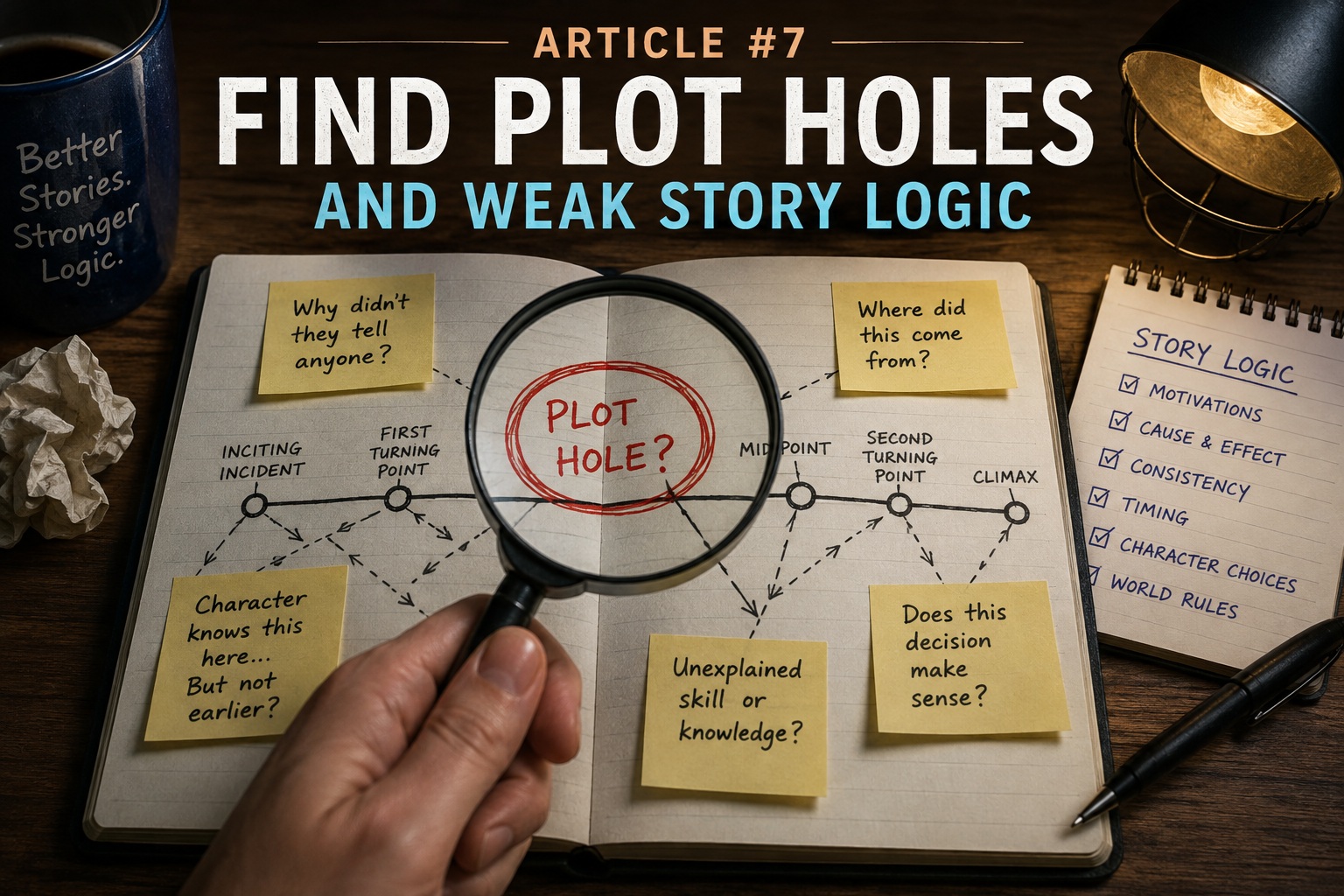
Once your plot and subplots are working together, the next question is whether all those story connections actually make sense.
Watch for the next article in our series on craft and story development. We’ll look at how AI can help you find plot holes and weak story logic without turning the process into a full manuscript revision.
For more guidance, see other writer’s guides in our series on craft and story development. We suggest starting with the first one, Use AI Without Giving Up Your Story.
We hope you found these writer’s guide strategies helpful and inspiring. They’re intended to provide you with the necessary tools and insights to succeed as an indie author.
You might also enjoy some of our books:
AI Future Ready Skills for Indie Authors
Amazon KDP Made Easy: A Simple, Stress-Free System to Self-Publish Your First Book on Amazon
Writing is an ongoing adventure that involves continuous learning and improvement. You don’t have to go through this alone. We are excited to accompany you every step of the way, providing you with support and motivation. Our goal is to give you the knowledge and practical advice to navigate the world of writing with confidence.
If you have a draft and want to explore how AI can help you self-publish it, read, Is Your Book Ready to Self-Publish?
Don’t wait. Start today! How can we help? To let us know, please fill out our Contact form.
Happy writing!