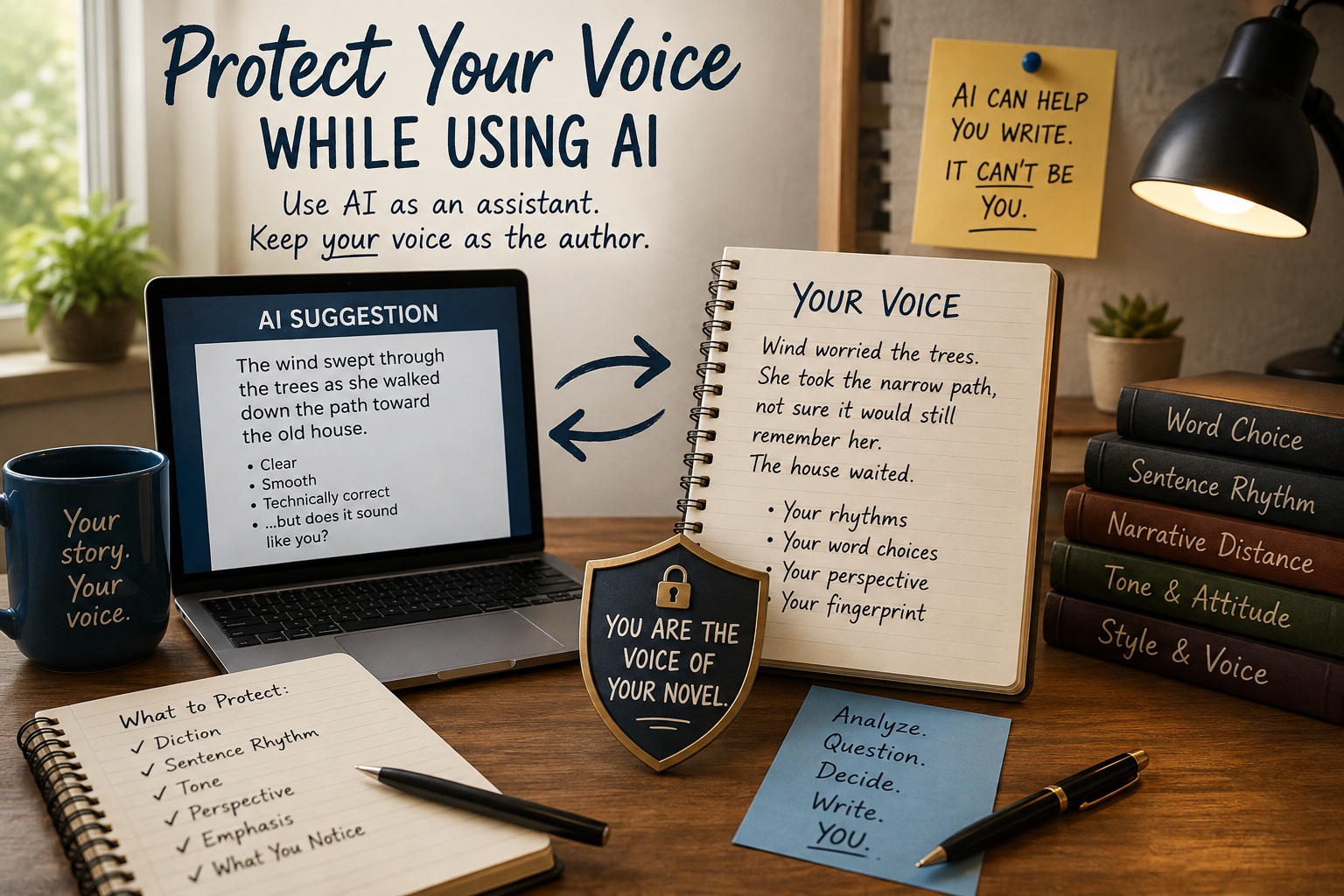
Protect Your Voice While Using AI: 8 Best Hacks
“Grammar and syntax are kind of the skeleton of the sentence.” — Ursula K. Le Guin
AI can make a sentence clearer, tighter, smoother, and more polished. That does not necessarily make it better.
I’ve had AI suggest changes that were perfectly acceptable English but didn’t sound like something I would write. The sentence was polished. The problem was that some of its personality had disappeared.
That matters even more in fiction.
Your voice is part of what makes your novel sound like your novel rather than a technically competent version of anybody’s novel. If you use AI while developing or drafting fiction, you need to recognize when it is helping your prose and when it is gradually sanding away what makes the prose yours.
Voice Is More Than Word Choice
Writers sometimes talk about voice as if it were a mysterious quality you either have or don’t have.
It is easier to work with when you break it into smaller choices.
Your narrative voice develops partly through patterns such as:
- The words you tend to choose;
- The length and structure of your sentences;
- The rhythm of your prose;
- How formal or conversational the narration sounds;
- How close the narration stays to a character’s thoughts and perceptions;
- What the narration notices;
- How much it explains;
- How directly or indirectly it expresses emotion;
- Where you use fragments, repetition, humor, understatement, or emphasis.
None of those elements alone creates your voice. Together, repeated across hundreds of sentences, they begin to create something recognizable.
Ursula K. Le Guin emphasized sound, rhythm, syntax, sentence construction, point of view, and narrative voice as fundamental elements of storytelling craft. Her approach reminds us that prose style grows from how language works together, not from decorating sentences with distinctive words.
That also explains why AI can alter your voice even when it barely changes the meaning.
AI Can Improve the Sentence and Weaken the Voice
Suppose you give AI a paragraph and ask: “Improve this.”
That sounds reasonable, but improve can mean almost anything.
The AI may shorten sentences, remove repetition, replace unusual wording, add transitions, clarify implications, smooth fragments, or make every thought more explicit.
Some of those changes might genuinely help. Others may remove choices you made intentionally.
A short fragment may create tension. Repetition may establish rhythm. An unexpected word may reveal the narrator’s attitude. A slightly uneven sentence may sound more natural in a particular narrative voice.
If AI treats every irregularity as something that needs fixing, the prose can become increasingly standardized.
It may also begin to favor patterns you would not normally use: similar sentence structures, predictable transitions, explanatory phrases, balanced constructions, or wording that sounds polished but impersonal.
The danger is usually accumulation.
Accept enough small changes without thinking about them, and you may eventually realize the writing sounds less like you than it did when you started.
Learn What You Want to Protect
One of the best protections against unwanted AI smoothing is becoming more conscious of your own writing patterns.
That does not mean creating a rigid voice formula.
You do not need a rule that says, “I write twelve-word sentences and use exactly three metaphors per chapter.”
Instead, pay attention to tendencies.
When I work with AI, I’ve found that this awareness makes it much easier to evaluate suggestions. I can recognize changes that improve clarity without objecting simply because they came from AI.
I can also recognize wording that may be technically fine but does not sound like me. That distinction is important.
Protecting your voice does not mean protecting every sentence you write.
Sometimes a sentence is confusing. Sometimes the rhythm really is awkward. Sometimes your favorite phrase is doing nothing useful.
The goal is to make the final decision deliberately.
Try looking at a few pages of your own fiction and asking questions such as:
- Do I usually favor simple or complex sentence structures?
- Where do I naturally vary sentence length?
- How directly does my narrator explain emotion?
- Do I tend toward plain language, lyrical language, humor, understatement, or something else?
- What kinds of details does my narration notice?
- Do I sometimes use fragments or repetition intentionally?
- How close does the narration stay to the viewpoint character?
You are not trying to lock yourself into those patterns forever. You are learning to recognize them.
Ask AI to Analyze Before It Rewrites
AI can actually help you understand your voice if you give it the right job.
Instead of immediately asking for rewritten prose, ask it to examine what is already there.
For example:
Analyze this passage without rewriting it. Identify recurring patterns in diction, sentence structure, rhythm, tone, narrative distance, and emphasis. Tell me which patterns appear distinctive and which may simply be accidental repetition.
Then evaluate the response.
AI may notice something useful that you have never consciously identified. It may also overinterpret a tiny sample or describe your writing with vague labels that could apply to almost anyone.
That is why your judgment still matters.
You can also use AI to compare your original prose with a suggested edit.
Try:
Compare these two versions. Do not decide which is better. Explain what changed in sentence rhythm, diction, tone, narrative distance, emphasis, and overall stylistic effect.
Now AI is helping you see the consequences of a choice. That can be far more useful.
Ask What the Revision Gained and What It Lost
When writers evaluate an AI suggestion, the obvious question is: “Is this better?”
That question can hide important tradeoffs.
Try asking two questions instead: What did this change improve?
And: What did this change remove?
- A rewritten sentence may gain clarity but lose humor.
- It may gain efficiency but lose atmosphere.
- It may become grammatically smoother while moving the reader farther from the viewpoint character.
- It may eliminate repetition that was actually creating emphasis.
- It may explain something stronger when implied.
Once you see both sides of the change, you have more useful choices. You can accept the suggestion. You can reject it.
Or you can make your own revision that solves the original problem without sacrificing the quality you want to preserve.
That third option is easy to overlook when AI presents a polished alternative in seconds.
Not Every Imperfection Needs to Be Fixed
Writers hear plenty of rules about prose.
Vary your sentence length. Eliminate unnecessary adverbs. Avoid repetition. Use stronger verbs. Remove filler. Tighten everything.
Most of that advice can be useful in the right situation. None of it means every sentence should be optimized according to the same standard.
Fiction depends on variation.
A long sentence can create a different experience from a short one. Repetition can be annoying or powerful. An adverb can be unnecessary or exactly the word the sentence needs.
Good voice often includes choices that would look inefficient if you evaluated prose only for clarity and compression.
That does not excuse sloppy writing.
It means you need to distinguish between an accident and a choice.
AI cannot reliably make that distinction for you because it does not know what effect you intended unless you provide enough context—and even then, its interpretation remains a suggestion.
You know what the novel is trying to sound like.
Give AI a Narrower Job
Broad instructions give AI broad permission.
- “Make this better.”
- “Make this more engaging.”
- “Polish my prose.”
Those requests invite the AI to decide what “better,” “engaging,” and “polished” mean.
Narrower requests keep more of that judgment with you.
You might ask AI to:
- Identify sentences that may be unclear without rewriting them;
- Point out repeated sentence structures;
- Flag places where the narrative distance appears to change;
- Identify words or phrases that sound noticeably more formal than the surrounding passage;
- Compare the rhythm of two versions;
- Identify where an edit changes implication into explanation;
- Offer several possible solutions instead of replacing the passage wholesale.
Then decide what deserves revision. This approach may require more thought than simply accepting a polished rewrite. That is precisely why it helps protect your voice.
Your Voice Should Still Be Allowed to Change
Protecting your voice does not mean freezing it.
- Your writing will change as you gain experience.
- You may become more concise in some places and more expansive in others.
- You may discover rhythms, techniques, or approaches you did not use in earlier work.
That growth belongs to you.
The important question is whether your style is changing because you are making increasingly intentional craft choices or because you have repeatedly accepted somebody else’s preferred wording.
AI can expose you to alternatives.
- It can identify habits.
- It can show you another way to construct a sentence.
- It can help you see your prose more clearly.
But you decide which lessons become part of your writing.
That is the difference between using AI to develop your voice and allowing AI to replace it.
Action Steps
- Choose a short passage of your fiction. Select something that sounds reasonably representative of the way you naturally write.
- Identify three to five voice patterns. Look at diction, syntax, rhythm, narrative distance, emphasis, and the kinds of details your narration notices.
- Ask AI to analyze rather than rewrite. See whether it identifies the same characteristics you noticed.
- Test one suggested edit. Compare the original and revised versions. Ask what improved and what may have been lost.
- Make the final version yourself. Accept the AI wording, reject it, modify it, or write a different solution according to what best serves your novel.
AI can help you hear your writing more clearly. Just make sure the voice you hear at the end is still yours.
For more guidance, see other writer’s guides in our series on craft and story development. We suggest starting with the first one, Use AI Without Giving Up Your Story.
We trust you’ve found this writer’s guide both enlightening and inspirational. It’s designed to equip you with the tools and insights to bolster your success as a burgeoning author.
You might also enjoy some of our books:
AI Future Ready Skills for Indie Authors
Amazon KDP Made Easy: A Simple, Stress-Free System to Self-Publish Your First Book on Amazon
The path of writing is one filled with ceaseless learning and enhancement. You are not expected to tread this path solo. We’re thrilled to accompany you on this journey, offering support and motivation at every turn. Our objective is to deliver foundational knowledge and practical guidance, enabling you to navigate the literary landscape with greater confidence.
How can we help? To let us know, please fill out our Contact form.
Happy writing!