E-E-A-T: Build Online Trust, Authority, and Visibility
“Experience is a very valuable thing. You can’t fake it, and you can’t shortcut it.” — Joanna Penn, The Creative Penn
If search engines and AI tools could give new indie authors one message, it would be this:
“We feature content we trust.”
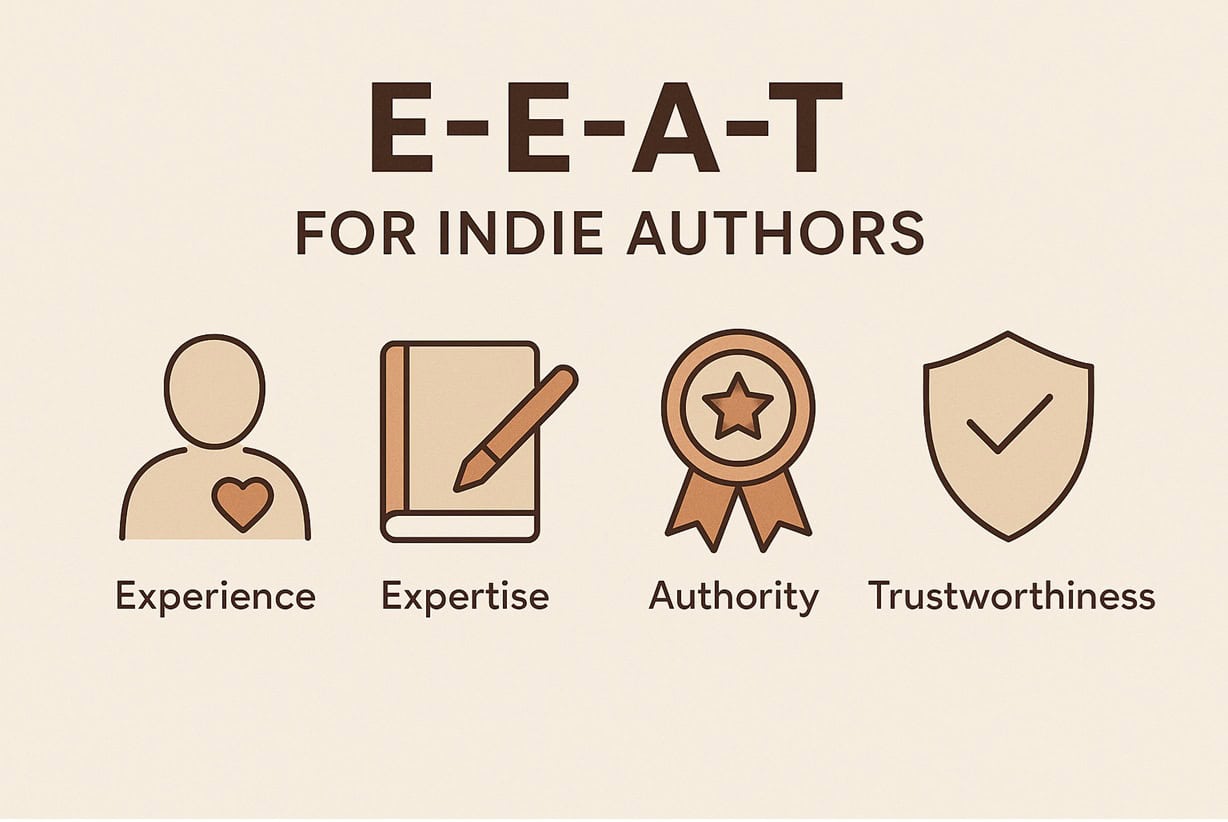
That’s where E-E-A-T comes in. It was originally introduced by Google. But it’s now heavily relied on by AI systems like ChatGPT, Gemini, Claude, Copilot, and Perplexity. The letters stand for four key elements:
- Experience
- Expertise
- Authority
- Trustworthiness
These four elements help search engines and AI determine whether your content deserves to be surfaced, cited, or recommended.
And for new indie authors competing in an increasingly crowded digital space, the four elements is often the deciding factor between:
- Your articles being shown or ignored
- Your website being trusted or overlooked
- Your advice being quoted or skipped
- Your books being discovered or buried
This part of our SEO, GEO, and AI Search for Indie Authors series explains what these four elements really mean for new indie authors and how to build it step by step. If you’d like to have all of the AI powered search strategies in one place, read SEO, GEO, and AEO for Indie Authors: Strategic Optimization for AI Search (paperback or eBook).
What Is E-E-A-T? (Plain English)
The four elements are a collection of signals search engines and AI systems use to evaluate:
- Who wrote the content
- Why that person is qualified
- How reliable the information is
- Whether the content genuinely helps readers
When your E-E-A-T is strong, your content is more likely to be:
- Ranked in search results
- Used in AI-generated answers
- Quoted in summaries
- Recommended to readers
- Trusted by potential subscribers and buyers
Important clarification: It’s a pattern of credibility signals built over time. It’s not a score.
Why These Matter So Much for New Indie Authors
Here’s the good news: new indie authors are not at a disadvantage.
In fact, you have a built-in strength that big brands often lack: real experience.
Your journey includes:
- Learning how to write consistently
- Navigating self-publishing for the first time
- Making mistakes and fixing them
- Testing tools, platforms, and strategies
- Figuring out what actually works
AI systems increasingly favor content grounded in lived experience, not generic theory. That means when you clearly share what you’ve done, learned, or tested, you’re giving AI exactly what it wants.
When you highlight your experience and explain it clearly, AI engines become far more likely to:
- Retain your content
- Cite your articles
- Use your explanations in answers
- Surface your site in search results
Which leads to more:
- Website traffic
- Email subscribers
- Reader trust
- Book sales
- Long-term author platform growth
Breaking Down E-E-A-T for New Indie Authors
Let’s walk through each element and what it looks like in practice.
E — Experience (Your Secret Weapon)
Experience is about firsthand knowledge, not credentials. Examples a new indie author might naturally include:
- “When I published my first book, I underestimated how long formatting would take…”
- “After revising my manuscript three times, I realized…”
- “When I tested Amazon ads on a small budget…”
- “Readers of my first novel consistently asked me…”
These statements quietly tell AI systems:
“This author isn’t repeating theory. They’ve lived this.”
You don’t need decades of experience—just honesty and clarity.
E — Expertise (Skill in Action)
Expertise is demonstrated through how you explain things, not just what you claim. You show expertise when you:
- Break processes into steps
- Define terms clearly
- Compare options thoughtfully
- Explain why something works
- Share lessons learned
Even brand-new indie authors can demonstrate expertise by documenting what they’re learning in a structured, helpful way.
AI systems love:
- Step-by-step explanations
- Clear definitions
- Practical examples
These naturally signal competence.
A — Authority (Recognition Over Time)
Authority grows when others begin to recognize your work.
For indie authors, authority signals may include:
- Reader testimonials
- Book reviews
- Guest articles
- Podcast interviews
- Workshop or webinar teaching
- Community involvement
- A consistent blog series
You don’t need media fame. Depth + consistency builds authority.
Your ongoing SEO/GEO series itself is an authority signal.
T — Trustworthiness (The Foundation)
Trust is the most critical element.
Trust is built when your content is:
- Accurate
- Clear
- Honest
- Up-to-date
- Helpful rather than hype-driven
Additional trust signals include:
- A clear About page
- Transparent contact information
- Privacy and disclaimer pages
- Secure (HTTPS) website
- No clickbait or exaggerated claims
AI engines strongly prefer trustworthy sites—because they’re responsible for what they surface.
The Age of AI Search (GEO + AEO)
Generative Engine Optimization (GEO) and Answer Engine Optimization (AEO) rely heavily on the four elements.
Why?
Because AI must feel confident about:
- Your experience
- Your clarity
- Your accuracy
- Your examples
Strong E-E-A-T increases the likelihood that AI will reuse your content in answers.
High-value formats include:
- Clear definitions
- FAQs
- Step-by-step guides
- Structured explanations
- Author bios with context
Your clean formatting, short paragraphs, and examples are already doing this work for you.
Practical Ways New Indie Authors Can Build E-E-A-T Today
Here’s a realistic checklist you can act on immediately.
Strengthen Your Author Bio
Include:
- What you write
- Your publishing stage
- What you’re actively learning or teaching
- A human, relatable detail
Use this bio consistently across your site.
Add Experience Statements to Articles
One sentence is enough.
Examples:
- “While publishing my first book, I tested several formatting tools and learned…”
- “As a new indie author navigating self-publishing, here’s what surprised me…”
Small additions, big impact.
Cite Reliable Sources When Appropriate
Link to:
- Publishing platforms
- Writing craft books
- Industry leaders
- Credible studies
Evidence strengthens trust.
Build Topic Clusters
Related articles reinforce authority.
Your SEO → GEO → AEO → E-E-A-T progression is a perfect example.
Update Content Periodically
Even small updates signal trust and relevance.
Show Social Proof
A few reviews, testimonials, or reader comments go a long way.
Keep Your Site Technically Trustworthy
Ensure:
- HTTPS
- Mobile-friendly design
- Fast load times
- No broken links
Technical trust matters more than many authors realize.
Realistic Examples for Indie Authors
Experience
“I’m a new indie author documenting what I’m learning as I publish my first books.”
Expertise
“I break down complex publishing topics into steps new authors can follow.”
Authority
“My articles help writers avoid common mistakes early in their journey.”
Trustworthiness
“This guide is updated as tools and platforms change.”
TL;DR
- E-E-A-T helps AI and search engines decide whether to trust your content
- New indie authors already have valuable experience
- Clear explanations matter more than credentials
- Consistency builds authority over time
- Trust comes from honesty, accuracy, and helpfulness
- Strong E-E-A-T increases visibility, traffic, and book discovery
E-E-A-T Checklist for Indie Authors (Printable)
Experience
✔ Share real examples
✔ Reference your journey
✔ Add personal insights
Expertise
✔ Include credentials
✔ Demonstrate clear knowledge
✔ Give step-by-step advice
Authority
✔ Add testimonials or reviews
✔ Link to interviews or features
✔ Create topic clusters
Trustworthiness
✔ Keep content updated
✔ Use clean, clear formatting
✔ Avoid sensational claims
✔ Provide accurate information
FAQs
Q: What is E-E-A-T, and why does it matter for authors?
E-E-A-T stands for Experience, Expertise, Authority, and Trustworthiness. It helps search engines and AI systems determine whether an author’s content is credible, reliable, and worth sharing.
Q: Do authors need credentials to build authority?
No. Authority can be built through lived experience, clear explanations, consistency, and helpful content. Credentials help, but they are not required.
Q: Can new indie authors compete with big websites?
Yes. New indie authors often have an advantage because AI systems value firsthand experience, clarity, and relevance. Well-structured content written from real experience can outperform larger sites that publish generic information.
Q: How long does SEO and GEO take to work?
SEO and GEO are cumulative. Early signals can appear within weeks, but meaningful visibility usually builds over several months through consistent publishing and updates.
We trust you’ve found this writer’s guide both enlightening and inspirational. We designed it to equip you with the tools and insights to bolster your success as a burgeoning author.
The path of writing is one filled with ceaseless learning and enhancement. You are not expected to tread this path solo. We’re thrilled to accompany you on this journey, offering support and motivation at every turn. Our objective is to deliver foundational knowledge and pragmatic guidance, enabling you to traverse the literary landscape with amplified confidence.
For more guidance, see other writer’s guides in this series. Start with the first guide, Is SEO Dead? What to Know About GEO and AI Search.
If you have a draft you want to publish with the help of AI, read, Is Your Book Ready to Self-Publish? Lastly, for help writing a non-fiction book, read Write Your First Non-Fiction eBook: a 30-Day Workbook for Getting It Done.
How can we help? To let us know, please fill out our Contact form.
Happy writing!