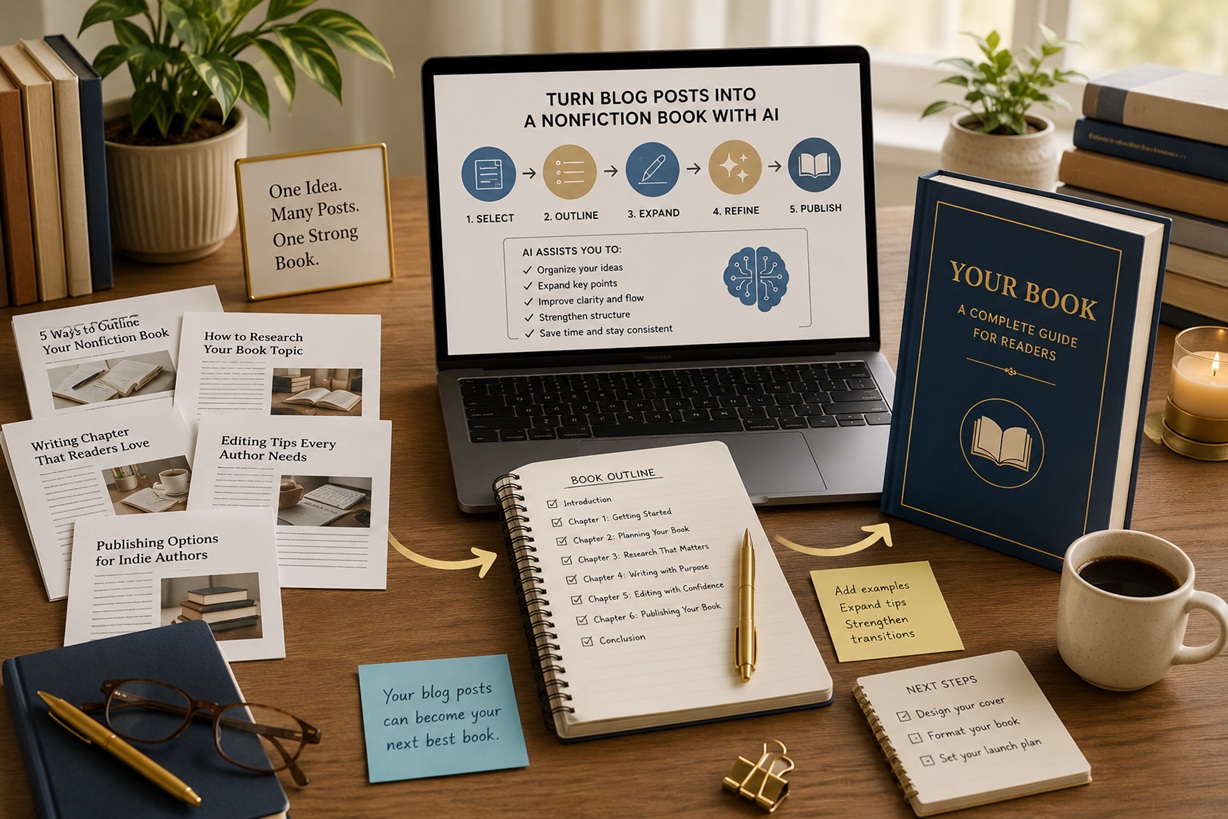
Turn Blog Posts into a Book with AI: 8 Best Hacks
“Content can be multifunctional.” – Jodi Harris, Content Marketing Institute
You have spent months, or possibly years, writing helpful articles for your website. Each article answers a question, teaches a skill, or solves a problem for your readers.
Now, you might be wondering whether to turn those blog posts into a book. The answer may be yes.
Your blog already contains ideas, explanations, examples, and practical advice that could give you a strong start. Artificial intelligence can help you review that material, recognize patterns, organize related topics, and identify what your future book still needs.
However, when you turn blog posts into a book, it involves much more than copying the articles into one document.
A group of related articles is still a group of related articles. A nonfiction book needs a clear purpose, a logical progression, consistent terminology, smooth transitions, and a satisfying promise that carries the reader from the introduction to the conclusion.
The following eight steps will help you turn blog posts into a book. By using AI, you can transform your existing content into a cohesive nonfiction book while keeping your knowledge, experience, and voice at the center of the project.
Why Turn Blog Posts into a Book?
Creating a book from your existing articles allows you to build on work you have already completed.
Instead of facing a blank page, you begin with a collection of ideas that you have already researched, explained, and shared. You may also have comments, reader questions, website analytics, or social media responses that reveal which subjects interest your audience most.
Your blogs can provide:
- Core concepts for chapters
- Explanations and examples
- Checklists and action steps
- Reader questions
- Stories from your experience
- Keywords and related topics
- Evidence of audience interest
AI can help you evaluate and organize those assets. It can also help you see connections that may be difficult to recognize when you have written the articles over several months or years.
AI should, however, serve as your assistant. It should not be the architect with final authority over your book.
You know your readers and your purpose. So you decide what belongs in the book and what does not.
Step 1: Audit Your Existing Content
Before creating an outline or choosing a title, determine what you have already written.
This step may sound obvious, but it is easy to underestimate how much content you have accumulated. You may also have covered the same subject under different titles or repurposed material without remembering every version.
I recently learned the value of this step firsthand.
I was preparing to turn a book into a new series of website articles. After comparing the book’s summary and table of contents with my website, I discovered that I had already published articles covering nearly every chapter.
A content audit at the beginning would have saved considerable time.
Start by creating an inventory of your relevant articles. Record:
- Article title
- URL
- Publication date
- Main topic
- Intended reader
- Primary takeaway
- Related articles
- Whether the information needs updating
- Whether the article could support a book chapter
Do not rely entirely on your memory. Review your website archive, sitemap, categories, tags, saved drafts, and article files.
Once you have an inventory, you can give the list to an AI assistant and ask it to group the articles by subject. You can also ask it to identify titles that appear to cover similar information.
Example AI Prompt
Act as a nonfiction content strategist. Review the following inventory of blog articles for new indie authors. Group the articles by their main topics. Identify articles that appear to overlap, articles that could work together as book chapters, and subjects that do not fit the larger collection. Do not create a book outline yet. First, provide a content-audit report explaining your reasoning.
Review the AI’s conclusions carefully. Similar titles do not always mean that the articles contain duplicate information, and very different titles may hide substantial overlap.
Step 2: Identify the Book’s Central Promise
A collection of articles becomes a book only when the material serves one focused purpose.
Ask yourself: What will readers be able to understand, accomplish, or change after reading this book? Your answer becomes the book’s central promise.
For example, “a book about using AI” is too broad. It could include AI writing tools, editing, images, marketing, productivity, publishing, ethics, and dozens of other subjects.
A more focused promise might be: This book will help new indie authors use AI to create useful, engaging content while preserving their authentic voice.
That promise tells you who the book is for, what it helps readers do, and what concern it addresses.
Your existing articles may suggest several possible book directions. AI can help you compare them.
Example AI Prompt
Based on the following article inventory, identify three possible nonfiction book concepts. For each concept, provide the intended reader, the problem the book solves, the transformation it promises, the articles that support it, and the major information that would still need to be written. Do not select the final concept for me.
AI can generate possibilities, but you should choose the promise. The strongest concept should align with your expertise, your readers’ needs, your author brand, and the books you have already published or plan to publish.
Step 3: Select the Articles That Support the Promise
Once you know the book’s promise, evaluate every article against it. An article may be useful and popular but still not belong in this particular book.
For each article, ask:
- Does it help fulfill the book’s reader promise?
- Does it provide information that the reader needs?
- Does it fit the book’s intended level of experience?
- Does it repeat material covered elsewhere?
- Is the information current and accurate?
- Could it become a full chapter, part of a chapter, or bonus material?
Sort the articles into four groups:
- Core material: Essential to the book
- Supporting material: Useful within a larger chapter
- Possible bonus material: Helpful but not essential to the main progression
- Unrelated material: Better saved for another book or article
Do not force every article into the manuscript simply because you have already written it.
A focused book containing ten strong chapters will usually serve readers better than a scattered book containing twenty chapters connected only by a broad subject.
Step 4: Find Overlap, Contradictions, and Gaps
Blog articles are usually written to stand alone. That means each one may define the same terms, introduce the same background information, or repeat advice that appeared in earlier posts.
This repetition may help a website visitor who reads only one article. In a book, however, repeated introductions and explanations can frustrate the reader.
AI is especially useful during this stage because it can compare several pieces of content at once.
Ask AI to identify:
- Repeated explanations
- Similar examples
- Contradictory recommendations
- Outdated tools or statistics
- Inconsistent terminology
- Changes in tone or intended audience
- Subjects introduced but not fully explained
- Missing steps in the reader’s progression
Example AI Prompt
Compare the following articles as possible source material for one nonfiction book. Identify repeated ideas, contradictory statements, inconsistent terminology, outdated information, and important gaps. Create a comparison report. Do not rewrite the articles or remove material.
This prompt asks AI to diagnose the content rather than immediately change it. That gives you an opportunity to evaluate the findings before revisions begin.
You should also verify factual claims, links, quotations, tool features, prices, policies, and statistics. AI may identify material that appears outdated, but it should not be your only fact-checking source.
Step 5: Create a Reader-Centered Book Structure
The order in which you published your articles is not necessarily the best order for your book.
A blog reader may arrive through a search engine and read one article about a specific problem. A book reader expects you to lead them through a complete learning experience.
For a practical nonfiction book, the structure might progress from:
- Understanding the problem
- Learning foundational concepts
- Preparing the necessary tools or information
- Following a step-by-step process
- Applying the process to specific situations
- Avoiding common mistakes
- Creating a long-term plan
Think about what readers need to know first. Each chapter should prepare them for what follows.
AI can propose several possible structures based on your content and reader promise.
Example AI Prompt
Act as a developmental editor for practical nonfiction. Using the book promise, reader description, and article summaries below, create three possible book structures. Each structure should show a clear learning progression. Explain the reasoning behind the order, identify which articles could support each chapter, and note where new material is required.
Do not automatically accept the first outline AI produces.
Compare the options. Move chapters. Combine weak sections. Separate overloaded topics. Remove anything that distracts from the promise.
Your final table of contents should reflect the reader’s needs, not the convenience of your source files.
Step 6: Turn Articles into Chapters
After creating the outline, assign your existing material to the appropriate chapters.
Some articles may become the foundation of a chapter. Others may provide only one section, example, checklist, or case study. Several short articles may need to be combined. One long article may support two chapters.
This is where many blog-to-book projects require more work than expected.
Articles frequently include:
- Standalone introductions
- References to the website or previous posts
- Search-focused wording
- Repeated definitions
- Short treatments of complex topics
- Calls to read another article
- Conclusions designed for an individual post
A chapter needs to connect with the chapters before and after it.
For each chapter, create a development outline containing:
- Chapter purpose
- Reader question
- Main takeaway
- Source articles
- New information needed
- Examples or stories
- Action steps
- Connection to the previous chapter
- Transition to the next chapter
Then revise the source material to fit that outline.
Do not ask AI merely to “turn this article into a chapter.” That instruction gives AI too much freedom and too little direction.
Provide the book’s purpose, intended reader, chapter objective, source article, style guide, and development outline. Tell AI what it may reorganize, what it must preserve, and where it should mark missing information instead of inventing it.
Step 7: Add the Material a Book Needs
Even an extensive article library is unlikely to contain everything required for a complete book. You may need to add:
- A book introduction
- Chapter introductions and conclusions
- Transitions between chapters
- Expanded explanations
- Original examples
- Case studies
- Worksheets
- Checklists
- Reflection questions
- Action steps
- Updated research
- A final conclusion
- Bonus resources
You may also need to address assumptions that were reasonable in an individual blog article but confusing in a book.
For example, an article might mention a prompting framework introduced in an earlier post. A book chapter should explain the framework, direct the reader to the chapter where it appears, or remove the reference.
AI can help create a gap report for every chapter.
Example AI Prompt
Compare this chapter outline with the source articles. Identify what information is already available, what needs to be expanded, and what is missing. Mark any place where a story, example, research source, transition, checklist, or action step would help the reader. Do not invent personal experiences, quotations, research, or statistics.
The last instruction is important. AI should not manufacture evidence or personal stories to fill an empty section.
Step 8: Complete a Whole-Book Review
When all the chapters have been drafted, review the manuscript as one book. A chapter-by-chapter editing process may not reveal problems that appear across the entire manuscript. Review the complete book for:
- Logical progression
- Repetition
- Missing information
- Consistent terminology
- Consistent tone
- Balanced chapter lengths
- Accurate cross-references
- Useful examples
- Smooth transitions
- Fulfillment of the reader promise
You can ask AI to conduct a manuscript-level review, but request an evaluation before requesting revisions.
Example AI Prompt
Review the complete manuscript as a developmental editor. Evaluate whether it fulfills the stated reader promise and provides a logical progression from beginning to end. Identify repetition, gaps, inconsistent terminology, weak transitions, unnecessary chapters, and chapters that need expansion. Provide a report with recommendations. Do not revise the manuscript yet.
Separating evaluation from revision helps you maintain control. You can approve, reject, or modify the recommendations before changes are made.
Keep Your Experience at the Center
AI can accelerate the blog-to-book process, but speed should not be the only goal.
Your readers can find general information in thousands of articles, videos, search results, and AI-generated summaries. They buy your book because they want your organization, judgment, explanations, examples, and experience.
Add the insights you gained while applying the advice. Explain the mistakes you made and what you learned from them. Include the questions your readers or clients frequently ask. Clarify where common recommendations fail or require adjustment.
That human contribution is what transforms repurposed content into a book worth reading.
Final Thoughts on Turning Blog Posts into a Book
Your blog posts can give you a valuable head start on a nonfiction book. They may already contain the central concepts, explanations, and practical guidance your readers need. However, the articles are source material, not a finished manuscript.
Begin with a thorough content audit. Define one focused reader promise. Select only the articles that support that promise. Then use AI to help you identify patterns, compare material, create a structure, find gaps, and review the developing manuscript.
Throughout the process, continue making the important decisions yourself.
When AI handles the sorting and comparison, you have more time to contribute what it cannot: your experience, perspective, judgment, and authentic connection with your readers.
Blog-to-Book Checklist
Use this checklist before transforming your blog content into a nonfiction manuscript.
Review Your Existing Content
- Create an inventory of relevant published articles.
- Include unpublished drafts and related materials.
- Record each article’s topic, takeaway, audience, and publication date.
- Check whether any book material has already been repurposed.
- Identify articles that need factual or technical updates.
Define the Book
- Choose one clearly defined reader.
- Identify the reader’s central problem.
- Write the transformation or outcome the book promises.
- Confirm that the concept fits your expertise and author brand.
- Compare the proposed book with your existing titles.
Select and Organize the Material
- Separate core, supporting, bonus, and unrelated content.
- Remove articles that do not support the book promise.
- Identify overlapping or repetitive material.
- Check for contradictions and inconsistent terminology.
- Arrange the topics in the order readers need them.
Develop the Chapters
- Give every chapter a clear purpose and takeaway.
- Assign source articles to the appropriate chapters.
- Identify where articles should be combined or divided.
- Replace article introductions and conclusions as needed.
- Add transitions between chapters.
- Expand explanations that are too brief for a book.
- Add examples, action steps, checklists, or exercises.
Protect Quality and Authenticity
- Verify research, quotations, statistics, links, and tool information.
- Review AI suggestions instead of accepting them automatically.
- Preserve your terminology and natural writing voice.
- Add firsthand experience and original insight.
- Never allow AI to invent personal stories or evidence.
- Complete a whole-book developmental review.
- Confirm that the finished manuscript fulfills its reader promise.
We hope you’ve found the writer’s guide strategies useful and motivating. We hope they’ll equip you with the insights and tools needed to help you succeed as a new author.
For all the writer’s guides in one place, grab our book: Repurpose Your Author Content with AI (available on Amazon).
You might also enjoy some of our books: Book Description Optimization: A Step-by-Step System to Clarity, Discoverability, and Reader Trust OR Write Smarter, Stay Human: Use AI Without Losing Your Voice, Values, or Vision
Writing is a journey of continuous learning and improvement. You don’t have to go it alone. We’re excited to continue the journey with you, providing guidance and encouragement every step of the way. Our goal is to provide essential insights and practical advice to help you navigate the writing world with increased confidence.
If you have a draft you want to publish and are wondering how AI can help, read: Is Your Book Ready to Self-Publish?
How can we help? To let us know, please fill out our Contact form.
Happy writing!