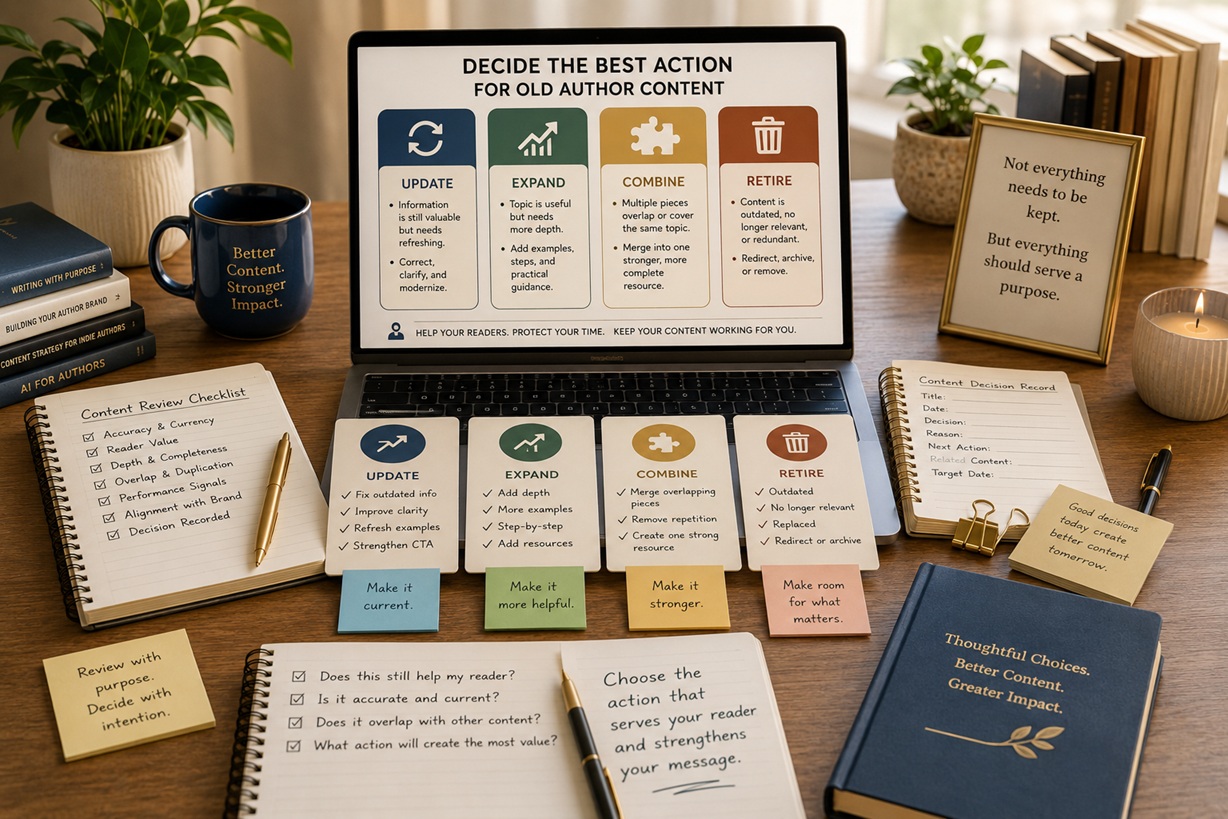
Old Content—Update, Expand, Combine, or Retire?
“The reality is that not everything can be done at once.” – Sarah Gibbons, Nielsen Norman Group
Old content is not automatically useless.
A blog post published several years ago may still contain a strong idea, a helpful example, or a framework readers need. A book chapter may remain valuable even if some tools, examples, or statistics have changed. A newsletter may contain the beginnings of a practical article. Several short posts may work better as one comprehensive guide.
The challenge is deciding what to do with each piece.
Should you update it?
Expand it?
Combine it with related material?
Or retire it?
Authors often make this decision informally. They reread an older piece, make a few changes, and publish it again. However, not every piece needs the same treatment.
Some content remains strong but needs current information. Some addresses an important topic too briefly. Some repeats ideas already covered elsewhere. Some no longer reflects your knowledge, audience, or author brand.
AI can help you compare, categorize, and evaluate your material. It should not make the final decision for you.
The following process will help you choose the most useful action for older author content.
Why Old Content Deserves a Decision
As your body of work grows, your books, articles, newsletters, downloads, and scripts begin to overlap.
That is not necessarily a problem.
Writers naturally return to important themes. Readers may also need related information in more than one format.
The problem begins when you do not know:
- Which version is current
- Which pieces repeat one another
- Which content still serves readers
- Which information is outdated
- Which articles need more depth
- Which pieces should be merged
- Which material no longer fits your work
Without a clear decision, older content can remain scattered across your website and files, creating confusion for both you and your readers.
A practical content review gives every piece a status.
That status might be:
- Keep
- Update
- Expand
- Combine
- Retire
For this article, we will focus on the four decisions that require the most judgment: update, expand, combine, or retire.
Begin with the Reader, Not the File
Before deciding what to do with an older piece, ask: Does this content still help the reader I serve now?
An article may be accurate but no longer relevant to your audience. A chapter may be useful but written for a more experienced reader than your current book serves. A newsletter may contain a strong idea that needs a more practical structure before it belongs on your website.
Evaluate each piece based on:
- The reader it serves
- The problem it solves
- The result it promises
- The accuracy of the information
- The depth of the explanation
- Its relationship to your other content
- Its alignment with your current author brand
Do not keep content merely because you worked hard to create it. Past effort does not guarantee present value.
Step 1: Summarize the Content’s Current Purpose
Before choosing an action, describe the piece as it exists now.
Record:
- Title
- Content type
- Publication or creation date
- Intended reader
- Main topic
- Reader problem
- Primary takeaway
- Call to action
- Related content
- Current status
Then write one sentence answering: This piece helps [READER] accomplish [RESULT] by teaching [MAIN METHOD OR IDEA].
If you cannot write that sentence clearly, the content may lack focus. AI can help summarize the piece, but you should verify the result.
Example AI Prompt
Review the following article and identify its intended reader, main problem, central promise, key points, and call to action. Summarize its purpose in one sentence. Do not evaluate or revise it yet.
This separates understanding from decision-making.
Step 2: Check Accuracy and Currency
Older content may remain useful while containing outdated details.
Review anything that can change over time, including:
- Software features
- Platform policies
- Prices
- Publishing procedures
- Marketing practices
- AI tools
- Statistics
- Research
- Links
- Screenshots
- Examples
- Legal or ethical guidance
Also look for terminology that has changed.
For example, an article about AI written several years ago may use broad language that no longer reflects how authors distinguish among chatbots, writing assistants, image generators, research tools, and automation platforms.
Ask:
- Is the central idea still accurate?
- Are the supporting details still current?
- Would outdated information mislead the reader?
- Can the piece be corrected without changing its purpose?
- Has the topic changed so much that a new article would be better?
The answers will help determine whether the piece should be updated or retired.
When to Update Old Author Content
Update content when the core value remains strong, but some information needs correction, clarification, or modernization.
An update is usually the right choice when:
- The reader problem still exists.
- The main promise remains useful.
- Most of the structure still works.
- The article already performs an important role on your website.
- The piece needs current tools, examples, links, or screenshots.
- Your advice has improved but not fundamentally changed.
- The article could better reflect your current voice or standards.
What an Update May Include
You might:
- Replace obsolete tools
- Correct inaccurate information
- Add current examples
- Revise screenshots
- Repair broken links
- Clarify confusing instructions
- Improve headings
- Add internal links
- Strengthen the introduction
- Add a checklist or action steps
- Revise the conclusion and call to action
An update should do more than change the publication date.
Readers should receive a meaningfully improved piece.
Example AI Prompt
Review this older article for information that may be outdated, unclear, incomplete, or inconsistent. Separate your findings into factual updates, structural improvements, examples needing replacement, broken or questionable references, and style issues. Do not rewrite the article.
This gives you an update plan before revision begins.
When to Expand Old Author Content
Expand content when the original piece addresses a valuable topic but does not provide enough depth to fulfill the reader’s needs.
An article may need expansion if it:
- Introduces a process without explaining the steps
- Lists tips without showing how to apply them
- Raises important questions without answering them
- Covers a broad topic too briefly
- Lacks examples
- Needs a checklist, template, or worksheet
- Serves as an introduction to a larger subject
- Could become a pillar article
- Contains one section that deserves its own article
Expansion is also useful when your experience has grown since the piece was first written.
You may now have:
- Better examples
- Client or reader questions
- Lessons learned
- Common mistakes to explain
- A clearer framework
- A stronger method
- More specialized advice
Expand Without Adding Filler
Longer is not automatically better. Do not add paragraphs simply to increase word count.
Expand only when the new material helps readers:
- Understand
- Decide
- Apply
- Avoid mistakes
- Complete a process
- Achieve a result
Example AI Prompt
Evaluate this article for depth. Identify sections that are too brief for the stated reader promise. Recommend specific additions such as examples, explanations, steps, comparisons, warnings, checklists, or action items. Explain how each addition would improve the reader’s outcome. Do not add material only to make the article longer.
When to Combine Old Author Content
Combine content when two or more pieces repeat one another, divide one topic unnecessarily, or would serve readers better as one complete resource.
Combining may be the right choice when:
- Several short articles cover the same topic.
- Each piece repeats the same introduction or definitions.
- Readers need all the pieces to complete one process.
- One article contains the explanation while another contains the steps.
- Two posts target the same keyword and reader problem.
- The material feels fragmented.
- One strong pillar article could replace several thin posts.
- A series no longer needs to remain separate.
Signs That Content Should Be Combined
Look for repeated:
- Definitions
- Frameworks
- Examples
- Warnings
- Checklists
- Conclusions
- Calls to action
- Reader promises
Also compare the sequence. If two articles follow nearly the same order, they may be competing versions of the same piece.
Combining Does Not Mean Copying Everything
A combined article should not become a storage container for every paragraph from the older pieces.
Instead:
- Choose one clear reader promise.
- Select the strongest material from each source.
- Remove repetition.
- Resolve contradictions.
- Create one logical structure.
- Add transitions.
- Update the information.
- Redirect readers from retired pages when appropriate.
Example AI Prompt
Compare these articles for possible consolidation. Identify repeated ideas, unique material, contradictions, differences in audience, and differences in reader promise. Recommend whether they should remain separate or be combined. If combining is appropriate, propose one structure and identify what should be kept, revised, or removed. Do not draft the combined article yet.
When to Retire Old Author Content
Retire content when keeping it creates more confusion than value.
Retirement may be appropriate when:
- The information is obsolete.
- The advice is inaccurate.
- The topic no longer fits your author brand.
- A stronger article has replaced it.
- The content targets an audience you no longer serve.
- The piece is too thin to justify updating.
- It duplicates another resource without offering a distinct benefit.
- The original purpose no longer exists.
- The content depends on discontinued tools or processes.
- Updating it would require creating an entirely new piece.
Retiring content does not always mean deleting it immediately.
You might:
- Remove it from navigation
- Redirect it to a stronger resource
- Archive it for internal reference
- Mark it as outdated
- Preserve it for historical purposes
- Move useful sections into another article
- Remove it from future repurposing plans
Before deleting anything, consider whether the page has:
- Useful backlinks
- Search traffic
- Internal links
- Reader comments
- Historical value
- Material worth preserving elsewhere
The publishing decision and the technical website decision are related but not identical.
Step 3: Measure Overlap with Other Content
Older content should not be evaluated in isolation.
Compare it with:
- Newer articles
- Book chapters
- Pillar content
- Newsletters
- Checklists
- Downloads
- Videos
- Planned projects
Ask:
- Does another piece already serve the same reader?
- Does it make the same promise?
- Does it use the same examples or framework?
- Is one version clearly stronger?
- Would readers benefit from both?
- Could the pieces be differentiated?
- Should one become the authoritative source?
AI can help identify overlap, but it should explain the evidence.
Example AI Prompt
Compare these pieces for exact duplication, structural duplication, thematic overlap, and distinct reader value. Identify which piece appears strongest and why. Mark any conclusion that depends on missing context.
Step 4: Evaluate Performance Carefully
Website data can help, but it should not make the decision by itself.
Useful signals may include:
- Page views
- Search impressions
- Time on page
- Clicks
- Email signups
- Downloads
- Reader comments
- Shares
- Backlinks
- Conversions
Low traffic does not always mean poor content.
A valuable article may have:
- A weak title
- Poor internal linking
- An unclear keyword focus
- Limited promotion
- A narrow but important audience
- Strong information buried in a weak structure
Similarly, high traffic does not guarantee that the article is current or helpful. Use performance data as one source of evidence not the final verdict.
Step 5: Choose the Best Action
Use the following decision guide.
Update
Choose update when:
- The core idea remains valuable.
- The structure mostly works.
- The information needs current details.
- The piece still serves your audience.
Expand
Choose expand when:
- The topic matters.
- The reader promise is strong.
- The piece lacks sufficient depth.
- Additional examples or steps would improve the outcome.
Combine
Choose combine when:
- Several pieces substantially overlap.
- Readers need the material together.
- One stronger resource would reduce confusion.
- Repetition weakens the current content library.
Retire
Choose retire when:
- The information is obsolete or misleading.
- The content no longer fits your audience or brand.
- A stronger resource has replaced it.
- Updating would require rebuilding the entire piece.
Sometimes the Answer Includes Two Actions
A piece may need to be:
- Updated and expanded
- Combined and updated
- Expanded and repositioned
- Partially preserved before retirement
For example, two older articles might be combined into one updated pillar article. The original pages could then be retired or redirected. The categories are decision tools, not rigid boxes.
Step 6: Create a Content Decision Record
Do not make the decision and then rely on memory.
Record:
- Content title
- URL or file location
- Current status
- Decision
- Reason
- Required actions
- Related content
- Source of truth
- Person responsible
- Target date
- Final result
A simple record might look like this:
| Content | Decision | Reason | Next Action |
| AI Prompting Basics | Update | Examples outdated | Replace tools and screenshots |
| Five Blog Tips | Expand | Too brief | Add process and checklist |
| Editing Articles 1–3 | Combine | Heavy overlap | Create one pillar guide |
| Discontinued Tool Review | Retire | Tool unavailable | Redirect to current resource |
This record can become part of your Author Content Repurposing Map.
Step 7: Use AI as an Evaluator Before Using It as a Rewriter
One of the most useful habits in AI-assisted content development is separating evaluation from revision.
Do not begin with: Rewrite this old article.
First ask AI to evaluate:
- Accuracy
- Relevance
- Depth
- Structure
- Overlap
- Audience fit
- Reader promise
- Missing information
Then decide what action to take. Only after you approve the decision should AI help draft the changes. This approach protects your voice and reduces unnecessary rewriting.
Example AI Prompt
Act as a content editor for an indie-author website. Evaluate the following older content and recommend one primary action: update, expand, combine, retire, or keep as is. Base the recommendation on accuracy, reader value, depth, overlap, audience fit, and alignment with the current author brand. Explain the evidence. Do not revise the content.
You may also ask AI to provide a confidence level and identify missing information.
Keep, Update, Expand, Combine, or Retire?
Not every old piece needs work. Some content may still be accurate, distinctive, useful, and aligned with your readers.
In that case, the correct decision may be:
Keep it as it is.
You might still add an internal link, improve the title, or review the call to action, but a complete rewrite is unnecessary. The goal is to help every piece serve a clear purpose.
Final Thoughts
Old author content can become a valuable asset—or a source of clutter and confusion. The difference depends on the decisions you make.
Update content when the central value remains strong, but the details need refreshing. Expand content when the topic matters, but the explanation is too limited. Combine content when several pieces repeat or divide one reader problem unnecessarily.
Retire content when it is obsolete, misleading, redundant, or no longer aligned with your work.
Before choosing, evaluate the reader promise, accuracy, depth, overlap, performance, and fit with your current author brand. Use AI to organize the evidence and suggest possibilities. Then make the final decision yourself.
Your goal is to build a useful, trustworthy body of content that continues to serve your readers.
Old Author Content Decision Checklist
Understand the Existing Piece
- Record the title, date, type, and location.
- Identify the intended reader.
- Define the reader problem.
- Write the content’s central promise.
- List the main ideas and call to action.
- Identify related content.
Check Accuracy and Relevance
- Verify facts, tools, links, statistics, and examples.
- Check whether the terminology is current.
- Confirm that the reader problem still exists.
- Decide whether the piece still fits your audience.
- Confirm that it aligns with your current author brand.
Evaluate Depth and Structure
- Determine whether the article fully delivers its promise.
- Identify sections that are too brief.
- Look for missing examples, steps, or explanations.
- Check whether the structure is logical.
- Decide whether a checklist or action steps would help.
Compare Related Content
- Look for repeated definitions.
- Identify duplicate examples or frameworks.
- Compare reader promises.
- Check for contradictions.
- Identify the strongest version.
- Select a source of truth.
Choose an Action
- Update accurate but outdated content.
- Expand useful but incomplete content.
- Combine substantially overlapping pieces.
- Retire obsolete or redundant content.
- Keep content that still works well.
- Use more than one action when appropriate.
Document the Decision
- Record the chosen action.
- Explain the reason.
- List the required revisions.
- Connect the piece to related content.
- Add the decision to the repurposing map.
- Record the final publication or retirement status.
For more guidance, see our other writer’s guides in this series. We suggest starting with the first one, Turn Blog Posts into a Book with AI: 8 Best Hacks.
Or for all the writer’s guides in one place, grab our book: Repurpose Your Author Content with AI (available on Amazon).
We hope you’ve found the writer’s guide strategies useful and motivating. We hope they’ll equip you with the insights and tools needed to help you succeed as a new author.
You might also enjoy our books: Book Description Optimization: A Step-by-Step System to Clarity, Discoverability, and Reader Trust OR Write Smarter, Stay Human: Use AI Without Losing Your Voice, Values, or Vision.
Writing is a journey of continuous learning and improvement. You don’t have to go it alone. We’re excited to continue the journey with you, providing guidance and encouragement every step of the way. Our goal is to provide essential insights and practical advice to help you navigate the writing world with increased confidence.
If you have a draft you want to publish and are wondering how AI can help, read Is Your Book Ready to Self-Publish?
Don’t wait. Start today!
How can we help? To let us know, please fill out our Contact form.
Happy writing!