Turn a Book Chapter into a Pillar Article and Supporting Posts
“Build it like a Lego sculpture, so you can take it apart without breaking the bricks.” – Ahava Leibtag, CEO, Aha Media Group
A strong nonfiction book chapter may contain enough material for several website articles.
It might include:
- A central concept
- A step-by-step process
- Several reader questions
- Examples
- Common mistakes
- A checklist
- Related tools or resources
That does not mean you should cut the chapter into equal sections and publish each section as a separate post.
A chapter is written for a reader moving through a book. An article is written for someone who may arrive through a search engine, newsletter, social link, or recommendation and read only that one page.
When you turn a book chapter into a pillar post, it needs its own:
- Reader problem
- Promise
- Introduction
- Structure
- Conclusion
- Call to action
- Reason to exist
The most useful approach is often to turn the chapter into a content cluster.
One pillar article provides a broad, organized introduction to the subject. Several supporting posts answer narrower questions or explore important parts of the topic in more depth.
Your book chapter provides the larger structure. When you turn a chapter into a pillar article or supporting post, your task is to identify the pieces that can stand independently without losing their purpose.
AI can help analyze the chapter, group related ideas, propose article topics, and check for overlap. You must decide which pieces genuinely help your website readers.
The following eight steps will help you turn one chapter into a pillar article and supporting posts.
What Is a Pillar Article?
A pillar article is a substantial website resource that provides a broad, organized treatment of one core topic.
It usually:
- Addresses an important reader problem.
- Explains the major concepts.
- Introduces the primary steps or categories.
- Links to more focused supporting articles.
- Helps readers understand how the pieces fit together.
A pillar article does not have to contain every detail from the chapter. Its purpose is to give readers a useful overview and guide them toward more specific information.
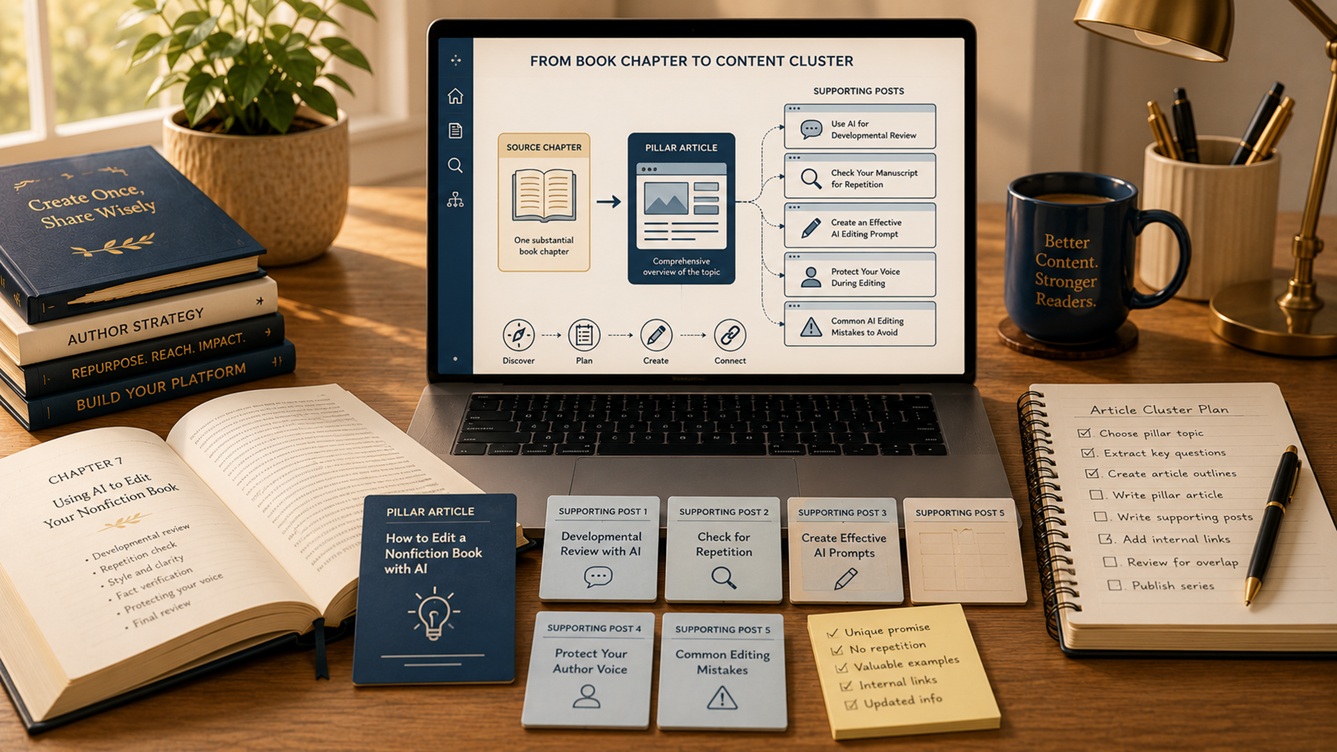
For example, a book chapter about using AI to edit a nonfiction manuscript might become the pillar article:
How to Edit a Nonfiction Book with AI
Supporting articles might include:
- How to Use AI for a Developmental Review
- How to Check a Manuscript for Repetition with AI
- How to Create an AI Editing Prompt
- How to Protect Your Voice During AI-Assisted Editing
- Common AI Editing Mistakes Authors Should Avoid
The pillar article introduces the full process. Each supporting post addresses one narrower need.
Content Marketing Institute describes a pillar page as a page that covers an overall topic in depth and links to related cluster content.
How Is a Pillar Article Different from the Book Chapter?
The pillar article and chapter may cover similar material, but they serve different reading experiences.
The Book Chapter
A chapter:
- Appears within a larger progression.
- Can rely on concepts explained earlier.
- Leads into later chapters.
- Supports the book’s complete promise.
- May contain extensive background and transitions.
- Assumes the reader is following the manuscript in sequence.
The Pillar Article
A pillar article:
- Must work independently.
- May be the reader’s first introduction to the topic.
- Needs a clear search-focused question or problem.
- Should guide readers toward related website resources.
- Usually requires more direct headings and navigation.
- Needs its own conclusion and call to action.
The article should not feel like a chapter removed from the middle of a book. It should feel complete for the website reader while still encouraging deeper exploration.
Step 1: Evaluate Whether the Chapter Can Support a Cluster
Not every chapter should become a pillar article and several supporting posts.
A short or highly focused chapter may work better as one article. A chapter containing several unrelated topics may need to be reorganized before it can support a cluster.
A strong candidate usually contains:
- One clear central topic
- Several meaningful subtopics
- Multiple reader questions
- A process with distinct stages
- Examples that could support separate explanations
- Enough depth to create multiple useful pieces
- Clear relevance to your website audience
Ask:
- What central problem does this chapter solve?
- How many distinct reader questions does it answer?
- Could any subtopic stand alone without repeating the entire chapter?
- Does each possible article offer a different benefit?
- Would the full cluster support the website’s purpose?
- Is the information current enough to repurpose?
If the chapter answers only one narrow question, create one strong article instead of forcing it into a cluster.
Example AI Prompt
Act as a content strategist for an indie-author website. Review the following nonfiction book chapter and determine whether it can support one pillar article and several supporting posts.
Identify:
- The chapter’s central reader problem
- Its main promise
- Distinct subtopics
- Reader questions
- Sections that could stand alone
- Sections that depend heavily on the book’s surrounding chapters
- Possible overlap among the subtopics
Do not create the final article plan yet. First, provide a suitability assessment.
This prompt asks AI to evaluate the material before generating titles.
Step 2: Identify the Chapter’s Central Reader Problem
The pillar article should revolve around one central problem. Do not begin by asking: What is this chapter about?
That question may produce a broad subject such as “book marketing” or “AI editing.”
Instead, ask: What does the reader need help understanding, deciding, or accomplishing?
For example:
- Broad subject: Author newsletters
- Reader problem: New authors do not know what to send subscribers.
- Pillar promise: Help new authors create a practical newsletter content plan.
Another example:
- Broad subject: Book-to-article repurposing
- Reader problem: Authors do not know how to divide a chapter into useful website content.
- Pillar promise: Help authors create one pillar article and several distinct supporting posts.
The reader problem gives the pillar article focus.
Write a Pillar Promise
Use this formula: This article will help [READER] achieve [RESULT] by teaching [PROCESS OR METHOD].
For example:
This article will help nonfiction authors turn one substantial book chapter into a connected website article cluster without creating repetitive content.
That promise becomes the standard for deciding what belongs in the pillar article.
Step 3: Select the Pillar Article’s Scope
The pillar article should be broad enough to introduce the complete subject but focused enough to remain useful.
A pillar article that is too broad may become vague. A pillar article that is too narrow may not support several related posts.
Too Broad
Everything Authors Need to Know About Content
This topic could include books, blogs, newsletters, social media, videos, courses, websites, research, branding, and marketing. It does not give the reader a manageable promise.
More Focused
How Indie Authors Can Repurpose Book Content with AI
This topic provides a clear subject, reader, and method.
Even More Specific
How to Turn a Book Chapter into a Pillar Article and Supporting Posts
This title promises one practical outcome.
The chapter may contain material outside the pillar’s scope. Save those sections for:
- Supporting posts
- Another article cluster
- A future book
- A downloadable resource
- The original chapter only
Do not force every paragraph into the website series.
Step 4: Extract Supporting Questions
Supporting posts should answer questions that readers may search for, ask independently, or need during one stage of the process.
Review the chapter for:
- Questions
- Steps
- Mistakes
- Decisions
- Tools
- Examples
- Comparisons
- Warnings
- Specialized audiences
- Practical resources
Suppose the chapter explains how to turn a nonfiction book into website articles.
Possible supporting questions might include:
- How many articles can one chapter become?
- Which chapter should become the pillar article?
- How do I avoid duplicate content?
- How much should I rewrite a book chapter for the web?
- How should I link articles in a series?
- What should I remove from a chapter before publishing it online?
- How can AI help divide a chapter into articles?
Each question may support a focused article.
Example AI Prompt
Review this chapter and extract the distinct questions a website reader might ask. Exclude questions that the pillar article can answer adequately in one short section. Highlight only questions that may deserve a separate supporting post. This helps prevent every minor point from becoming an unnecessary article.
Group the questions into:
- Foundational questions
- Process questions
- Decision questions
- Mistake-prevention questions
- Tool or AI questions
- Follow-up questions
Step 5: Give Every Article a Distinct Reader Promise
The most important protection against repetition is a distinct promise for each article.
Compare these weak article ideas:
- How to Repurpose a Book Chapter
- Tips for Repurposing a Book Chapter
- Best Ways to Repurpose Book Chapters
- Repurposing Book Chapters with AI
The titles differ, but the reader promises are almost identical.
Now compare the following.
Pillar Article
How to Turn a Book Chapter into a Pillar Article and Supporting Posts
Promise: Create the complete article-cluster plan.
Supporting Post 1
How to Choose the Best Pillar Topic from a Book Chapter
Promise: Select the central topic and scope.
Supporting Post 2
How to Divide a Long Book Chapter into Distinct Articles
Promise: Separate the material without arbitrary cuts.
Supporting Post 3
How to Rewrite Book Content for Website Readers
Promise: Adapt chapter material for independent online reading.
Supporting Post 4
How to Link a Pillar Article with Supporting Posts
Promise: Build the cluster’s navigation and internal-link structure.
Supporting Post 5
How to Avoid Repetition When Repurposing Book Chapters
Promise: Detect and remove unnecessary overlap.
Every article solves a different problem. If two proposed articles have the same problem and promise, combine them or revise their focus.
Create an Article Promise Table
| Article | Reader Problem | Promise | Distinctive Material |
| Pillar article | Does not know the full process | Create the cluster plan | Complete overview |
| Choose the topic | Cannot identify the central idea | Select the pillar scope | Decision criteria |
| Divide the chapter | Does not know where to separate content | Create distinct article units | Topic boundaries |
| Rewrite for the web | Chapter feels incomplete online | Adapt it for independent reading | Website revision |
| Build internal links | Articles remain disconnected | Create the reader pathway | Linking structure |
Step 6: Decide What Belongs in the Pillar Article
The pillar article should provide enough information to be useful without absorbing every detail that supporting posts need.
Include:
- A clear definition of the subject
- Why it matters
- The major stages or categories
- A practical overview of the process
- Brief answers to common foundational questions
- Links or references to deeper supporting content
- A checklist or next-step plan
Reserve for supporting posts:
- Detailed tutorials
- Extended examples
- Specialized situations
- Comparisons
- Troubleshooting
- Templates
- Case studies
- Narrow questions
Think of the pillar as the reader’s map. The supporting posts are the detailed routes.
Avoid the Empty-Pillar Problem
A pillar article should not merely introduce the supporting posts. Readers should receive meaningful value even if they do not click another link.
The pillar should explain the complete process at an overview level. Supporting posts should deepen specific parts of that process.
Step 7: Adapt the Chapter for Website Readers
Once the cluster plan is approved, revise the source material for each article.
Do not simply paste the chapter sections into WordPress.
Add a Standalone Introduction
The article reader may not know:
- The book
- Earlier chapters
- Your framework
- Why the topic matters
- What problem the article solves
Introduce the subject directly.
Remove Book-Dependent References
Revise phrases such as:
- “As we learned in Chapter 2”
- “Later in the book”
- “In the previous section”
- “By this point in your journey”
- “The next chapter will explain”
Replace them with:
- A brief explanation
- A website link
- A direct transition
- A reference to the related article series
Revise the Structure
Website readers benefit from:
- Descriptive headings
- Shorter sections
- Clear steps
- Tables
- Checklists
- Examples
- Direct answers
- Helpful internal links
Create a New Conclusion
The chapter conclusion may lead into the next chapter.
The article conclusion should:
- Reinforce the reader’s result
- Summarize the next action
- Link to the most relevant supporting resource
- Include a suitable call to action
Update the Information
Before publishing, verify:
- Tools
- Features
- Links
- Examples
- Statistics
- Quotations
- Platform policies
- Screenshots
Google’s current guidance emphasizes unique, useful, people-first content rather than content produced mainly to influence rankings. Repurposing should therefore improve accessibility and reader value not merely multiply pages.
Step 8: Build the Internal-Link Structure
The articles should function as a connected series rather than isolated posts.
Link from the Pillar to Supporting Posts
Within the relevant section, link to the deeper article.
For example:
Choosing the pillar topic is one of the most important decisions in the process. For a detailed method, read How to Choose the Best Pillar Topic from a Book Chapter.
Link Supporting Posts Back to the Pillar
Each supporting article should help readers understand where it fits in the larger process.
For example: This step is part of the complete process explained in How to Turn a Book Chapter into a Pillar Article and Supporting Posts.
Link Supporting Posts to One Another When Useful
Do not add links simply because the articles belong to the same series. Link when the next resource helps the reader continue.
For example:
- Topic selection → dividing the chapter
- Dividing the chapter → rewriting for the web
- Rewriting → reviewing overlap
- Review → publishing and linking
Create a Series Navigation Section
At the beginning or end of each article, consider adding:
Part of the Book-to-Article Series
- Create the pillar-and-supporting-post plan
- Choose the pillar topic
- Divide the chapter into articles
- Rewrite for website readers
- Review for repetition
- Build the internal-link structure
This helps readers follow the complete process.
Use AI to Create the Cluster Plan
After analyzing the chapter, you can ask AI to propose the cluster.
Example AI Prompt
Act as a content strategist and developmental editor for an indie-author website. Using the chapter analysis below, create one pillar-article plan and up to five supporting-post plans.
For each article, provide:
- Working title
- Intended reader
- Reader problem
- Reader promise
- Primary topic
- Material drawn from the chapter
- New material required
- What must not be repeated from the other articles
- Recommended internal links
Then create an overlap report comparing all proposed articles. Do not divide the chapter by word count. Do not create a supporting post unless it offers a distinct reader benefit. Review the proposed plan before allowing AI to draft anything.
Create an Article Development Outline
Each article should have its own outline before drafting. The development outline protects the distinction among the articles.
Include:
- Article title
- Purpose
- Reader
- Reader problem
- Promise
- Primary keyword
- Search intent
- Source chapter sections
- Original material to preserve
- Material needing expansion
- New introduction
- Main headings
- Examples
- Checklist or FAQ
- Conclusion
- Call to action
- Internal links
- Facts requiring verification
Review the Full Cluster Before Publishing
A strong article may still create problems when compared with the complete series.
Review all drafts together for:
- Repeated introductions
- Duplicate definitions
- Similar headings
- Reused examples
- Conflicting advice
- Inconsistent terminology
- Uneven depth
- Missing steps
- Weak internal links
- Articles with indistinct promises
Example AI Prompt
Review this complete pillar-and-supporting-post cluster as one content system.
Identify:
- Exact repetition
- Necessary repetition
- Structural overlap
- Missing information
- Inconsistent terminology
- Weak transitions
- Articles that do not provide a distinct benefit
- Internal links that should be added
Recommend changes, but do not revise the drafts yet. Separating evaluation from revision allows you to approve the recommendations first.
How Many Supporting Posts Should One Chapter Produce?
There is no correct number. Do not decide in advance that every chapter must become three articles. Let the material and reader needs determine the structure.
A chapter may become:
- One article
- One pillar and two supporting posts
- One pillar and five supporting posts
- Several independent articles without a pillar
- Part of a larger multi-chapter cluster
The right number depends on:
- Chapter complexity
- Number of distinct reader questions
- Depth of the source material
- Website strategy
- Reader needs
- Risk of repetition
- Available time
- Value of each proposed article
Protect the Value of the Book
Some authors worry that publishing book-derived articles will give away the entire book.
That risk increases when articles:
- Reproduce chapters almost unchanged
- Follow the exact book sequence
- Include every example and exercise
- Provide the complete book experience online
- Fail to distinguish the website content from the manuscript
A well-designed article cluster should provide genuine value while offering a different experience. The articles should demonstrate the value of your knowledge, not eliminate the reason to read the book.
The website may provide:
- Searchable answers
- Focused tutorials
- Updated examples
- Shorter practical resources
- Related downloads
- Links among topics
The book provides:
- A complete progression
- Deeper context
- Unified terminology
- Extended examples
- Exercises and resources
- A sustained reader transformation
Final Thoughts on Turning a Chapter into a Pillar Post
One strong nonfiction chapter can become an entire website content cluster.
Begin by evaluating whether the chapter contains enough distinct material. Identify the central reader problem and select one focused pillar topic. Then extract the narrower questions that deserve supporting posts.
Give every article its own reader problem and promise.
Adapt the chapter for website readers by creating new introductions, removing book-dependent references, revising the structure, updating information, and writing new conclusions.
Finally, connect the articles through thoughtful internal links and review the complete cluster for repetition.
AI can help analyze, organize, compare, and plan the material. Your role is to make sure every article serves a real reader need and earns its place in the series.
Book Chapter-to-Article Cluster Checklist
Evaluate the Chapter
- Identify the chapter’s central topic.
- Define the main reader problem.
- List the chapter’s primary promise.
- Identify distinct subtopics and questions.
- Determine whether the chapter can support several useful articles.
- Confirm that the material fits the website audience.
- Check whether the information requires updating.
Select the Pillar Article
- Choose one focused core topic.
- Define the pillar article’s reader.
- Write its reader promise.
- Confirm that it can stand independently.
- Decide what overview material belongs in it.
- Reserve detailed material for supporting posts.
Plan Supporting Posts
- Extract meaningful reader questions.
- Group related questions.
- Remove minor topics that do not justify separate articles.
- Give every supporting post a distinct problem.
- Give every post a distinct promise.
- Compare proposed posts for overlap.
- Combine posts with substantially similar purposes.
Adapt the Source Material
- Assign chapter sections to each article.
- Create a new introduction for every article.
- Remove references dependent on the book.
- Add context for website readers.
- Update facts, examples, links, and tools.
- Add headings, steps, tables, or examples.
- Create a new conclusion and call to action.
- Preserve the author’s voice and original meaning.
Build the Cluster
- Link the pillar article to supporting posts.
- Link supporting posts back to the pillar.
- Connect supporting posts when readers need the next step.
- Add series navigation when helpful.
- Use consistent terminology across the cluster.
- Plan the publication order.
Complete the Final Review
- Review all articles together.
- Remove unnecessary repetition.
- Preserve necessary context.
- Check for conflicting recommendations.
- Confirm that every article offers distinct value.
- Verify all external facts and quotations.
- Update the content repurposing map.
- Record the source chapter and published URLs.
For more guidance, see our other writer’s guides in this series. We suggest starting with the first one, Turn Blog Posts into a Book with AI: 8 Best Hacks.
Or for all the writer’s guides in one place, grab our book: Repurpose Your Author Content with AI (available on Amazon).
We hope you found these writer’s guide strategies helpful and inspiring. They’re intended to provide you with the necessary tools and insights to succeed as an indie author.
You might also enjoy our books: Book Description Optimization: A Step-by-Step System to Clarity, Discoverability, and Reader Trust OR Write Smarter, Stay Human: Use AI Without Losing Your Voice, Values, or Vision.
Writing is an ongoing adventure that involves continuous learning and improvement. You don’t have to go through this alone. We are excited to accompany you every step of the way, providing you with support and motivation. Our goal is to give you the knowledge and practical advice to navigate the world of writing with confidence.
If you have a draft and want to explore how AI can help you self-publish it, read Is Your Book Ready to Self-Publish?
Don’t wait. Start today! How can we help? To let us know, please fill out our Contact form.
Happy writing!