Repurpose One Core Idea into Blog Posts, Emails, Lead Magnets, and Social Content
“Content is king, but context is God.” – Gary Vaynerchuk
Many authors think content repurposing means taking one piece of content and posting the same information everywhere.
That is not repurposing. That is repetition.
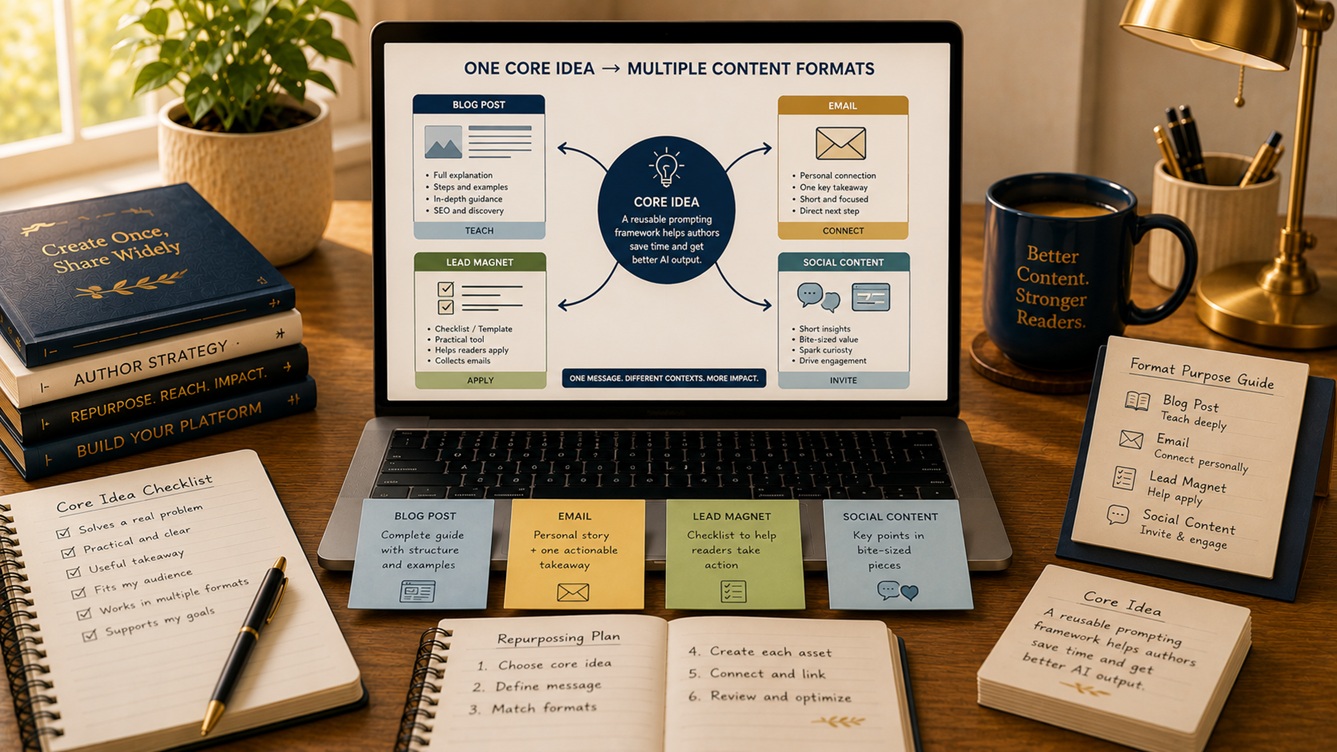
True repurposing begins with one core idea and then adapts that idea for different formats, audiences, purposes, and stages of reader engagement.
For example, one core idea might begin as:
- a lesson from a nonfiction chapter
- a recurring problem your readers face
- a simple framework
- a checklist concept
- a strong example from your experience
- a useful AI prompting method
- a content strategy insight
That one idea might later become:
- a blog post that teaches the full concept
- an email that introduces one practical takeaway
- a lead magnet that helps readers apply it
- a social series that highlights the key points
The message remains connected. The delivery changes.
As Gary Vaynerchuk has said, “Content is king, but context is God.” That principle matters for authors.
Your readers do not interact with a blog post, an email, a lead magnet, and a social caption in the same way. Each format has a different job to do.
The following seven-step process will help you take one core idea and turn it into several useful content formats without sounding repetitive or generic.
What Is a Core Idea?
A core idea is a useful central concept that can support more than one type of content.
It is not merely a topic. “AI” is a topic.
“Why indie authors need a repeatable AI prompting system” is a core idea.
A strong core idea usually includes:
- a clear reader problem
- a practical takeaway
- a meaningful result
- enough depth for explanation
- flexibility across more than one format
For example, these are stronger core ideas than broad topics:
- How to audit your existing content before repurposing it
- Why authors need a source of truth for their content
- How one blog post can become a lead magnet
- How to preserve your voice while using AI
- Why content gaps matter more than content volume
A good core idea gives you something worth adapting.
Why One Core Idea Can Power Several Assets
Many authors believe they need a completely new idea every time they create a new piece of content.
That assumption leads to:
- content fatigue
- inconsistent messaging
- weak content planning
- a scattered author platform
- unnecessary pressure to constantly invent
A stronger approach is to choose one worthwhile idea and then let that idea work harder for you. One core idea can support several assets because different formats serve different purposes.
A Blog Post
A blog post can explain the full concept in a structured, searchable way.
An Email
An email can create a more personal, direct, and immediate connection.
A Lead Magnet
A lead magnet can help the reader apply the concept in a practical way.
Social Content
Social content can highlight bite-sized insights, invite curiosity, and lead readers to the larger resource.
You are not saying the exact same thing four times. You are helping readers encounter the same valuable idea in four different ways.
Step 1: Choose the Right Core Idea
Not every idea deserves a multi-format repurposing plan.
A strong core idea should meet at least most of these criteria:
- It solves a real reader problem.
- It aligns with your author brand.
- It supports one of your books, services, or platform goals.
- It offers a meaningful takeaway.
- It can be explained at both short and long lengths.
- It has practical application.
- It could lead readers toward a next step.
Ask:
- What idea do my readers most need?
- What concept do I explain repeatedly?
- What lesson supports my larger content strategy?
- Which idea could work in several formats?
- Which topic can I explain clearly and confidently?
For example, if you help indie authors use AI well, one strong core idea might be: Authors should create a reusable prompting framework instead of starting every AI prompt from scratch.
That single idea could support a blog post, email, checklist, and social series.
Example AI Prompt
Act as a content strategist for an indie-author brand. Review the following list of possible ideas and identify which ones are strongest for multi-format repurposing. Evaluate each idea for reader value, clarity, practical usefulness, and adaptability across blog, email, lead magnet, and social content.
This helps you choose the right idea before planning the assets.
Step 2: Define the Core Message
Once you choose the idea, define its central message clearly.
If the message is fuzzy, the repurposed content will also be fuzzy.
Write:
- the reader problem
- the key insight
- the main takeaway
- the desired next action
A simple formula is:
My audience struggles with [PROBLEM].
This core idea helps them [RESULT] by showing [KEY METHOD OR INSIGHT].
For example:
New indie authors often write inconsistent AI prompts and waste time starting over. This core idea helps them create better results by showing how to use a repeatable prompting framework.
Then write a shorter version: A reusable prompting framework helps authors save time and get better AI output.
That short version becomes the anchor message for the different formats.
Step 3: Match the Idea to the Right Formats
Do not choose formats randomly. Each format should serve a distinct purpose.
Here is a simple way to think about the four formats in this article.
Blog Post = Teach
The blog post should explain the concept fully.
It may include:
- the problem
- why it matters
- a framework or process
- examples
- common mistakes
- practical steps
- a conclusion and call to action
Email = Connect
The email should feel more personal and immediate.
It may include:
- one core lesson
- a brief story or example
- one strong takeaway
- a simple invitation or next step
Lead Magnet = Help the Reader Apply
The lead magnet should make the idea usable.
It may include:
- a checklist
- worksheet
- template
- prompt pack
- workbook page
- quick-start guide
Social Content = Highlight and Invite
Social content should surface the most useful or intriguing parts of the idea.
It may include:
- quick tips
- short quotes
- mini-lessons
- one-step reminders
- myth-versus-truth posts
- carousel-style sequences
- calls to read or download the larger resource
The formats work best when each one has a clear job.
Step 4: Adapt the Idea Instead of Copying It
This is the most important step.
If you simply shorten the blog post into social captions and paste the same phrases into an email, the content will feel flat and repetitive.
Adaptation means asking:
- What does this format need most?
- How much detail does this audience need here?
- What tone fits this platform?
- What should be emphasized?
- What can be left out?
- What should the next step be?
For example, suppose your core idea is:
Authors should audit their content before repurposing it.
That idea might become:
Blog Post
A complete explanation of why authors need a content audit, what to review, what to compare, and how AI can help.
A shorter, more personal message:
“I almost repeated an entire project because I did not audit my content first. Here is why that matters.”
Lead Magnet
A practical Content Audit Worksheet with spaces to record titles, formats, overlap, and next actions.
Social Content
A short sequence such as:
- Sign 1 you need a content audit
- 3 places authors forget to check
- Why different titles can still mean duplicate content
- One question to ask before repurposing anything
The central idea stays the same.
The presentation changes.
Step 5: Build a Small Repurposing Plan
Once you know the formats, create a small plan.
You do not need a massive production chart.
A simple table may be enough.
| Format | Purpose | Main Angle | CTA |
| Blog post | Teach the full concept | Explain the method | Read / comment / explore related article |
| Connect and encourage | Share one key lesson | Read article / reply / download resource | |
| Lead magnet | Help apply the method | Provide practical tool | Subscribe / download |
| Social content | Attract attention | Highlight insights | Visit article / join email list |
Now note what each piece should include.
Blog Post
- full explanation
- examples
- steps
- reader benefit
- quick connection
- one practical takeaway
- clear invitation
Lead Magnet
- actionable tool
- concise format
- easy next step
Social
- short insight
- curiosity
- visibility
- clear path to larger content
This plan keeps the outputs distinct.
Step 6: Use AI to Support the Repurposing Process
AI can help you plan and organize the variations efficiently.
Useful AI tasks include:
- summarizing the core idea
- extracting key points
- identifying the strongest takeaway for each format
- suggesting blog headings
- drafting a lead magnet outline
- organizing a short email structure
- creating social post angles
- checking for repetition across outputs
AI is especially useful for turning one larger explanation into several format-specific outlines.
Example AI Prompt
I have one core idea for indie authors: [INSERT IDEA].
Help me repurpose it into:
- one blog post
- one email
- one lead magnet
- one short social-content series
For each format, identify:
- the reader problem
- the main angle
- the best structure
- what should be emphasized
- what should not be repeated from the other formats
- the most suitable call to action
Do not simply summarize the same content four times. Adapt the idea for each format’s purpose.
That last instruction is essential.
Step 7: Review the Outputs as One Connected System
Before publishing, review the full set together.
Ask:
- Does each piece have a distinct purpose?
- Does the blog post go deepest?
- Does the email feel more personal?
- Does the lead magnet help the reader apply the idea?
- Does the social content invite attention rather than trying to teach everything?
- Do the pieces sound connected?
- Do they avoid unnecessary repetition?
- Do they lead readers logically from one asset to the next?
Also review the system for flow.
A connected repurposing path might look like this:
Path 1
Social post → blog post → lead magnet
Path 2
Email → blog post → related article
Path 3
Blog post → lead magnet → email series
The goal is not merely to create four disconnected outputs.
The goal is to create a small ecosystem around one strong idea.
A Sample Core-Idea Repurposing System
Suppose your core idea is:
Authors should keep a content repurposing map so they know what they have already created.
That might become:
Blog Post
How to Create an Author Content Repurposing Map with AI
Purpose: Explain the concept, the process, and the benefits.
Subject idea:
The Content Problem You May Not Realize You Have
Purpose: Share a quick story about losing track of prior content and introduce the map concept.
Lead Magnet
Author Content Repurposing Map Template
Purpose: Give the reader a practical tool to apply the idea.
Social Content
A short sequence on:
- signs you need a repurposing map
- what a map tracks
- how it differs from a content inventory
- one mistake a map helps prevent
This is how one core idea becomes a connected set of resources.
Common Mistakes When Repurposing One Core Idea
Authors often run into trouble when they:
- choose an idea that is too broad
- try to use too many formats at once
- repeat the same language in every piece
- forget to define the purpose of each format
- create a lead magnet that is not genuinely useful
- make social posts too long or too complicated
- let AI flatten every version into the same tone
- fail to connect the pieces through links or calls to action
A strong repurposing system needs both consistency and variation.
Final Thoughts
One strong idea can do much more work than many authors realize.
When chosen carefully, a core idea can support a blog post, an email, a lead magnet, and social content without feeling repetitive.
Begin with a real reader problem and a clear takeaway. Match the idea to formats that serve different purposes. Adapt the message for each platform instead of copying it unchanged. Use AI to help organize the variations. Then review the final pieces as one connected system.
You do not need a brand-new concept every time you publish.
You need a better way to develop the good ideas you already have.
Core-Idea Repurposing Checklist
Choose the Core Idea
- Identify one useful central idea.
- Confirm that it solves a reader problem.
- Confirm that it fits your author brand.
- Make sure it offers a practical takeaway.
- Confirm that it can work in several formats.
Define the Message
- Write the reader problem.
- Write the core insight.
- Write the main takeaway.
- Write the desired next action.
- Create a short anchor message.
Match the Formats
- Choose the blog post angle.
- Choose the email angle.
- Decide what the lead magnet should help the reader do.
- Choose the social-content angles.
- Make sure each format has a distinct purpose.
Plan the Outputs
- Define the purpose of each piece.
- Note the main angle for each format.
- Decide what to emphasize in each format.
- Decide what to leave out.
- Choose the call to action for each format.
Use AI Strategically
- Use AI to summarize the idea.
- Use AI to suggest outlines.
- Use AI to vary the angle by format.
- Use AI to identify repetition.
- Do not let AI merely restate the same message in four ways.
Review the System
- Confirm that each piece stands on its own.
- Confirm that the pieces feel connected.
- Remove repetitive wording.
- Check voice consistency.
- Add links and next steps.
- Record the outputs in the repurposing map.
For more guidance, see our other writer’s guides in this series. We suggest starting with the first one, Turn Blog Posts into a Book with AI: 8 Best Hacks.
Or for all the writer’s guides in one place, grab our book: Repurpose Your Author Content with AI (available on Amazon).
We trust you’ve found this writer’s guide both enlightening and inspirational. It’s designed to equip you with the tools and insights to bolster your success as a burgeoning author.
You might also enjoy our books: Book Description Optimization: A Step-by-Step System to Clarity, Discoverability, and Reader Trust OR Write Smarter, Stay Human: Use AI Without Losing Your Voice, Values, or Vision.
The path of writing is one filled with ceaseless learning and enhancement. You are not expected to tread this path solo. We’re thrilled to accompany you on this journey, offering support and motivation at every turn.
Our objective is to deliver foundational knowledge and pragmatic guidance, enabling you to traverse the literary landscape with amplified confidence.
If you have a draft you want to publish with the help of AI, read Is Your Book Ready to Self-Publish?
How can we help? To let us know, please fill out our Contact form.
Happy writing!