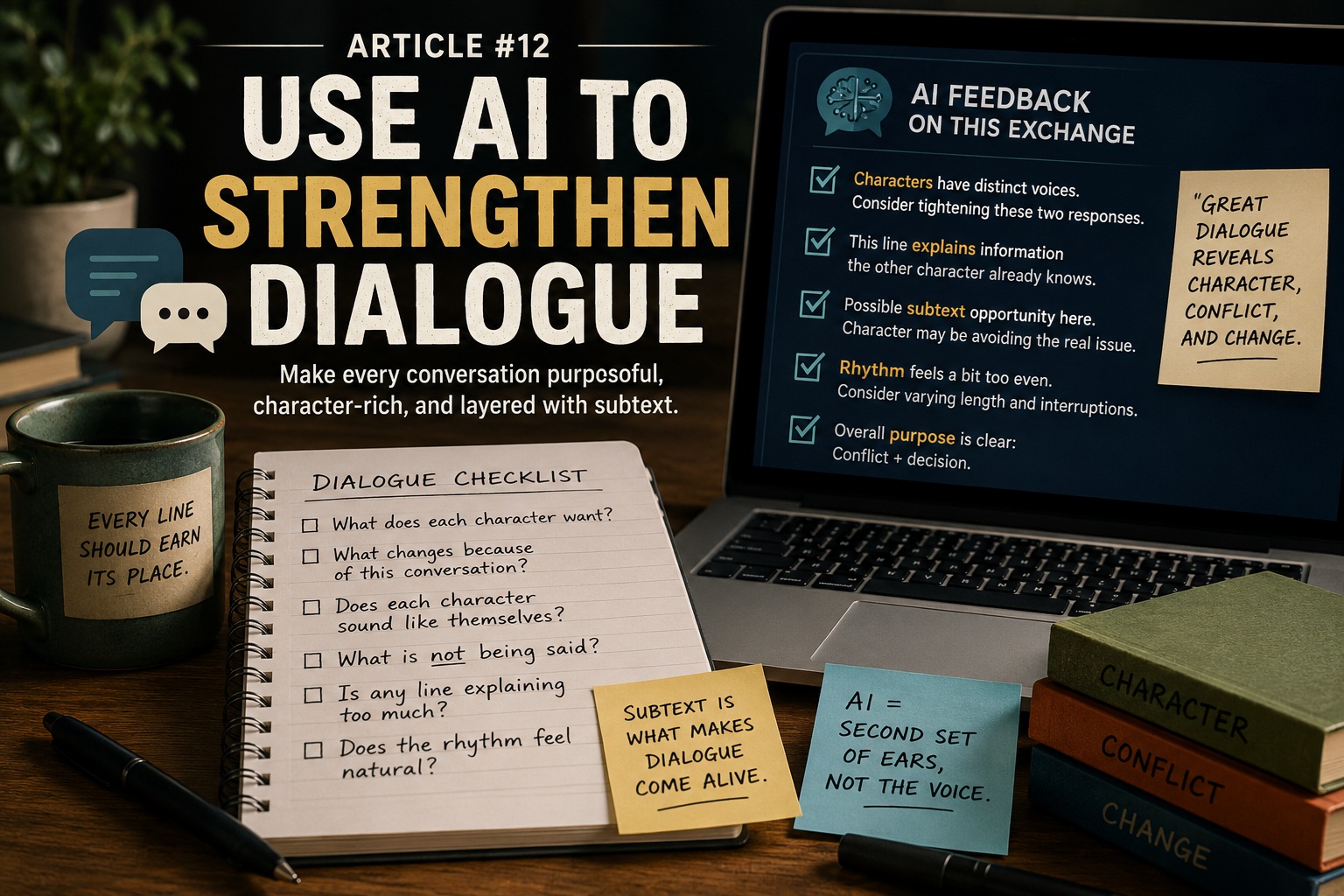
Use AI to Strengthen Dialogue: 7 Best Hacks
“Dialogue is not conversation.” —Robert McKee, Dialogue: The Art of Verbal Action for the Page, Stage, and Screen
Dialogue can be tricky to evaluate while you’re writing it.
You know who the characters are. You know what they mean, what they want, and what happened before they started talking. That knowledge can make it harder to hear what is actually on the page.
A conversation may communicate everything the reader needs to know and still feel flat. Two characters may sound interchangeable. An emotional exchange may become too explicit. Dialogue may seem technically correct but strangely polished.
AI can help you hear those problems differently.
The goal is to use AI as another set of ears so you can identify what the conversation is doing, and decide what needs to change.
Give the Conversation a Job
Strong dialogue does more than fill the silence between characters.
A conversation might reveal character, change a relationship, create conflict, conceal information, force a decision, introduce a problem, or move the story forward. Often, it does several of those things at once.
Before asking whether the dialogue sounds natural, ask a more fundamental question: Why are these characters talking right now?
Then look at what each character wants from the exchange.
One character may want information. Another character may want reassurance. Someone may be trying to avoid answering a question, gain control, hide embarrassment, end an argument, or provoke a response.
That underlying purpose changes how the conversation works.
AI can help identify that purpose when you are too close to the scene to see it clearly. Give it a selected exchange and enough context to understand the situation.
You might ask:
- What Does Each Character Appear to Want From This Conversation?
- What Changes Between the Beginning and End of the Exchange?
- Which Lines Reveal Character, Conflict, or New Information?
- Which Lines Seem to Repeat Something the Scene Has Already Established?
- Are There Places Where the Dialogue Seems to Exist Mainly for the Reader’s Benefit?
That last question can be especially useful.
Watch for Dialogue That Explains Too Much
Writers sometimes need to give readers information through conversation. There is nothing inherently wrong with that. The problem begins when characters start explaining things they have no reason to explain.
Two longtime friends probably do not need to summarize their shared history for each other.
Coworkers usually don’t explain familiar procedures just because the reader needs the information.
Characters can also overexplain their feelings.
“I’m angry because you ignored what I told you yesterday, and now I don’t trust you” may communicate the emotion clearly. But a real character might dodge the issue, become sarcastic, change the subject, or say much less.
When it tells the reader everything, it can leave little room for the reader to participate.
AI can help flag lines that appear unusually explanatory. But do not automatically delete every line it identifies.
Sometimes clarity matters more than subtlety. Sometimes a character really would state the obvious. Personality, circumstance, genre, age, and relationship all matter.
Ask AI to explain why a line feels expositional rather than simply asking it to rewrite the line. That gives you something you can evaluate.
Make Characters Sound Like Themselves
Character differentiation does not require giving everyone a catchphrase, verbal tic, or unusual accent.
People distinguish themselves in smaller ways.
They may differ in:
- Vocabulary
- Sentence Length
- Formality
- Directness
- Humor
- Use of Questions
- Willingness to Interrupt
- Tendency to Explain
- Tendency to Evade
- Emotional Restraint
- Comfort With Silence
A blunt character may answer a question in five words while another circles around it for a paragraph.
One character may use humor when uncomfortable. Another may become unusually formal. Someone else may answer questions with questions.
These differences should grow from the characters rather than being pasted onto them as decorative quirks.
AI can be useful for comparison.
Give it an exchange between two or more characters and ask it to analyze how their speech differs. If it cannot identify much difference, that does not automatically mean the dialogue is weak.
It does give you something worth examining.
You can also provide several short excerpts from the same character and ask what speech patterns appear consistently. Then evaluate the response yourself.
AI may notice a useful pattern you created intuitively. It may also mistake coincidence for characterization or recommend exaggerating differences that are already strong enough.
The author decides what belongs.
If the underlying problem is that the characters themselves are not sufficiently differentiated, that is a bigger problem. That belongs with character development rather than trying to fix everything through speech.
Let Characters Mean More Than They Say
Some of the most interesting dialogue happens when the literal words are not the whole conversation.
That is where subtext enters.
A character says, “Are you going out again?”
The words may be a simple question. Depending on the relationship and situation, the real message could be:
- I Don’t Want You to Leave.
- I Don’t Trust Where You’re Going.
- I’m Hurt That You’d Rather Be Somewhere Else.
- I Know You’re Lying to Me.
- Please Ask Me to Come With You.
You do not necessarily need to put any of those meanings on the page.
The surrounding scene, prior information, character behavior, and response may allow the reader to understand what is happening underneath the words.
This is another area where AI can be a useful diagnostic tool.
Try asking:
- What Might Each Character Be Avoiding Saying Directly?
- Where Does the it State an Emotion That the Scene May Already Imply?
- Which Lines Have More Than One Possible Meaning?
- Where Could a Character’s Response Reveal Resistance, Deflection, or Concealment?
- Does Either Character Consistently Answer Exactly What Was Asked?
That final question can uncover conversations that feel too orderly. Real disagreement rarely proceeds like a well-moderated interview.
Characters misunderstand. They dodge. They seize on the wrong word. They answer what they wish they had been asked. They sometimes refuse to answer at all.
Those choices can reveal as much as the spoken words.
Listen for Conversational Rhythm
Fictional dialogue should not reproduce ordinary conversation exactly.
Real people repeat themselves, use filler words, lose their train of thought, and wander into subjects that do not matter to the story.
Putting all of that on the page could become exhausting.
At the same time, it can swing too far in the other direction.
AI-generated or heavily AI-polished dialogue may become unusually balanced. Every sentence is complete. Every character answers appropriately. Everyone expresses herself clearly and efficiently.
The result can sound less like characters interacting and more like people taking turns delivering polished statements.
Look at the rhythm of the exchange.
- Are all the lines approximately the same length?
- Does every question receive a direct answer?
- Does each speaker politely wait for the previous thought to finish?
- Does every line sound complete?
- Does the conversation move too smoothly for the emotional situation?
Depending on the characters and scene, you might need interruptions, short answers, longer bursts of speech, unanswered questions, silence, or abrupt shifts.
Do not add those mechanically. A string of sentence fragments is no more automatically realistic than a string of perfect sentences.
The question is whether the rhythm fits these characters in this situation.
Be Careful When AI Makes Dialogue “Better”
AI can produce a rewritten conversation quickly.
That does not mean the rewrite belongs in your novel.
A revised version may be clearer, smoother, more dramatic, or more concise. Still, it may also move farther away from the characters you created.
This is especially important when you are trying to protect your author voice from unwanted AI smoothing. Dialogue carries another layer of individuality because each speaker also needs a recognizable presence.
Instead of beginning with “Rewrite this dialogue to make it better,” start with analysis.
- Ask what is not working.
- Ask where characters sound alike.
- Ask which lines seem too explanatory.
- Ask where subtext disappears.
- Ask what makes the rhythm feel artificial.
Then decide whether the diagnosis is right.
If you do ask AI for alternate versions, treat them as comparisons. Look at what changed and why the change affects the scene.
You might keep none of the generated wording while still learning something useful from the comparison.
Try This With One Conversation
Choose one conversation from the novel you are developing or drafting. Pick an exchange important enough to matter but small enough to examine closely.
Before asking AI anything, answer these questions yourself:
- What Does Each Character Want From the Conversation?
- What Changes Because the Conversation Happens?
- What Does Each Character Know?
- What Is Each Character Willing—or Unwilling—to Say Directly?
Then ask AI to analyze the exchange rather than rewrite it immediately. Compare its observations with your own.
Look especially for:
- Dialogue That Exists Mainly to Deliver Information
- Speakers Who Sound Too Similar
- Emotions or Intentions Stated More Directly Than Necessary
- Missing Opportunities for Subtext
- Repetitive Question-and-Answer Patterns
- Dialogue That Sounds Too Complete or Polished
- Suggestions That Do Not Fit the Characters You Created
You do not need to fix everything AI notices.
Some observations will reveal genuine weaknesses. Some will reflect different creative choices. Others may be completely wrong for your story.
Your job is to know the difference.
Action Steps
- Choose one meaningful conversation. Use a manageable exchange rather than asking AI to judge all the dialogue in your novel.
- Identify what each character wants. Decide what each speaker is trying to gain, avoid, reveal, conceal, or change.
- Ask AI to diagnose before rewriting. Look for character similarity, exposition, missing subtext, and unnatural conversational patterns.
- Evaluate every observation against the characters. Keep suggestions that illuminate the conversation and reject those that flatten or misrepresent it.
- Make the final dialogue yours. Revise the exchange yourself or intentionally adapt useful ideas while preserving the characters and the story you want to tell.
AI can help you notice what your familiarity with the scene makes difficult to hear.
But stronger dialogue does not come from making every line cleaner or more impressive. It comes from knowing who is speaking, what that character wants, and why these particular words belong in that character’s mouth.
For more guidance, see other writer’s guides in our series on craft and story development. We suggest starting with the first one, Use AI Without Giving Up Your Story.
We hope you found these writer’s guide strategies helpful and inspiring. They’re intended to provide you with the necessary tools and insights to succeed as an indie author.
You might also enjoy some of our books:
AI Future Ready Skills for Indie Authors
Amazon KDP Made Easy: A Simple, Stress-Free System to Self-Publish Your First Book on Amazon
Writing is an ongoing adventure that involves continuous learning and improvement. You don’t have to go through this alone. We are excited to accompany you every step of the way, providing you with support and motivation. Our goal is to give you the knowledge and practical advice to navigate the world of writing with confidence.
Don’t wait. Start today! How can we help? To let us know, please fill out our Contact form.
Happy writing!