Create an Author Vault to Protect Your Privacy and Ethics
“When we think about this technology, we need to put human dignity, human well-being, human jobs in the center of consideration.” — Fei-Fei Li, computer scientist and AI pioneer
If you plan to use AI in your writing life, you need more than prompts and productivity tricks. You also need a way to protect your privacy, you work, ideas, and reader relationships. That matters even more for indie authors, because you in addition to being a writer, you are also the publisher, business owner, archivist, and decision-maker.
When AI enters your workflow, privacy and ethics stop being abstract topics. They become practical writing and business issues. They become your author vault. Your notes, early drafts, unpublished manuscripts, research files, prompts, and reader materials all carry value. Some of them also carry responsibility.
This part of our writer’s guide series on AI Systems will help you build a simple, human-first approach to protecting both with an author vault.
Why Privacy Matters More than Many Authors Realize
Many indie authors think privacy is mostly a technical issue. It is partly that, of course, but it is also a creative, business, and trust issue.
When you paste material into a tool without thinking about exposure, you may be sharing far more than you intended. That can include unpublished manuscripts, deeply personal journals, private interviews, coaching notes, proprietary frameworks, or future book ideas. Even when the risk feels distant, repeated casual sharing can weaken your long-term control over your work.
This is especially important if you write nonfiction based on lived experience, client stories, reader feedback, teaching materials, or sensitive subject matter. A productivity shortcut can create a bigger problem if it leads you to handle valuable content too casually.
A stronger approach begins with one simple shift. Stop treating all writing as if it carries the same level of risk.
Think Like an Author with Aassets to Protect
One of the best mindset upgrades you can make is to start viewing your writing materials as business assets, not just files on a laptop.
Your raw ideas have value. Your half-finished drafts have value. Your prompt library has value. Your backlist files, research folders, workshop materials, and author systems all have value. They represent time, judgment, and creative labor. In many cases, they also support the future growth of your author business.
That is why you need an author vault mindset.
An author vault is not a specific app. It is a way of thinking and organizing. It means you create clear boundaries around what is safe to use in casual tools and what deserves stronger protection. Once you begin working aith an author vault, your decisions get much easier.
Public-safe Material vs. Protected Material
A simple way to reduce risk is to sort your material into two broad categories.
Public-safe material includes content that is already public or low risk. For example, published blog posts , generic marketing copy, broad brainstorming, or simple headline experiments.
Protected material includes anything unpublished, personal, proprietary, or commercially sensitive. That may include:
- unpublished book drafts
- private journals
- coaching or client notes
- interview transcripts
- reader surveys with personal details
- proprietary frameworks
- refined prompt libraries
- research files for future books
- book bibles, outlines, and revision notes
This distinction helps you stop making one-size-fits-all decisions. A social media caption idea and an unpublished manuscript chapter do not belong in the same risk category. A general book description and a reader’s vulnerable personal story should never be treated the same way.
Once you begin separating public-safe from protected material, you can use AI more confidently because you know where caution belongs.
Build Local Control into Your Workflow
Cloud tools are convenient. They are fast, searchable, and easy to access from multiple devices. That convenience can absolutely support your writing life. It just should not become the foundation of your entire creative business.
One of the smartest habits you can build is local control. In practical terms, keep your most valuable files in places you directly manage. That might include secure folders on your computer, external hard drives, encrypted backups, or offline archives.
Your crown-jewel files should stay close. That includes things like:
- final manuscript files
- major revision drafts
- private research materials
- proprietary teaching or course content
- prompt libraries you have refined over time
- reader, client, or interview information
When your most important work lives only inside someone else’s system, you create unnecessary dependence. Accounts change. policies change. platforms disappear. A stable author business needs a stronger foundation than borrowed convenience.
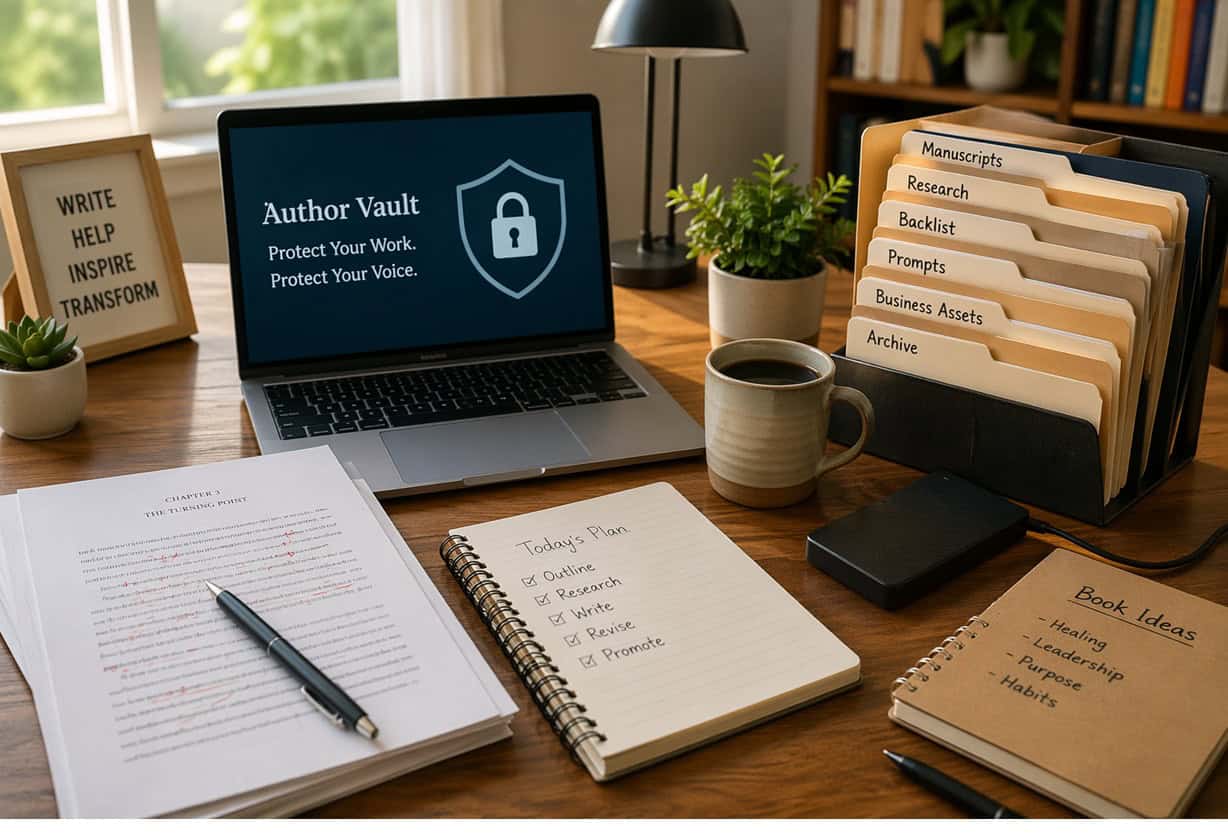
Quick Win: Create one master folder called Author Vault this week. Inside it, add folders such as Manuscripts, Research, Backlist, Prompts, Business Assets, and Archive. Even a simple structure can instantly reduce digital chaos.
What Ethical AI Use Looks Like
A lot of authors worry about whether using AI makes them less authentic. That concern is understandable, but guilt is not a useful framework for decision-making. Ethical clarity is much more helpful.
Ethical AI use begins with a few grounded questions:
- Did I remain the originator, decision-maker, and final judge of this work?
- Did I protect material that was not mine to expose?
- Did I use AI to support thinking, structure, or workflow in a way that strengthened the work?
- Would I feel comfortable explaining my process to a thoughtful reader?
These questions are practical because they keep you focused on authorship, responsibility, and trust. They also help you avoid two common mistakes.
The first mistake is overcorrecting. Some authors become so worried about doing something wrong that they avoid useful tools altogether. They miss out on legitimate help with organization, idea sorting, revision comparisons, or workflow support.
The second mistake is under-correcting. That happens when an author lets AI take over too much of the work and then assumes light editing makes everything fine. That approach often leads to weaker writing, fuzzier authorship, and reduced confidence.
A stronger middle path is human-led AI use. You stay in charge. You use the tool to support your thinking and process. You keep responsibility where it belongs, with you.
Protect Other People’s Material
If your book draws from readers, clients, interviewees, students, community members, or people who have shared personal stories with you, you carry an ethical duty to protect that material. Even if you have permission to use an insight in your book, that does not automatically mean it belongs inside every AI workflow.
Sensitive material deserves a slower, more deliberate approach. In many cases, the safest move is to summarize it yourself rather than pasting raw source material into a tool. In other cases, it may be wiser to keep that material entirely outside casual AI use.
Pro Tip: Before using any third-party story, ask yourself one question: Do I truly have the right to use this material here, in this way, in this tool? That pause alone can prevent a lot of regret.
Create Your Transparency Standard
Reader trust has always mattered. AI simply makes it more visible.
You do not need to over explain every small use of a tool. A better approach is to create a personal transparency standard before you are under pressure to decide.
For example, you might decide to disclose AI use when it significantly shaped your research, drafting, or production process. You may decide you do not need disclosure for minor organizational help that did not affect authorship. You might also prepare a short statement you can adapt for future books when needed.
Here is the key: make your decision calm, clear, and values-based.
A simple disclosure might sound like this:
This book was created through a human-led process. AI-assisted tools were used selectively for organization, workflow support, and editorial analysis. All final ideas, judgments, and wording remain the author’s own.
That kind of language builds confidence because it is honest, measured, and easy to understand.
Make Privacy Part of Your Routine
The most effective privacy and ethics systems are not dramatic. They are repeatable.
- Before you paste anything into a tool, ask whether the material is public-safe or protected.
- Before you save a draft or prompt, ask whether it belongs in your Author Vault.
- Before you use AI with another person’s story or sensitive experience, ask whether you have the right to use it that way.
You can also reduce mistakes by adding a second review step. Many authors already review for clarity, structure, and quality. Add one more lens: exposure. Ask yourself whether anything sensitive is sitting in the wrong place, labeled poorly, or stored too casually.
Simple file labels can help more than you might expect. Terms like PUBLIC, PRIVATE, DRAFT, CLIENT, and ARCHIVE can make your workflow safer with very little effort.
Why This Matters for Your Author Business
Privacy and ethics are of professional authorship.The stronger your systems become, the easier it is to write, publish, and grow with confidence. You stop making impulsive decisions, and you gain more control over your materials. You build trust with readers because your process reflects care.
That is especially valuable in an AI-assisted writing life. Tools will keep changing. Platforms will keep evolving. Your standards are what keep you steady.
When you build an author vault mindset, you create space for both innovation and integrity.
- You can work faster without becoming careless.
- You can use helpful tools without giving away what matters most.
- You can build an author business that feels modern, capable, and trustworthy.
Start Small and Build from There
You do not need a perfect system by tonight. You just need one smart next step.
Create your Author Vault folder. Separate your materials into public-safe and protected categories. Move your most valuable files to a more secure storage location. Draft your personal transparency statement. Identify the types of content you will never paste into casual tools.
Those small actions create real momentum. More importantly, they help you build the kind of writing practice that protects your work, your readers, and your integrity.
That is a strong foundation for any indie author, especially one who wants to use AI wisely.
Checklist: Build Your Author Vault
- Create one master “Author Vault” folder for your most important creative and business assets.
- Separate your materials into two categories: public-safe and protected.
- Move unpublished manuscripts, private notes, and proprietary materials into controlled storage.
- Back up your crown-jewel files in at least one local or offline location.
- Identify which AI tasks are low-risk and which require extra caution.
- Decide what types of content you will never paste into casual tools.
- Write a short personal transparency pact for your own use.
- Draft simple disclosure language you can adapt for future books if needed.
- Add a second review step for exposure.
- Label files and folders so you can spot sensitive material at a glance.
We hope you found these writer’s guide strategies helpful and inspiring. They’re intended to provide you with the necessary tools and insights to succeed as an indie author.
For more guidance, see other writer’s guides in this series. We suggest starting with the first one, Use AI Without Losing Your Author Voice: 6 Best Hacks.
For all the writer’s guides in this series, along with several bonuses, grab our ebook: Write Smarter, Stay Human: Use AI Without Losing Your Voice, Values, or Vision (available on Amazon).
Writing is an ongoing adventure that involves continuous learning and improvement. You don’t have to go through this alone. We are excited to accompany you every step of the way, providing you with support and motivation. Our goal is to give you the necessary knowledge and practical advice to navigate the world of writing with confidence.
If you have a draft and want to explore how AI can help you self-publish it, read, Is Your Book Ready to Self-Publish?
For help writing a nonfiction book, read Write Your First Nonfiction eBook: a 30-Day Workbook for Getting It Done.
Don’t wait. Start today! How can we help? To let us know, please fill out our Contact form.
Happy writing!