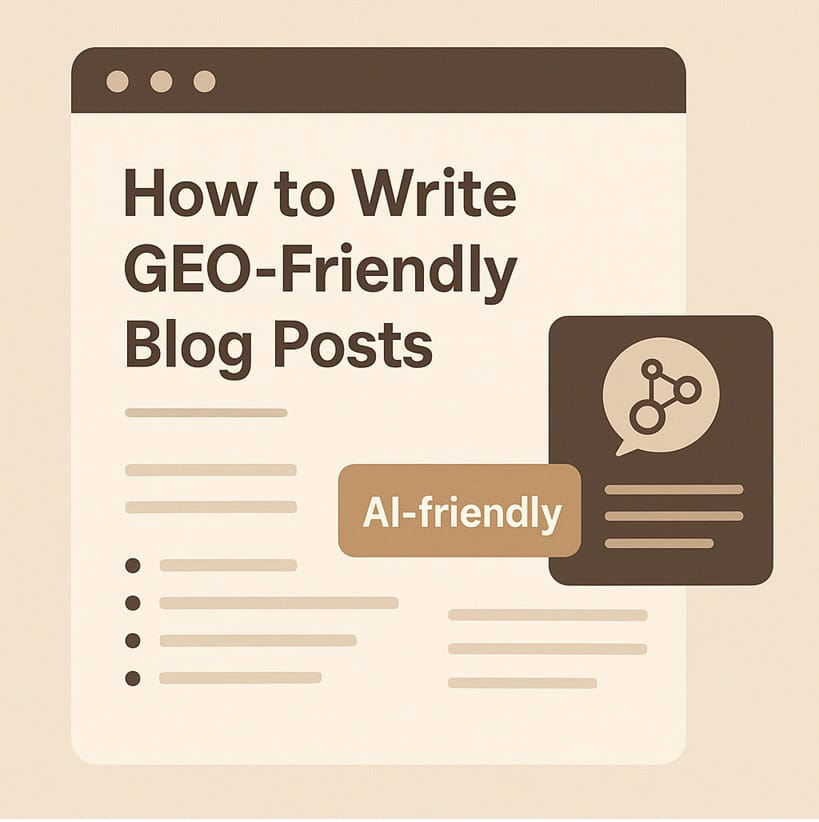
How to Write GEO-Friendly Blog Posts (+Templates)
“The clearer your content, the easier it is for AI systems to understand and work with it.” — Demis Hassabis, CEO of DeepMind
As AI-driven search becomes the norm, one skill separates content that gets seen from content that disappears.
Writing blog posts that AI can easily interpret, summarize, and reference.
This is the heart of GEO: Generative Engine Optimization.
GEO-friendly writing isn’t about chasing algorithms. It’s about structuring your blog posts so clearly and logically that:
- AI search tools can instantly “see” the meaning
- Your content is more likely to be quoted
- You become a preferred resource in answer engines
- Readers stay longer because your content is easier to read
In this part of our SEO, GEO, and AI Search for Indie Authors Series, you’ll learn the exact structure AI tools prefer. Plus, you’ll get plug-and-play templates you can use for every article on your website.
This is one of the most important articles in our series because GEO-FRIENDLY formatting directly affects whether AI engines select your content as a preferred answer. If you’d like to have all of the AI powered search strategies in one place, read SEO, GEO, and AEO for Indie Authors: Strategic Optimization for AI Search (paperback or eBook).
What Makes a Blog Post GEO-Friendly?
AI search engines (ChatGPT, Gemini, Claude, Perplexity, Bing Copilot) extract meaning in a specific order.
✔ 1. Title
✔ 2. Headings
✔ 3. Short paragraphs
✔ 4. Lists
✔ 5. Definitions
✔ 6. FAQs
✔ 7. Summaries
If those elements are clear, AI can:
- Understand your topic
- Identify the purpose of each section
- Pull out exact answers
- Place your website in generative search results
- Recommend your content as a trusted source
GEO-friendly isn’t technical. It’s clarity + structure + intent-matching.
The GEO-Friendly Blog Structure (The 8-Part Blueprint)
Here’s the structure AI tools reward the most.
1. A Clear, Reader-Focused Title
AI engines use the title to identify topic + intent.
Example:
How to Build an Author Platform in 30 Minutes a Day
2. A Short Introduction That States the Outcome
Aim for 2–4 sentences.
Example:
“This guide helps new indie authors build a sustainable author platform using small, consistent steps. You’ll learn how to prioritize tasks, simplify tools, and avoid overwhelm.”
3. A Section That Defines the Topic
AI prioritizes definition-first content because it’s easy to quote.
Example:
“An author platform is the combined online presence, audience, and communication channels an author builds over time.”
4. A Step-by-Step List or Framework
List structures are extremely AI-friendly.
Example:
- Choose one social platform
- Create a simple author bio
- Build a basic email list
- Publish small, consistent content
- Engage with readers weekly
5. Supporting Sections With H2/H3 Headings
AI reads headings first.
Headings = meaning markers.
6. Examples or Case Studies
Great for GEO and E-E-A-T.
7. FAQ Section
AI answer engines LOVE FAQs.
8. Summary / TL;DR
Perfect for AI extraction.
The GEO-Friendly Blog Post Template (Copy & Paste)
Below is your ready-to-use template for every article you publish.
GEO-Friendly Blog Post Template
Title:
[Insert clear, outcome-based title here]
Introduction (2–4 sentences)
State what the reader will learn and why it matters.
Section 1: Definition
What is [topic]?
Write a 1–2 sentence definition.
Section 2: Why It Matters
Explain its importance for the reader.
Section 3: Step-by-Step Framework
Step 1: [title]
Short explanation (1–3 sentences)
Step 2: [title]
Short explanation
Step 3: [title]
Short explanation
Step 4: [title]
Short explanation
Step 5: [title]
Short explanation
Section 4: Examples
Example 1 – [label]:
Short example
Example 2 – [label]:
Short example
Section 5: FAQs
FAQ 1:
Short, direct answer
FAQ 2:
Short, direct answer
FAQ 3:
Short, direct answer
Section 6: Summary / TL;DR
Summarize key ideas in 3–5 bullet points.
What AI Tools Look for in GEO-Friendly Posts
✔ Headings structured like an outline
✔ Short paragraphs
✔ Lists or numbered steps
✔ Direct answers
✔ Definitions early in the article
✔ Examples
✔ Evidence or sources
✔ Clear section transitions
✔ Summary or TL;DR
Real GEO-Friendly Examples for Indie Authors
Here are examples pulled directly from how AI reads:
Example A — Clear Definition
“Generative Engine Optimization (GEO) is the process of structuring your content so AI search tools can interpret, summarize, and reference it easily.”
Example B — Step-by-Step Format
- Choose one main keyword
- Define it in simple terms
- Write a step-by-step explanation
- Add an example
- Include a summary
Example C — FAQ Section
Q: How long should a blog post be?
Short answer: 800–1,500 words for most topics.
Common Mistakes That Make Posts “Unfriendly” to AI
Avoid these GEO blockers:
✘ Long paragraphs
Hard to interpret.
✘ Vague headings
AI can’t categorize meaning.
✘ Missing definitions
AI needs definitions to build context.
✘ No lists or steps
AI loves step-based clarity.
✘ Too much storytelling before answering the question
This hides the main point.
✘ Overuse of keywords
AI sees this as noise.
GEO-Friendly Blog Post Checklist (Printable)
✔ Structure
- Clear title
- Short introduction
- Topic definition
- Step-by-step list
- Examples
- FAQs
- Summary
✔ Formatting
- H2/H3 headings
- Short paragraphs
- Lists
- Simple sentences
✔ Content Quality
- Clear explanations
- Real examples
- Focus on reader intent
- Updated information
FAQs
How can authors make content AI-friendly?
Authors can make content AI-friendly by using clear headings, concise paragraphs, definitions, examples, FAQs, and structured formatting that makes answers easy to identify.
What matters more: keywords or reader intent?
Reader intent matters more, although keywords help identify topics. Content succeeds when it clearly solves the problem the reader or AI system is trying to address.
Do tools matter more than strategy?
No. Tools support strategy. They don’t replace it. Clear goals, reader-focused content, and consistency matter more than specific tools.
Can blog content really help sell books?
Yes. Blog content establishes trust, visibility, and authority. These make readers more likely to subscribe, follow, and eventually buy books.
We hope you found these GEO-friendly strategies helpful and inspiring. They’re intended to provide you with the necessary tools and insights to succeed as an indie author.
For more guidance, see other writer’s guides in this series. Start with the first guide, Is SEO Dead? What to Know About GEO and AI Search.
If you have a draft and want to explore how AI can help you self-publish it, read, Is Your Book Ready to Self-Publish? Lastly, for help writing a non-fiction book, read Write Your First Non-Fiction eBook: a 30-Day Workbook for Getting It Done.
Writing is an ongoing adventure that involves continuous learning and improvement. You don’t have to go through this alone. We are excited to accompany you every step of the way, providing you with support and motivation.
Our goal is to give you the necessary knowledge and practical advice to navigate the world of writing with confidence.
Don’t wait. Start today! How can we help? To let us know, please fill out our Contact form.
Happy writing!