Align Your Book’s Production With Its Promise: 8 Hacks
“AI enables us to dramatically change the way we interact with and grow audiences.” — Joanna Penn, The Creative Penn
By the time many indie authors reach their book’s production, they’re tired. They have spent weeks, months, or even years shaping the manuscript. They know the book matters. They also know presentation matters. Yet this is often the stage where energy drops while confusion rises.
Suddenly, the work becomes about subtitles, blurbs, categories, keywords, positioning, and all the visible signals that tell a potential reader what kind of book this is and why they should care.
That shift can feel frustrating because your book’s production is often treated like a separate world from authorship. As if the writing ends and the marketing begins. In reality, strong production begins with the manuscript itself. If you do not know what the book truly offers, your subtitle can drift, your metadata can miss, and your packaging can make promises the pages do not keep.
That mismatch hurts discoverability, weakens reader trust, and makes every downstream marketing task harder. It’s why production seems so hard for many indie authors.
What a Book’s Production Alignment Really Means
The core job of production is simple. The outside of the book should match the truth inside.
That means your cover, title, subtitle, description, categories, and keywords should reflect the actual reading experience. They should also reflect the tone, promise, usefulness, and transformation your book offers. A book’s production works best when it tells the truth clearly and attractively.
Readers buy expectation before they buy content. They are deciding, often in seconds, whether the book seems relevant, credible, and worth their time. If the presentation suggests one kind of experience and the manuscript delivers another, disappointment follows even if the book itself is strong.
For nonfiction indie authors, this is especially important. Your book’s production choices need to communicate what the book helps with, who it helps, and how it helps.
Start With Your Book’s DNA
Before you write a blurb or test subtitle ideas, get clear on your book’s core DNA.
In practical terms, ask yourself three questions that can guide nearly every production decision that follows.
- What is this book?
- What does it promise the reader?
- What kind of reader will feel most helped by it?
A nonfiction book may offer step-by-step help, a framework, a field guide, a mindset shift, a system, or a clearer path through a confusing problem. Your production should reflect which of those is most true.
For example, a book for overwhelmed parents may promise calmer routines and more realistic support. A book about habit change may promise practical change rather than vague inspiration. A book about emotional healing may promise grounded guidance, safety, and steady progress. Each book needs packaging that accurately reflects its real value.
When your production starts with the book’s DNA, it becomes easier to make decisions that feel aligned instead of random.
Let the Manuscript Tell the Truth
Some production mistakes occur because authors focus on what sounds marketable in the abstract rather than what is accurate for their specific book.
The stronger path is to let the manuscript tell the truth.
Read your own work closely and ask:
- What problem does this book solve most directly?
- What kind of help does it actually offer?
- What promise does it fulfill on the page?
- What tone does it naturally carry?
- What level of experience does it assume from the reader?
These questions help you package the book honestly. If the manuscript is practical and beginner-friendly, your subtitle and description should signal clarity and usefulness. If the book is more strategic or reflective, the language should reflect that. If it assumes some prior knowledge, the presentation should avoid sounding too introductory.
A professional book’s production is about making its strongest value easier for the right reader to recognize.
Build a Better Blurb Process
A strong blurb should not be your first reaction to the manuscript. It should not be whatever AI produces in one pass, either. A useful blurb comes from a process.
Start by listing:
- Book’s core promise
- Reader problem
- Meaningful benefits
- Likely audience
- Book’s strongest differentiators
Then begin testing possible openings, hook lines, problem statements, and benefit-driven language. Compare each version against the manuscript itself.
Ask questions like:
- Does this sound like the actual book?
- Does it overpromise?
- Is the tone aligned with the reading experience?
- Does it help the right reader feel seen?
- Does it make the value easy to understand?
This kind of testing helps you move from a generic description to one that actually supports reader trust.
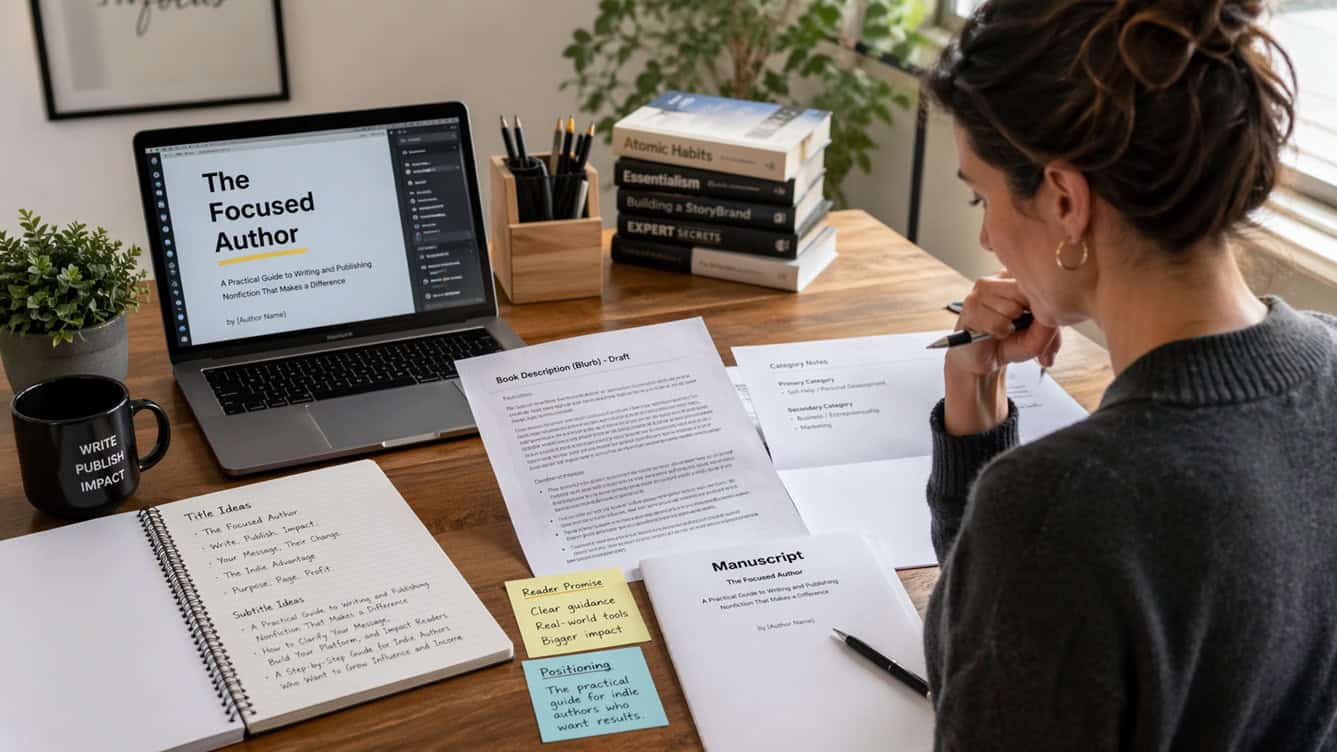
Quick Win: before creating major your book’s production assets, build a one-page production brief.
Include the following:
- What the book is
- What it promises
- Who it serves
- Strongest practical payoff
- Emotional or practical need it addresses
- Tone the packaging should reflect
- Expectations the book must meet
- How it differs from other similar books
Your book’s Production Brief becomes a filter for all subsequent decisions. It can help you test subtitle ideas, sharpen blurbs, compare hook lines, and evaluate categories and metadata.
It also reduces confusion because you no longer have to reinvent your production identity from scratch each time. You are working from a clear foundation.
Test Hooks for Fit
A strong hook creates interest quickly, but a misleading hook creates disappointment just as quickly.
That is why hooks should be tested for fit. A good hook should make the right reader feel understood and helped. It should point toward a real problem, a meaningful benefit, or a believable transformation. It should not rely on hype, inflated promises, or attention-grabbing language the book cannot support.
A simple test helps here. Ask yourself whether the hook would still feel fair after someone finishes the book. If the answer is no, revise it.
The best hook is the one that draws in the right reader most accurately by reflecting what the book truly offers.
Use AI as Your Book’s Production Assistant
AI can be very useful during production if you keep the task narrow and strategic.
For example, AI can help keep you in charge of the book’s identity in the following ways:
- Generate subtitle variations based on a clear promise
- Compare blurbs for clarity and reader appeal
- Flag wording that sounds vague or too broad
- Identify where a description feels generic
- Test whether hook lines match tone and benefit
- Surface repeated phrases across your metadata
The trouble starts when authors ask AI to invent the positioning for them. AI can produce clean-looking language, but it does not know your book better than you do. It can support the process, but it should not be the source of truth about what your book is.
Your manuscript remains the source of truth.
Think Clearly About Categories and Metadata
Categories, keywords, subtitle language, and positioning phrases all help readers find the book and understand where it fits. This is one of the most practical parts of production, but it still needs alignment.
The goal is clarity.
When your metadata reflects the book’s actual strengths, you make it easier for the right reader to find it. You also reduce confusion. A reader discovering your book through search or category browsing should be able to tell quickly what the book is about and why it matters to them.
Good metadata supports discoverability. Great metadata supports both discoverability and trust.
Look for White Space Without Forcing It
One smart production habit is looking for market white space.
That means noticing where your book offers a useful combination of qualities that feels distinct. Perhaps it blends practical habit change with emotional healing. Perhaps it combines parenting guidance with stress recovery. Perhaps it helps professionals navigate reinvention after burnout. The white space often lives in the overlap.
This helps you position the book more clearly without forcing it into a false niche.
Study comparable books to understand the signals readers already recognize. Notice the covers, subtitles, categories, and promises that show up repeatedly. Then ask where your book is genuinely different. Use those market signals for fluency, but do not lose your book’s true identity in the process.
Production Is Part of Authorship
One of the most helpful mindset shifts is seeing production as part of authorship rather than a chore tacked on at the end.
When your subtitle, cover, description, metadata, and categories reflect the real manuscript, you are helping the book reach the readers it was meant to serve. That is a professional act. It is also an act of respect for the work you have already done.
When production begins with alignment, other tasks become easier too. Launch planning becomes clearer. Content creation becomes more focused. Reader trust becomes easier to build and easier to keep.
Production is one way authorship becomes visible.
Turn Production Into a Trust-Building System
Professional production begins with a simple principle: the market-facing version of your book should tell the truth about the book itself.
When you align your book’s DNA with its presentation, your subtitle, blurb, categories, and metadata stop feeling like disconnected chores. They become tools for clarity, discoverability, and reader trust.
Start with your manuscript. Build a one-page production brief. Use that brief to test your subtitle, hook, description, categories, and keywords. Then compare each asset to the book’s real promise.
That one shift can prevent a great deal of confusion later and help your book make a stronger first impression with the readers it was written to help.
Checklist: Professional Production for Indie Authors
- Identify the manuscript’s real strengths before creating production assets.
- Describe what the book is, what it promises, and who it serves.
- Make sure the cover and description match the actual reading experience.
- Build a production brief before drafting blurbs or metadata.
- Use a testing process to refine multiple blurb versions.
- Check whether your hook matches tone, promise, and reader desire.
- Review subtitle and positioning language for clarity and accuracy.
- Choose categories and metadata that genuinely fit the book.
- Look for market white space without forcing an artificial niche.
- Study comparable books for signals.
- Treat production as part of authorship.
- Prioritize reader trust as much as discoverability.
We hope you’ve found the writer’s guide strategies useful and motivating. We hope they’ll equip you with the insights and tools needed to help you succeed as a new author.
For more guidance, see other writer’s guides in this series. We suggest starting with the first one, Use AI Without Losing Your Author Voice; 6 Best Hacks.
For all the writer’s guides in this series, along with several bonuses, grab our ebook: Write Smarter, Stay Human: Use AI Without Losing Your Voice, Values, or Vision (available on Amazon).
Writing is a journey of continuous learning and improvement. You don’t have to go it alone. We’re excited to continue the journey with you, providing guidance and encouragement every step of the way. Our goal is to provide essential insights and practical advice to help you navigate the writing world with increased confidence.
If you have a draft you want to publish and are wondering how AI can help, read: Is Your Book Ready to Self-Publish?
For help writing a nonfiction book, read Write Your First Nonfiction eBook: a 30-Day Workbook for Getting It Done.
Don’t wait. Start today!
How can we help? To let us know, please fill out our Contact form.
Happy writing!