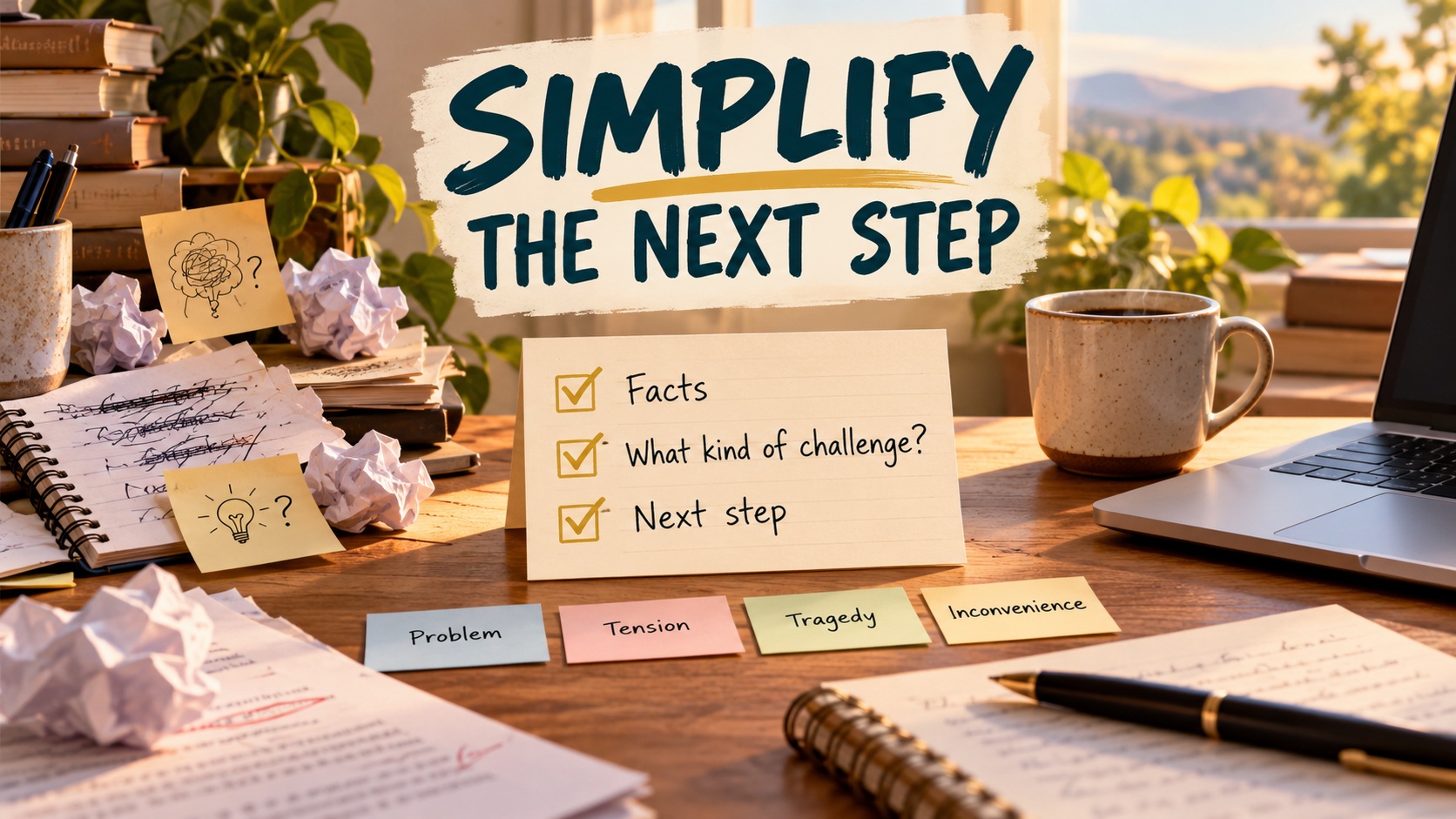
When Writing Gets Hard, Simplify the Next Step: 12 Best Tips
“The more precisely you define the problem, the more easily you can find a solution.” — James Clear
Writing and publishing a book can get complicated fast.
Your plot stops working. Your beta readers disagree. Your formatting software does something strange. Amazon rejects a file. Your cover doesn’t look right. Sales disappoint you.
Or maybe the problem has nothing to do with your book.
Family responsibilities increase. Your job gets demanding. Something unexpected happens that takes away the time, energy, or concentration you normally have for writing.
When several things hit at once, our natural response is often to make everything even more complicated. We research more. Worry more. Consider more possibilities. Make longer lists. Try to solve everything at once.
There may be a better approach.
Before the 2026 postseason, pitcher Tarik Skubal explained that as games become more meaningful, he goes back to what got him there in the first place. In another interview, he summed it up this way: “So, the bigger the game, the simpler my game gets on the mound.”
That idea to simplify applies surprisingly well to writing, publishing, and many of the challenges that can interfere with both.
When the challenge gets bigger, perhaps your next step should get simpler.
Start With What You Actually Know
Before deciding what to do, separate the facts from everything you’re adding to them.
Start with three steps:
- Get the facts or data.
- Make sense of what you know.
- Decide what to do and take the appropriate action.
That sounds obvious, but it can be difficult when you’re frustrated or worried.
Suppose your book isn’t selling.
The fact might be: I sold 12 copies this month.
The interpretation might be: My book is a failure.
The prediction might be: I’ll never be able to sell books.
Those are three very different things. The first is data. The second is an interpretation. The third is a prediction.
Before trying to solve a challenge, make sure you know which is which.
When something goes wrong, I try to figure out what I actually know before I start deciding what it means.
If a book isn’t selling the way I hoped, for example, I can look at the numbers first. How many books sold? Did anything change in my advertising, pricing, cover, description, or promotion?
I try not to jump immediately from “sales are lower than I expected” to “there must be something wrong with the book.”
Those are two different statements. The first is something I can verify. The second requires more information.
What Kind of Challenge Are You Facing?
James Clear once posed a useful question: Is this a problem you need to solve or a tension you need to learn to live with?
Psychologist Ellen Langer offers another: Is it a tragedy or an inconvenience?
Put those two questions together, and you get four useful ways of looking at challenges:
- A problem to solve
- A tension to live with
- A tragedy to work through
- An inconvenience to manage
They require different responses.
One principle applies to all four: Don’t do anything that unnecessarily complicates the situation.
Is It a Problem You Can Solve?
Many writing and publishing challenges really are problems.
- Your manuscript has a plot hole.
- Your EPUB contains formatting errors.
- Your cover text is difficult to read at thumbnail size.
- Your book description isn’t converting browsers into buyers.
Those problems have potential solutions.
But before you start fixing one, ask:
- What exactly is the problem?
- What outcome am I trying to achieve?
- What information do I need?
- What part of this is within my control?
- What is the smallest useful action I can take next?
- Could my solution create another problem?
That last question matters.
Solving one publishing problem sometimes creates another. Changing a title may improve discoverability while weakening its connection to the series. Adding more material to clarify a chapter may create pacing problems. Redesigning a cover may improve readability while making it less appropriate for the genre.
The goal isn’t necessarily to find the perfect solution.
It may be to find a good solution that doesn’t create unnecessary complications elsewhere, or create a whole new problem. Then solve the problem and move on.
When I run into a writing or publishing problem, I usually start by trying to make the problem smaller.
Instead of asking, Why isn’t this book working? I might ask whether the problem is the cover, description, categories, pricing, advertising, or something else.
Instead of asking, Why isn’t this chapter working? I might look at the scene and ask whether the problem is pacing, character motivation, conflict, point of view, or something else.
Once I can describe the problem more precisely, it usually becomes much easier to decide what to try next. I also try to avoid changing five things at once. If I do that and the situation improves, I won’t know which change helped.
Is It a Tension You Need to Live With?
Other challenges don’t disappear after you make the right decision.
Indie publishing is filled with ongoing tensions.
- You want to write the book you love, but you also want readers to buy it.
- You want professional quality, but you have a limited budget.
- You want to publish regularly, but you don’t want to rush your books.
- You want to use AI to make your work easier, but you don’t want it taking over your creative decisions.
- You want more writing time, but other parts of your life matter too.
Those are tensions you manage.
Ask:
- Can any part of this tension be reduced?
- What part do I need to accept?
- What makes the tension worse?
- Would a boundary help?
- What can I change?
- What do I need to stop trying to change?
- What helps me continue working well while the tension remains?
Sometimes the goal isn’t to eliminate the tension. The goal is to build a way of working that allows you to keep writing despite it.
What works for another writer may not work for you. One author may write 2,000 words every morning. Another may get 500 words written after dinner three nights a week. If both finish books, both systems work.
I’ve found that some parts of being an indie author never completely settle down.
There is always another book I could write, another article I could publish, another marketing idea I could try, another tool I could learn, or another improvement I could make.
Trying to do all of it would leave me with less time for the work that matters most.
So I try to decide what deserves my attention now and what can stay on the list for later. Sometimes that means accepting that something worthwhile simply isn’t going to happen yet.
The tension is still there. I just don’t have to respond to everything it presents me.
Is It a Tragedy?
Some life events are much bigger than writing. A death. A serious illness. A family crisis. A devastating loss.
At those times, completing the manuscript may no longer be the most important objective. And that is appropriate.
You may need to change the question from: How can I keep up with my writing schedule?
to: What do I need to do right now to get through this period without making things harder for myself?
That might mean:
- Reducing commitments.
- Accepting help.
- Protecting basic routines when you can.
- Postponing decisions that don’t need to be made immediately.
- Writing less.
- Temporarily not writing at all.
Eventually, writing itself may become helpful again. But there doesn’t need to be a deadline for that.
A tragedy can also create long-term tensions that remain after the immediate crisis has passed. You may have less time, different responsibilities, lower energy, or an entirely different perspective on what matters.
Your writing life may need to change with you.
When life becomes more important than the writing schedule, I think it helps to let the writing schedule change. That might mean doing less for a while, postponing a project, or setting writing aside temporarily.
I don’t think I have to overcome every interruption.
Sometimes the sensible response is to acknowledge that life has changed and adjust the work accordingly.
When things become more stable, I can decide what writing looks like from there instead of expecting myself to immediately return to the old routine.
Is It an Inconvenience?
This may be the category indie authors underestimate most. Something goes wrong, and because it interrupts what we wanted to do, it feels much bigger than it really is.
Your internet goes down. Your formatting software moves a heading somewhere you don’t want it.
KDP’s previewer finds something you have to fix. Your proof copy arrives later than expected. You lose an afternoon you planned to spend writing.
Annoying? Absolutely.
A catastrophe? Probably not.
Dr. Langer points out that many things we worry about are inconveniences, not tragedies. Simply making that distinction can change how we respond.
When something goes wrong, ask:
- How long is this likely to last?
- What happens if I simply wait?
- Is there a workaround?
- Can I do something else useful in the meantime?
- What is the actual cost of doing nothing right now?
- Am I making the inconvenience worse through frustration or overreaction?
Sometimes solving an inconvenience takes more time and energy than tolerating it would have.
You don’t have to fix everything that annoys you.
Publishing software has taught me quite a bit about inconveniences.
Sometimes something doesn’t behave the way I expect. A heading moves. Formatting changes. A preview looks strange. Something that should take five minutes suddenly takes much longer.
My first impulse can be to stop everything and fix it. But I’ve learned to ask whether I actually need to solve it right now. If I can work around it, continue with something else, or come back later when I have more patience, that may be the simpler choice.
Not every irritating thing deserves to become the most important thing on my schedule.
Decide What You Can Control
Once you’ve identified the kind of challenge you’re facing, ask another simple question:
What part of this is actually mine to do something about?
- You can’t control whether readers leave reviews.
- You can ask for reviews appropriately.
- You can’t control Amazon’s algorithms.
- You can improve your metadata, cover, description, and marketing.
- You can’t control whether everyone likes your book.
- You can make the book as good as you reasonably can and try to reach the readers most likely to enjoy it.
- You can’t control every disruption in your life.
- You can decide what writing looks like while you’re dealing with one.
This keeps your attention on actions, not outcomes you can’t guarantee.
I try to bring publishing decisions back to the part I can actually influence. I can’t make someone buy my book. But I can improve the cover, description, keywords, categories, pricing, or advertising.
I can’t make readers like a story.
But I can revise it carefully, get useful feedback, and make the book as strong as I reasonably can before publishing it. That distinction helps me decide where to spend my energy.
If I can’t control the outcome, I look for the next action I can control.
Watch Your Time Horizon
Another useful question is: When does this actually need to be solved?
Some things matter today. Some things matter this month. Some things only feel urgent because you’re thinking about them right now.
Ask yourself: What needs my attention today?
Then: What can wait?
Writers can spend hours solving next month’s problem while avoiding the 30-minute task that would move today’s book forward.
Know When You Have Enough Information
Research is useful. But so is stopping.
At some point, gathering more information doesn’t improve the decision. It simply delays it.
- You probably don’t need to read 47 articles before choosing a book trim size.
- You don’t need to compare every writing application ever created.
- You don’t need 25 opinions about your cover.
Gather enough information to make a reasonable decision. Make it. Then move forward.
This may be especially important now that AI can help me research almost anything. It is very easy to keep asking one more question and end up going down an information rabbit hole. (I’m guilty of this).
I can compare another tool. Look at another publishing strategy. Generate another possibility. Ask for another opinion.
Sometimes that helps. Too often, I’m simply delaying the decision.
At some point, I have to decide whether I know enough to take the next reasonable step. I can always change course later if new information gives me a good reason to do so (too often it does).
Reassess After You Act
Your first classification might be wrong.
Something that seems like an inconvenience may become a real problem. Something you keep trying to solve may reveal itself as an ongoing tension.
A problem you thought was enormous may turn out to require one email or a five-minute correction.
So after you take action, look again.
Did that help?
What changed?
What do I know now that I didn’t know before?
Then adjust.
Look for the Opportunity Afterward
Not every challenge needs a positive spin, especially tragedy. But ordinary problems, tensions, and inconveniences sometimes reveal useful information.
- Maybe the problem exposed a weakness in your publishing workflow.
- Maybe the interruption showed you that your writing schedule was too rigid.
- Maybe the failed book launch taught you something about positioning your next book.
- Maybe the software problem convinced you to create a checklist so you don’t have to figure it out again.
Once you’ve dealt with the immediate challenge, ask: What can I learn, change, or make easier next time?
That’s how one frustrating problem can improve your future process.
When I solve something that caused unnecessary trouble, I try to avoid solving the same problem from scratch next time.
That might mean adding a step to a checklist, changing part of my workflow (which I often do), saving instructions, creating a reusable prompt, or simply noting what worked.
One annoying publishing problem can sometimes become a better process for every book that follows.
When Things Feel Complicated, Simplify the Next Step
You don’t have to solve your entire writing career today. You don’t have to know how every part of your publishing journey will turn out.
And you certainly don’t have to solve all of life’s problems before you’re allowed to write another book.
When something gets difficult, bring your attention back to what is actually in front of you:
- What are the facts?
- What kind of challenge is this?
- What is within my control?
- What is the simplest useful thing I can do next?
- What should I avoid doing that could make it worse?
- What happened after I acted, and do I need to adjust?
That’s a much smaller job. And when the situation feels especially big, making the job smaller may be exactly what helps you move forward.
We hope you’ve found the writer’s guide strategies useful and motivating. We hope they’ll equip you with the insights and tools needed to help you succeed as a new author.
Another article you might find helpful is Making Decisions Without Waiting for AI Certainty.
You might also enjoy some of our books:
AI Future Ready Skills for Indie Authors
Amazon KDP Made Easy: A Simple, Stress-Free System to Self-Publish Your First Book on Amazon
Writing is a journey of continuous learning and improvement. You don’t have to go it alone. We’re excited to continue the journey with you, providing guidance and encouragement every step of the way.
Our goal is to provide essential insights and practical advice to help you navigate the writing world with increased confidence.
If you have a draft you want to publish and are wondering how AI can help, read: Is Your Book Ready to Self-Publish?
Don’t wait. Start today!
How can we help? To let us know, please fill out our Contact form.
Happy writing!