Legacy Architect: Build a Durable Author Business with 5 Hacks
“AI is the new electricity.” — Andrew Ng, computer scientist and entrepreneur
Most indie authors spend their time trying to finish, publish, and promote the book. That makes sense. There is always something urgent to do.
What often gets overlooked is a bigger question. “If your tools changed tomorrow, if you had to step away for a while?” Or “if someone else needed to understand your business, would what you have built still hold together?”
That question is not only for large publishers or seasoned entrepreneurs. Durability matters more than most authors realize. It matters to any serious indie author who wants to build something worth keeping. A durable author business is easier to manage, protect, and grow. It also creates less stress because you are no longer depending so heavily on memory, scattered files, or fragile tool setups.
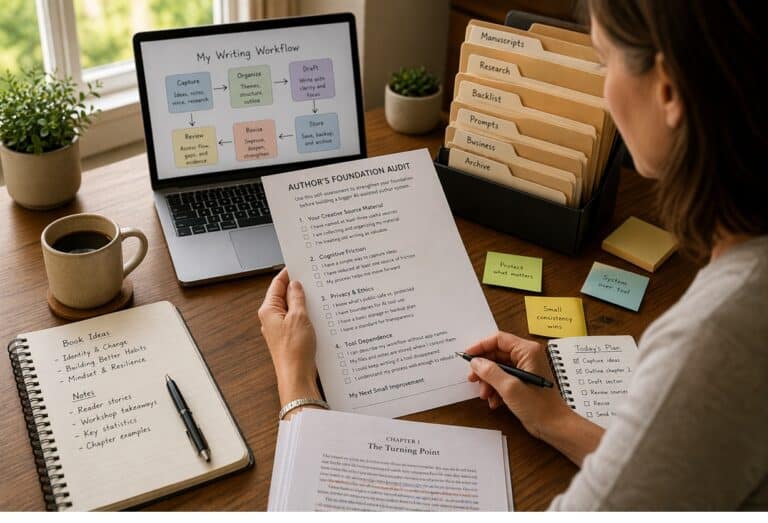
This part of our writer’s guide series on AI Author Systems will help you think more like a legacy architect. That means building a business that is portable, documented, reviewable, and resilient enough to handle change.
For more guidance, see other writer’s guides in this series. We suggest starting with the first one, Use AI Without Losing Your Author Voice; 6 Best Hacks.
What a Legacy-Minded Author Business Looks Like
A durable author business is built with a longer horizon in mind.
Instead of organizing everything around one launch, one platform, or one frantic season of output, you start treating your prompts, workflows, files, assets, and processes as parts of a real structure. You build in ways that can withstand tool changes, business growth, and everyday interruptions.
For nonfiction indie authors, the business usually grows in layers. One book leads to another. A checklist becomes a reader magnet. A framework becomes a workshop. A blog series becomes a book. A workbook, article library, or course may grow out of material that began in a manuscript draft.
The more that grows, the more important it becomes to create order that can outlast your memory.
A practical author business should not depend entirely on you remembering where everything is, how every process works, or which tool currently holds a critical asset.
Start by Seeing Your Author Business as a System
One reason authors delay this kind of thinking is that their business still feels small or personal. They may think system-building is something to worry about later.
In reality, stewardship starts early.
Even one book can involve manuscripts, covers, metadata, launch materials, prompts, email assets, downloadable resources, financial notes, and platform accounts. That is already a system. The question is whether it is a clear system or a fragile one.
A stronger mindset is to stop asking only, “How do I get this done?” and start asking, “How do I make this repeatable, understandable, and easier to protect?”
That shift changes a great deal. It moves you from informal habit toward a durable structure.
Quick Win: document one recurring process. Choose one recurring task in your author business and write the steps once in plain language.
For example, you might document how you:
- Draft blog posts
- Update metadata
- Create launch emails
- Build a companion workbook
- Prepare article prompts
- Organize book assets after publication
This does not need to be elegant. It just needs to be clear enough that you or someone else could follow it later.
That one small act begins the shift from carrying everything in your head to building a business that can actually hold together over time.
Why Portability Matters
AI tools change. Platforms change. Interfaces change. File locations change. Subscriptions come and go. If your business depends too heavily on one tool or one dashboard, you may be more vulnerable than you realize.
Portability means your core work can move.
That includes things like:
- storing important files in usable formats
- saving prompts somewhere you control
- keeping key assets from being trapped inside one platform
- making sure descriptions, launch emails, metadata notes, and content plans can be found and reused without rebuilding them from scratch
Convenience often creates dependence. A tool that saves time today can become a problem tomorrow if you have no clean way to export, back up, or recreate the work elsewhere.
Portability is really about resilience.
Ask the Tool-Dependency Question
A useful yearly question is this: if this tool disappeared next month, what would I lose, and how quickly could I recover?
That question reveals weak spots fast.
Maybe your prompts live only inside one chat history. Maybe your cover files are scattered. Maybe your category research is saved nowhere reliable. Maybe your article-production workflow exists only in your head. These are common problems, and they are fixable once you can see them clearly.
The goal is practical resilience.
Create a Simple System Manual
Many authors carry too much of their business in their heads. That works until life gets busy, a collaborator joins the business, a password goes missing, or a project sits untouched long enough for the details to blur.
A simple system manual helps solve that problem.
This can begin as one working document with clear headings. Its purpose is to explain how your author business operates in practical terms.
It may include:
- Where you store manuscripts
- How you name files
- Where cover files live
- Which prompts you rely on most
- How you manage your email list
- Which platforms matter most
- How you track keywords and categories
- Where financial, licensing, or royalty notes are stored
- Which tasks happen monthly, quarterly, or annually
For now, usefulness matters more than perfection. A basic manual that exists is far more valuable than the perfect one you never create.
Think About Transfer
One sign of a durable business is that someone besides you could make sense of it if necessary. That strengthens continuity.
If you became sick, took an extended break, hired an assistant, or needed a family member to help with practical matters, would there be enough documentation for that to happen without chaos? For most indie authors, this is not about handing over creative control. It is about reducing avoidable confusion.
A few simple documents can make a big difference:
- Core platforms listed
- Login-location guidance
- Publishing-process notes
- Recurring expense notes
- Where major files and assets live
- Which books connect to which bonuses or support tools
This is also where the idea of intellectual property becomes practical. Your books, files, rights, royalties, and related assets are real parts of the business. Treating them that way is part of becoming more professional.
Pro Tip: review and clean up once a year. At least once a year, step back and ask:
- Which tools still serve me well?
- Which prompts are outdated?
- Which files need backup or better organization?
- Which processes have become cluttered?
- Where am I carrying unnecessary complexity?
This kind of review matters even more in AI-supported workflows, as tools and habits can quickly become outdated. A prompt that worked beautifully a year ago may now be bloated, redundant, or tied to a tool you no longer use.
A yearly cleanup prevents slow drift into confusion.
In most cases, you are simplifying, clarifying, backing up, and documenting.
Protect What Is Worth Keeping
At the center of this whole conversation is one simple idea: build in a way that protects what matters.
That includes your manuscripts, your backlist, your rights, your prompts, your systems, your reader relationships, and the intellectual property you may keep using for years. It also includes your time and mental energy. A fragile business drains both. A well-documented one gives some of that energy back.
Legacy begins the moment you start treating your work as something worth preserving, organizing, and passing forward.
That is true whether you have one practical guide in progress or a growing catalog of books, articles, tools, and reader resources.
Build Resilience One Layer at a Time
A resilient author business is portable, documented, and built to survive change.
You do not need a huge operations manual this week. You do not need perfect systems before moving forward. You only need a clear next step.
Choose one part of your business that exists mostly in your head and document it. Back up one critical asset. Export one prompt set. Create a one-page explanation of how an important process works.
That is how resilience gets built. One practical layer at a time.
The result is better organization. It’s also greater continuity, less confusion, and a business that is easier to manage and protect as your work grows.
Checklist: Legacy Architect for a Durable Author Business
- Think beyond the next launch and consider long-term durability.
- Identify which parts of your author business depend heavily on one tool or platform.
- Back up critical files in formats you can access later.
- Save important prompts, templates, and workflows in a location you control.
- Create a simple system manual with clear headings.
- Document where manuscripts, cover files, metadata, and business assets are stored.
- Make it easier for a trusted helper to understand your business if needed.
- Treat books, rights, royalties, and intellectual property as real assets.
- Review your tools and workflows at least once a year.
- Clean up outdated prompts, cluttered processes, and fragile dependencies.
- Strengthen portability rather than relying solely on convenience.
- Build for continuity.
We hope you’ve found the writer’s guide strategies useful and motivating. We hope they’ll equip you with the insights and tools needed to help you succeed as a new author.
For more guidance, see other writer’s guides in this series. We suggest starting with the first one, Use AI Without Losing Your Author Voice; 6 Best Hacks.
For all the writer’s guides in this series, along with several bonuses, grab our ebook: Write Smarter, Stay Human: Use AI Without Losing Your Voice, Values, or Vision (available on Amazon).
Writing is a journey of continuous learning and improvement. You don’t have to go it alone. We’re excited to continue the journey with you, providing guidance and encouragement every step of the way. Our goal is to provide essential insights and practical advice to help you navigate the writing world with increased confidence.
If you have a draft you want to publish and are wondering how AI can help, read: Is Your Book Ready to Self-Publish?
For help writing a nonfiction book, read Write Your First Nonfiction eBook: a 30-Day Workbook for Getting It Done.
Don’t wait. Start today!
How can we help? To let us know, please fill out our Contact form.
Happy writing!