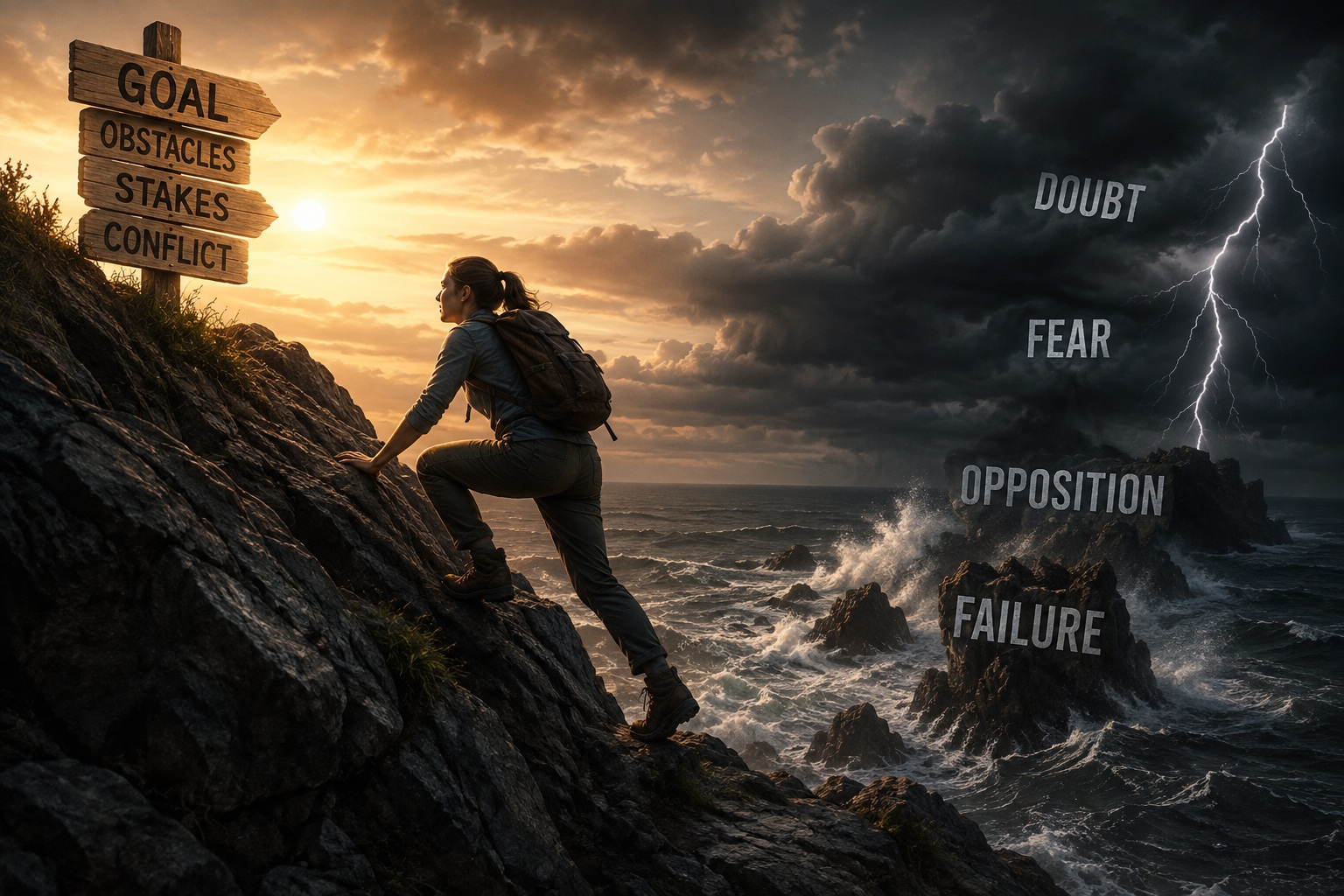
Strengthen Goals, Stakes, and Conflict: Best Hacks
“The greater the obstacle, the greater the glory in overcoming it.” — Molière
You can create a character you understand deeply and still have a story that feels strangely flat.
The protagonist may be interesting. Her history may make sense. Her relationships may have emotional depth. But if she has no strong reason to act, the story can drift.
That is where goals, stakes, and conflict begin to matter. These elements create story pressure. They give the character something meaningful to pursue, something that interferes, and a reason the outcome matters.
AI can help you test that pressure.
The useful question is not, “How can I make this more dramatic?”
It is, “Where is the story not making the character work hard enough for something that matters?”
Start With What the Character Wants
A character may have many goals. They can want many things.
She may want to be loved, feel safe, prove herself, protect her family, escape responsibility, earn respect, or belong somewhere. Those desires can shape the character, but they do not always create immediate action.
For story purposes, it often helps to ask what the character is trying to accomplish now.
Maybe she wants to repair a damaged relationship. Solve a problem. Keep a secret. Win something. Stop something. Find someone. Protect what she already has.
The goal does not need to remain identical throughout the entire novel. Circumstances can change. New information can change what the character thinks she needs. What matters is that the character has enough direction to make choices.
If the protagonist mostly reacts to whatever happens around her, AI can help you examine whether the goals are too vague.
You might ask:
- What does my protagonist appear to be trying to accomplish?
- Is that goal clear enough to influence her decisions?
- Where does she act because of the goal rather than simply respond to events?
- Does the goal seem specific, or is it still a broad desire?
- What information are you assuming that I did not actually provide?
Those questions do not tell you what the character should want. They help you see whether what you have already created gives her enough reason to act.
Make the Obstacle Actually Interfere
An obstacle is not simply something unpleasant that happens. It needs to interfere with what the character goals. That is, with what she’s trying to accomplish.
A bad day may frustrate her. An annoying person may irritate her. An unexpected delay may be inconvenient. But if none of those things meaningfully complicate the goals, they may not create much story pressure.
Resistance can come from many places:
- another person;
- an institution or system;
- the environment;
- limited resources;
- competing responsibilities;
- incomplete information;
- social expectations;
- the protagonist’s own beliefs, fears, or choices.
The obstacle also needs enough strength to matter.
If the character can solve every problem immediately, the reader has little reason to worry about what happens next. That does not mean every obstacle must be enormous.
A relatively small obstacle can matter when it blocks something important, creates a difficult tradeoff, or forces the character to change her approach.
AI can be useful for spotting obstacles that look stronger on the page than they really are. The point is to make sure the problems already present actually matter.
You might ask:
- Which obstacles currently seem easy to solve?
- Where does the protagonist have an obvious solution she is not using?
- Which complications genuinely interfere with the goal?
- Which ones are merely inconvenient?
- Does the same type of obstacle repeat without changing the situation?
Make the Stakes Matter to This Character
Writers sometimes hear “raise the stakes” and assume the story needs more danger.
That can lead quickly to bigger villains, disasters, threats, betrayals, or life-and-death consequences. Sometimes those belong in the story. Sometimes they do not.
Stakes answer a simpler question: Why does the outcome matter?
The answer depends on the character and the kind of novel you are writing.
Stakes may be:
- emotional
- relational
- moral
- social
- professional
- financial
- practical
- physical
Losing someone’s trust may matter more in one story than surviving an explosion would in another. A romance can have powerful stakes without anyone’s life being threatened. So can a family drama, cozy mystery, or coming-of-age story.
Scale matters less than meaning. Ask:
- What changes if the character succeeds or fails?
- What does she stand to lose?
- What might she have to give up?
- Who else could be affected?
- What belief, relationship, identity, responsibility, or future is tied to the outcome?
AI can help identify vague stakes by asking questions such as:
- What appears to matter most to this character?
- Are the consequences specific enough to understand?
- Which stakes seem generic rather than personal?
- Would failure actually change anything important?
- Are the stakes appropriate to this story, or do they feel artificially inflated?
That last question can be especially helpful. A story does not become stronger merely because the consequences become more extreme.
Understand Internal and External Conflict
External conflict comes from forces that interfere with the character from outside.
Another person may want something incompatible. A rule may prevent action. Circumstances may create limits. The environment may make success difficult.
Internal conflict happens when the difficulty exists inside the character’s own decision-making.
- She may want two incompatible things.
- She may value honesty but fear what the truth will cost.
- She may want independence while also wanting closeness.
- She may know what she should do but resist doing it.
Internal conflict does not require trauma, and it does not need to become a psychological diagnosis. It simply means the character has something meaningful pulling her in more than one direction.
Internal and external conflict can strengthen each other.
An external problem may force the character to confront an internal contradiction. An internal fear may make an external obstacle harder to overcome.
That combination can create stronger pressure because solving the problem is no longer only about what happens outside the character.
AI can help you examine whether those pressures connect.
You might ask:
- What external force currently blocks the protagonist?
- What internal concern makes that obstacle harder?
- Are the internal and external conflicts related, or do they feel disconnected?
- Is the character facing a genuine choice between competing values, needs, or consequences?
The goal is to notice where meaningful conflict may already exist.
Let Choices Become Harder
Story pressure weakens when the same problem keeps happening in slightly different forms.
The protagonist tries something. It fails. She tries almost the same thing again. It fails again.
Technically, the story contains conflict. But the pressure may not be changing. Escalation does not always mean “bigger.”
It can mean:
- fewer good options;
- higher personal cost;
- more complicated consequences;
- increased responsibility;
- conflicting obligations;
- lost opportunities;
- damaged trust;
- less time;
- incomplete information;
- a choice that solves one problem while creating another.
The important question is whether each major difficulty changes the situation.
- Does the character learn something?
- Lose something?
- Commit more deeply?
- Narrow her options?
- Create a consequence she now has to manage?
If the story keeps returning to the same problem in essentially the same form, AI can help you see that pattern.
Ask:
- Does each major complication change the situation?
- Are the character’s choices becoming harder?
- Do consequences carry forward?
- Are options narrowing or costs increasing?
- Where does the conflict repeat rather than develop?
Those questions help you test pressure without asking AI to build the plot for you.
Don’t Let AI Inflate the Story
AI can identify weak pressure and then overcorrect.
- If you tell it the stakes feel low, it may suggest a kidnapping.
- If conflict feels weak, it may recommend betrayal.
- If the protagonist’s goal seems too easy, AI may introduce a villain, deadline, disaster, or secret.
Those suggestions are not automatically wrong. They are also not automatically better.
I have found this distinction useful in my own work: AI may correctly identify something as weak while offering a solution that doesn’t fit the story I want to tell.
Keep the diagnosis separate from the proposed fix.
If AI says the character faces no meaningful consequences, examine the consequences. If it says the obstacle is too easy, examine the obstacle.
You do not have to adopt the dramatic event it invents next. Sometimes the better solution is quieter and more personal.
A relationship may become harder to repair. A choice may cost the character trust. A responsibility may become impossible to avoid.
Stronger pressure means more meaningful difficulty, not necessarily more spectacle.
Try a Story Pressure Check
Choose one major story problem.
Write down five things:
- What does my protagonist want right now?
- What meaningfully prevents success?
- Why does the outcome matter?
- What internal pressure makes the situation harder?
- How does the difficulty change or increase?
Then give those answers to AI and ask it to evaluate the pressure without inventing new plot events.
You could try:
Help me evaluate the story pressure in this situation without redesigning the plot. Look for vague goals, weak resistance, generic stakes, disconnected internal and external conflict, repeated obstacles, or consequences that do not meaningfully change the situation. Tell me which conclusions come from information I provided and which are your own inferences. Do not suggest new plot events unless I ask.
Review the response in three groups:
- Accurate
- Worth considering
- Doesn’t fit my story
Pay special attention to anything AI says is too easy, too vague, repetitive, or disconnected. Then decide whether the underlying problem is real before considering any proposed solution.
Goals, Stakes, and Conflict Are Not the Plot
At this point, you are still working with the forces that create story movement. You are not yet deciding exactly where every major event belongs.
Plot architecture asks different questions:
- What causes what?
- How do major events connect?
- Where does the story turn?
- What needs setup?
- What needs payoff?
- Does the sequence hold together?
Those questions belong in the next step.
For now, ask whether your character has something meaningful to pursue, whether resistance makes success difficult, and whether the outcome matters enough to affect her choices.
Strong conflict is not simply more danger, more arguing, or more obstacles. It comes from meaningful opposition.
The character wants something. Something genuinely interferes. The consequences matter. And as the story develops, the choices become harder.
AI can help you identify where that pressure weakens. You still decide what belongs in the story.
Watch for our next article in our series on craft and story development, we’ll take those story forces and examine how to build a plot that holds together.
Action Steps
- Clarify what your protagonist wants. State the character’s immediate goal in plain language and make sure it is specific enough to create direction.
- Identify what stands in the way. List the strongest internal and external obstacles preventing the character from reaching that goal.
- Test why the outcome matters. Ask what the character stands to lose, protect, risk, or change if the goal is not achieved.
- Use AI to stress-test the conflict. Ask AI where the goal, obstacles, or stakes feel weak, repetitive, or too easily resolved, then decide which findings genuinely strengthen the story.
For more guidance, see other writer’s guides in our series on craft and story development. We suggest starting with the first one, Use AI Without Giving Up Your Story.
We hope you’ve found the writer’s guide strategies useful and motivating. We hope they’ll equip you with the insights and tools needed to help you succeed as a new author.
You might also enjoy some of our books available on Amazon:
AI Future Ready Skills for Indie Authors
Amazon KDP Made Easy: A Simple, Stress-Free System to Self-Publish Your First Book on Amazon
Writing is a journey of continuous learning and improvement. You don’t have to go it alone. We’re excited to continue the journey with you, providing guidance and encouragement every step of the way. Our goal is to provide essential insights and practical advice to help you navigate the writing world with increased confidence.
Don’t wait. Start today!
How can we help? To let us know, please fill out our Contact form.
Happy writing!