Making Decisions Without Waiting for AI Certainty
“Plans are nothing; planning is everything.” — Dwight D. Eisenhower
If you use AI in your writing or publishing business, you may feel as if the ground keeps shifting beneath you. Platforms change their rules. Copyright questions remain unsettled. New AI tools appear almost weekly. One expert says one thing, another says the opposite, and sometimes both seem reasonable. Making decisions comes to a standstill.
It is tempting to think the answer is to keep researching until the uncertainty disappears. The problem is that it may not disappear anytime soon.
I find it more useful to think of AI as a tension to live with.
A problem implies that, with enough information or effort, you can solve it and move on. An inconvenience is annoying, but you can usually work around it. A tragedy involves unavoidable loss. A tension is different. Two or more legitimate values pull against each other, and the tension may never be permanently resolved. Making decisions in that tension may seem impossible.
AI Creates Tensions, Not Just Problems
For indie authors, some of those tensions might look like this:
- Efficiency and human authorship
- Innovation and protection of creative work
- Experimentation and legal uncertainty
- Using powerful tools and preserving your individual voice
- Moving forward and avoiding unnecessary risk
You do not solve those tensions once and for all. You manage them over time. That means the goal is to make responsible decisions based on the information you have now, then keep moving.
1. Decide What Actually Needs Decisions Now
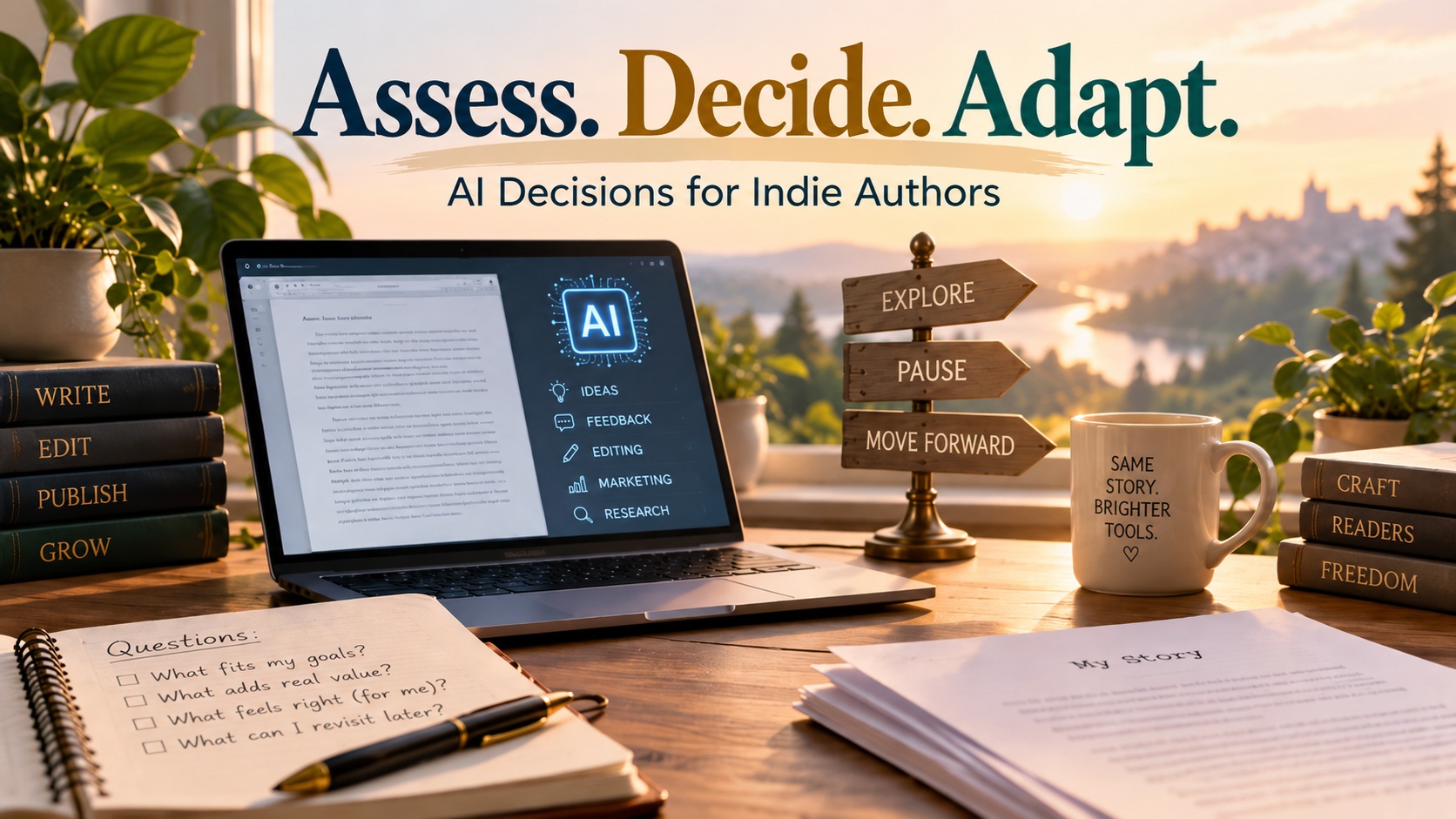
Do not try to answer a question as large as, “What should my permanent position on AI be?” That question is so broad that it can leave you stuck. A specific question turns a huge philosophical debate into manageable publishing decisions.
Instead, narrow the decision:
- Should I use AI to help analyze this manuscript?
- Should I use an AI-generated image on this book cover?
- Should I use AI to brainstorm alternatives for this scene?
- Does this particular use need to be disclosed to the platform where I publish?
2. Separate What You Know from What You Do Not Know
I would mentally sort the information into three buckets.
Known: Current platform rules, current official guidance, what you actually did with AI, and how the tool affected your work.
Reasonably inferred: Where the industry appears to be heading, likely risks, and how readers or publishing partners may respond.
Unknown: Future court rulings, future Amazon policies, future copyright rules, and what AI technology will look like several years from now.
Make today’s decision primarily from what you know and what you can reasonably infer. Don’t build your entire decision around information that doesn’t exist yet.
3. Ask What Happens If You Are Wrong
This is one of the most useful questions you can ask because not every AI decision carries the same level of risk.
Some choices are easy to reverse. If an AI workflow is not helping you, you can stop using it. If a brainstorming method produces weak ideas, you can discard them.
Other choices may be harder to undo. Publishing material whose copyright status is uncertain, violating a distributor’s rules, or releasing something that could damage reader trust deserves more caution.
Ask yourself: If this turns out to be the wrong decision six months from now, how difficult will it be to undo?
The harder the decision is to reverse, the more carefully I would make it.
4. Choose a Reasonable Position, Not a Perfect One
At some point, additional research produces diminishing returns. You can spend hours reading opinions and still end up with uncertainty.
What you need is enough information to say: Given what I know today, this choice is responsible, defensible, and consistent with how I want to work.
That is different from saying you are absolutely certain the decision is correct. Certainty may not be available. A thoughtful, defensible decision usually is.
5. Decide What Would Make You Reconsider
This step can keep you from reopening your entire AI policy every time you see a new headline, lawsuit, YouTube video, social media argument, or platform rumor.
Before you move on, identify the kinds of changes that would genuinely matter to your decision. For example, you might decide to reconsider if:
- A platform you use changes a rule that directly affects your books.
- Copyright law or official guidance materially changes.
- A court ruling changes the legal landscape in a way that applies to your work.
- The technology changes enough that the assumptions behind your decision are no longer true.
- You discover that a particular AI use conflicts with your values, your voice, or the trust you want to maintain with readers.
Now you have a reason to revisit the decision. Until one of those conditions occurs, you can keep working instead of reconsidering everything every week.
Not Every AI Issue Is the Same Kind of Issue
It also helps to distinguish among the kinds of situations AI creates:
Tension: How much AI involvement still allows the work to feel genuinely yours?
Problem: A publishing platform changes a requirement. You determine the new requirement and comply.
Inconvenience: A tool changes its interface, and you have to learn a new workflow.
Risk: Copyright guidance is uncertain, so you preserve drafts and records of your creative process.
Those situations call for different responses. Treating every change as a crisis wastes energy you could be using to write, revise, publish, and build your author business.
A Simple Decision Rule
If I reduced the whole process to one question, it would be: Based on what I reasonably know today, what choice lets me continue moving forward while protecting the things that matter most?
For an indie author, those things might include your authorship, your readers’ trust, the quality of the finished book, compliance with publishing rules, and your ability to keep creating. Then decide, get back to the work, and stay willing to change when something material changes.
Action Steps for Decisions
Use these steps the next time an AI question threatens to stall your writing or publishing progress.
- Define the specific decision you need to make now.
- Separate what you know, what you can reasonably infer, and what remains unknown.
- Consider how difficult the decision would be to reverse if you are wrong.
- Choose the most responsible and defensible option based on today’s information.
- Write down what kind of new information would justify revisiting the decision.
- Then return to your writing or publishing work.
Learn to Live with the Tension
AI will keep changing. Publishing rules will keep changing with it. Waiting for every legal, ethical, technical, and business question to be settled before you move forward could mean waiting for years.
And the phrase “a tension to live with” is a useful concept for indie authors. It gives you permission to stop waiting for the AI issue to be completely settled before you continue writing and publishing.
We trust you’ve found this writer’s guide both enlightening and inspirational. It’s designed to equip you with the tools and insights to bolster your success as a burgeoning author.
Another article you might find helpful is “When Writing Gets Hard, Simplify the Next Step.”
You might also enjoy some of our books:
AI Future Ready Skills for Indie Authors
Amazon KDP Made Easy: A Simple, Stress-Free System to Self-Publish Your First Book on Amazon
The path of writing is one filled with ceaseless learning and enhancement. You are not expected to tread this path solo. We’re thrilled to accompany you on this journey, offering support and motivation at every turn. Our objective is to deliver foundational knowledge and pragmatic guidance, enabling you to traverse the literary landscape with amplified confidence.
How can we help? To let us know, please fill out our Contact form. Happy writing!